For a small business, email is more than a way to send and receive messages. It is part of your brand identity, customer communication, sales process, internal collaboration, and day-to-day operations. That is why choosing the right email hosting for small business can have a much bigger impact than simply comparing the price per mailbox.
A professional address such as sales@yourcompany.com or support@yourcompany.com creates a very different impression from a generic personal address. Modern business email hosting also needs to provide reliable delivery, strong security, sufficient storage, easy administration, and room to scale as your team grows. Current 2026 guides similarly emphasize custom domains, security, storage, support, scalability, and productivity features when evaluating small-business email providers.
But with dozens of email hosting providers offering different combinations of features and pricing, how do you determine which solution is actually right for your business? This guide explains the most important factors to evaluate before choosing an email hosting provider in 2026.
Email hosting for small business is a service that allows a company to send, receive, and store business emails using its own domain rather than relying on a free consumer email address.
For example:
The email hosting provider manages the underlying infrastructure required to deliver and store these messages.
Depending on the provider, business email services may also include calendars, contacts, file storage, collaboration tools, administration controls, spam filtering, security features, and other productivity capabilities.
The important distinction is that email hosting and web hosting are not necessarily the same thing. A company can host its website with one provider while using a completely different provider for business email.
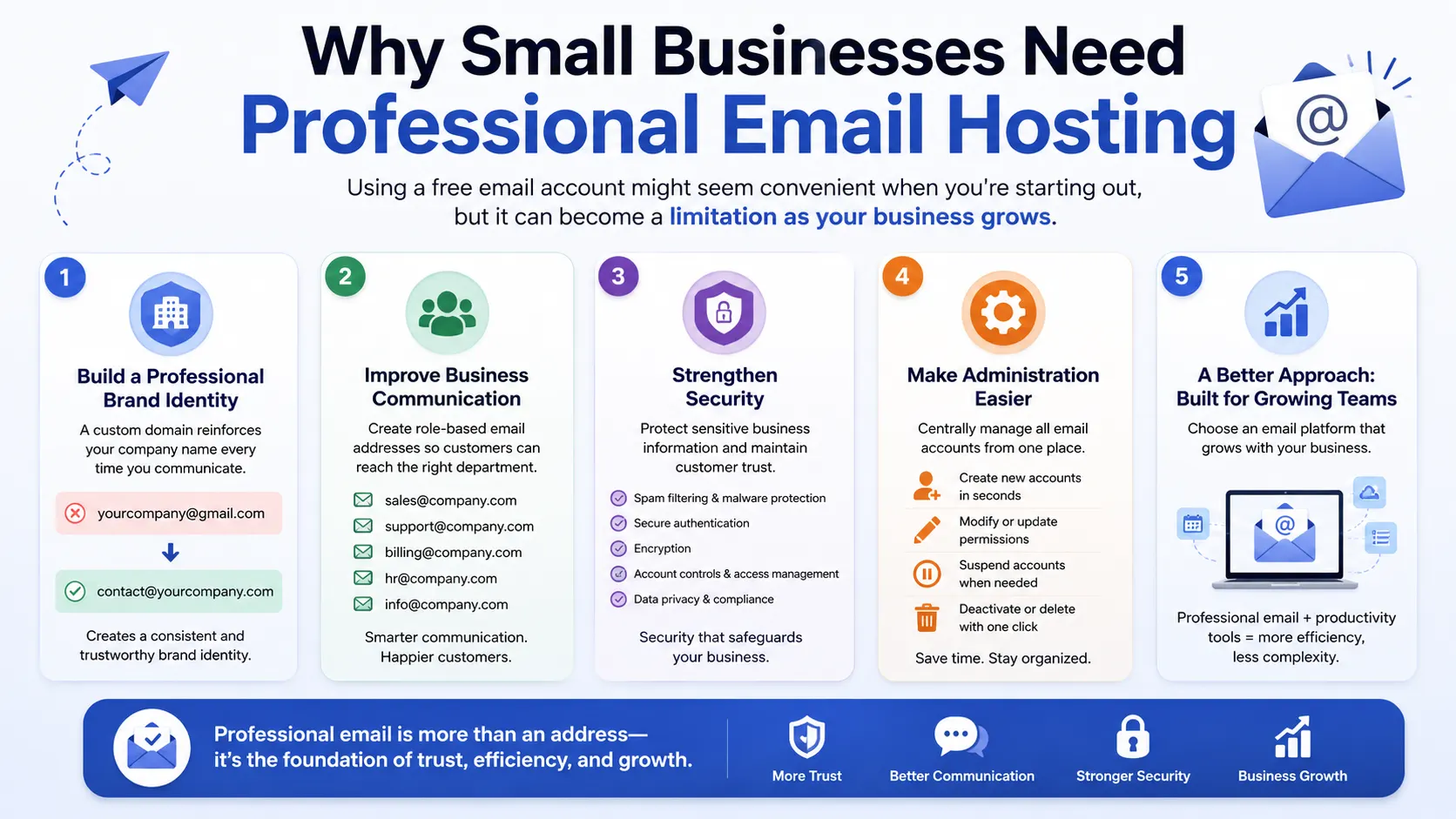
Using a free email account might seem convenient when you're starting out, but it can become a limitation as your business grows.
A custom domain reinforces your company name every time you communicate with a customer, supplier, partner, or prospect.
Instead of:
yourcompany@gmail.com
you can use:
contact@yourcompany.com
This creates a consistent digital identity across your website, email communications, invoices, proposals, and marketing materials.
Professional email hosting makes it easier to create role-based addresses such as:
This allows customers to contact the appropriate department without relying on individual employee addresses.
Business email accounts can contain contracts, invoices, customer information, credentials, financial documents, and other sensitive information.
A suitable provider should therefore offer protections such as spam filtering, malware detection, secure authentication, encryption, account controls, and other security mechanisms.
When employees join or leave your organization, administrators need to create, modify, suspend, or delete accounts quickly.
A centralized administration system makes this much easier than managing individual personal email accounts.
For small businesses, choosing an email platform is also a decision about how the company will manage communication as it grows. A solution that provides professional domain-based email while also supporting everyday business productivity can reduce the need to manage multiple disconnected tools.
This is where Mailz can be a practical option for growing businesses. Rather than focusing only on mailbox hosting, Mailz combines professional business email with a broader business workspace, giving teams a centralized environment for communication and productivity. This approach can be particularly useful for companies that want to establish a professional email presence today while keeping room for additional business collaboration needs as the organization expands.
Not every provider is designed for the same type of business. Before choosing one, evaluate these factors.
This should be one of your first checks.
Your provider should allow you to use your own domain and create professional addresses for employees and departments.
Look for support for:
If you are planning to build a recognizable brand, custom domain email should be considered a fundamental requirement rather than an optional feature.
An email platform is only useful if your messages consistently reach their intended recipients.
Ask potential providers about:
You should also check whether the provider supports modern email authentication standards such as SPF, DKIM, and DMARC.
These technologies help authenticate legitimate email and reduce the risk of spoofing and fraudulent messages.
Security should never be sacrificed simply because you're a small business.
A secure email hosting solution should ideally provide features such as:
The provider should also have a clear approach to protecting customer data and maintaining its infrastructure.
Storage requirements vary considerably between businesses.
A consulting company sending mostly text messages may require relatively little storage, while a design agency or legal firm may receive large attachments every day.
Before selecting a plan, consider:
| Requirement | What to Evaluate |
|---|---|
| Mailbox storage | Storage available per user |
| Attachments | Maximum attachment size |
| Archive | Whether older emails can be retained |
| Search | Ability to quickly find historical messages |
| Expansion | Whether storage can be increased |
| Shared storage | Whether teams can share files or resources |
Don't simply choose the provider offering the largest number. Choose storage based on your actual business requirements.
Small businesses often don't have a dedicated IT administrator.
That makes a simple control panel extremely important.
You should be able to easily:
A complicated administration interface can create unnecessary operational overhead.
Your employees should be able to access business email from the devices they actually use.
Check compatibility with:
Mobile access is particularly important for salespeople, managers, consultants, and employees who frequently work outside the office.
A business may start with five employees and grow to 50 or 500.
Your email provider shouldn't become a limitation when that happens.
Consider:
The best solution isn't necessarily the cheapest plan today. It is the one that remains practical as your organization grows.
This is where modern business email platforms are moving beyond traditional inboxes.
Depending on your business requirements, you may want email integrated with:
A unified business workspace can reduce the need to switch constantly between disconnected applications.
When business email stops working, the consequences can be immediate.
Imagine your sales team being unable to send proposals or your support department losing access to customer messages.
Before purchasing, investigate:
Support can be particularly important for small businesses without an internal IT team.
Don't evaluate providers solely on their advertised starting price.
Check the total cost of ownership.
Your actual cost may depend on:
Some providers position email as a standalone service, while others bundle it into broader productivity suites. Current small-business comparisons similarly recommend first deciding whether you need standalone email or a complete productivity suite.
For a serious business, professional email hosting is generally the better long-term choice.
| Feature | Free Personal Email | Business Email Hosting |
|---|---|---|
| Custom domain | Usually limited/not included | Yes |
| Professional identity | Limited | Strong |
| Central administration | Limited | Yes |
| Employee management | Poor | Designed for businesses |
| Security controls | Basic | Advanced options |
| Scalability | Limited | Designed to scale |
| Business support | Limited | Usually available |
| Collaboration | Varies | Often available |
| Brand consistency | Low | High |
A free account may be acceptable for personal communication, but businesses handling customer relationships, sales, financial information, and internal operations need greater control.
This is one of the most important decisions to make in 2026.
Choose this if your primary requirement is:
It can be a cost-effective option for businesses that already use separate productivity tools.
A broader business workspace combines email with other productivity and collaboration capabilities.
This can make sense when a business wants to bring several everyday communication and productivity functions into one environment.
For example, a growing company may prefer a platform where email, contacts, calendars, collaboration, and other business functions can be managed together rather than maintaining multiple disconnected services.
The cost varies significantly depending on the provider and features included.
Current 2026 market comparisons show that small-business email plans can range from low-cost standalone mailboxes to significantly more expensive productivity suites.
Instead of asking only:
"Which provider is cheapest?"
ask:
"Which provider gives my business the features and reliability I actually need at a sustainable cost?"
For a five-person company, the cheapest mailbox may be sufficient. For a growing organization that needs collaboration, administration, security, and integrated productivity tools, a broader platform may provide better value.
Avoid these mistakes when evaluating business email hosting:
Choosing solely on price: The cheapest plan may lack essential security, storage, support, or administration features.
Ignoring email security: Spam filtering alone isn't enough for a business handling sensitive information.
Not checking migration options: Moving existing mailboxes later can become complicated if the provider offers poor migration support.
Buying more than you need: A small business doesn't necessarily need an expensive enterprise productivity suite.
Ignoring scalability: A provider that works for five users may become inconvenient when your team reaches 50.
Overlooking support: Technical problems with business email can quickly affect customers and revenue.
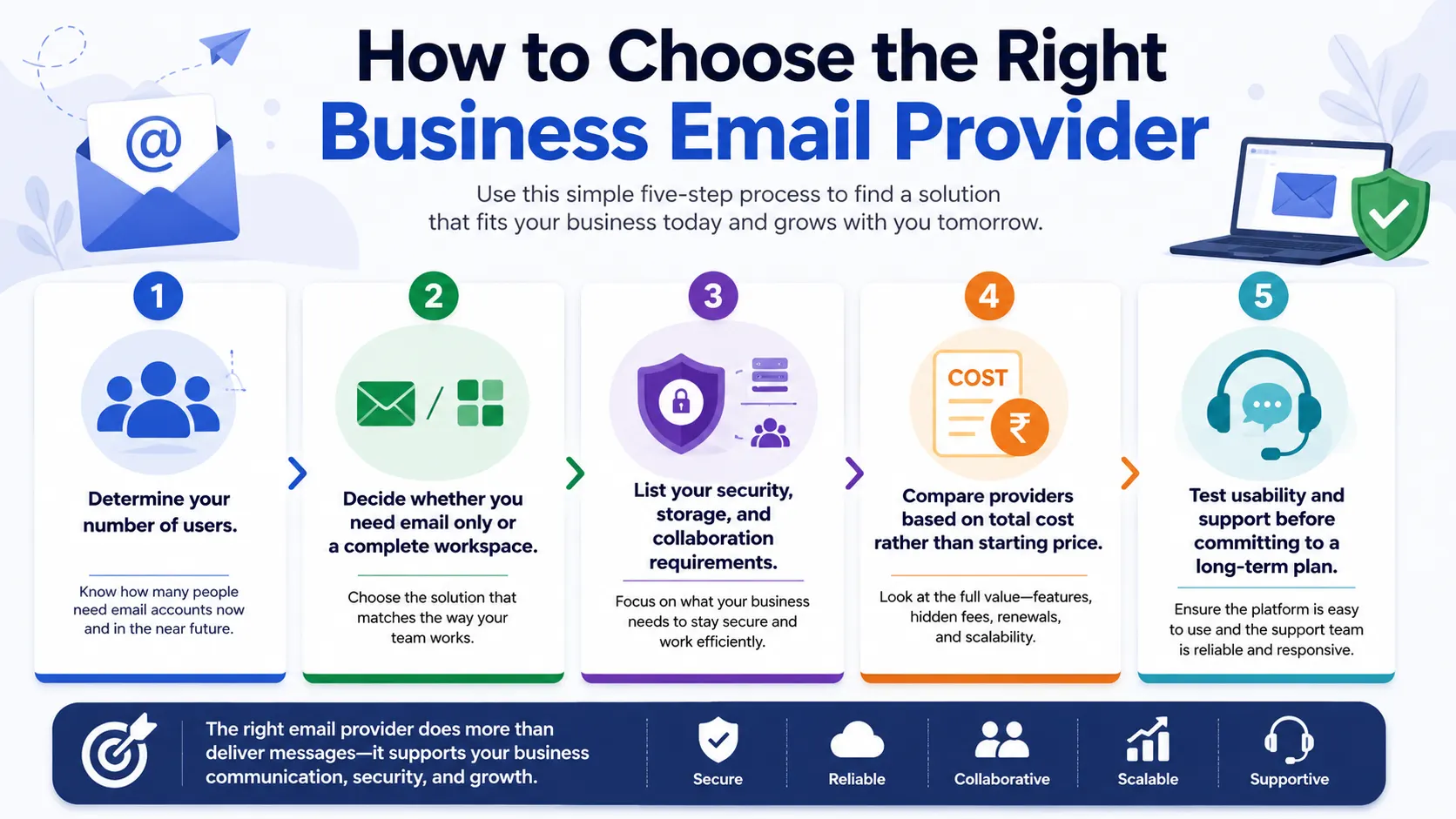
Use this simple five-step process:
You can also create a scoring sheet and rate each provider from 1–5 for security, reliability, storage, administration, collaboration, support, scalability, and cost.
This prevents you from making the decision based on marketing claims alone.
For very small teams, standalone email may be enough. But businesses increasingly need more than an inbox.
As organizations grow, employees communicate through email, manage calendars, share information, coordinate tasks, and collaborate across teams. Managing each function through separate tools can create unnecessary complexity.
A complete business workspace brings these capabilities closer together, helping organizations simplify their technology stack while providing employees with a centralized environment for everyday work.
For businesses evaluating this approach, Mailz is positioned as an email platform and complete business workspace designed to bring business communication and productivity into one environment.
Choosing an email hosting platform shouldn't only solve today's communication requirements. Small businesses also need a solution that can grow with their teams and support the way employees work.
Mailz is designed as an email platform and complete business workspace, bringing professional business email and workplace productivity into a unified environment. Businesses can use it to establish custom-domain email addresses while having access to a broader workspace designed around everyday business communication.
Some of the reasons businesses may consider Mailz include:
For a small business, this can mean starting with a professional email solution without necessarily limiting future productivity requirements. Rather than selecting a platform purely because it offers the lowest mailbox price, businesses can consider the overall value of having email and workplace capabilities available through one business-focused platform.

Choosing the best email hosting for small business in 2026 is about much more than finding the lowest price per mailbox. Businesses should evaluate custom domain support, security, email reliability, storage, administration, scalability, support, and productivity capabilities before making a decision. The right platform should protect business communication today while remaining flexible enough to support future growth.
For businesses that only need professional email, a straightforward email hosting service may be sufficient. But if your organization wants to bring communication and productivity tools together, a complete business workspace can provide greater long-term value. The key is to choose a platform based on your actual business requirements, not simply the provider with the cheapest advertised plan.
Copyright ©2026 Secuodsoft. All rights reserved.