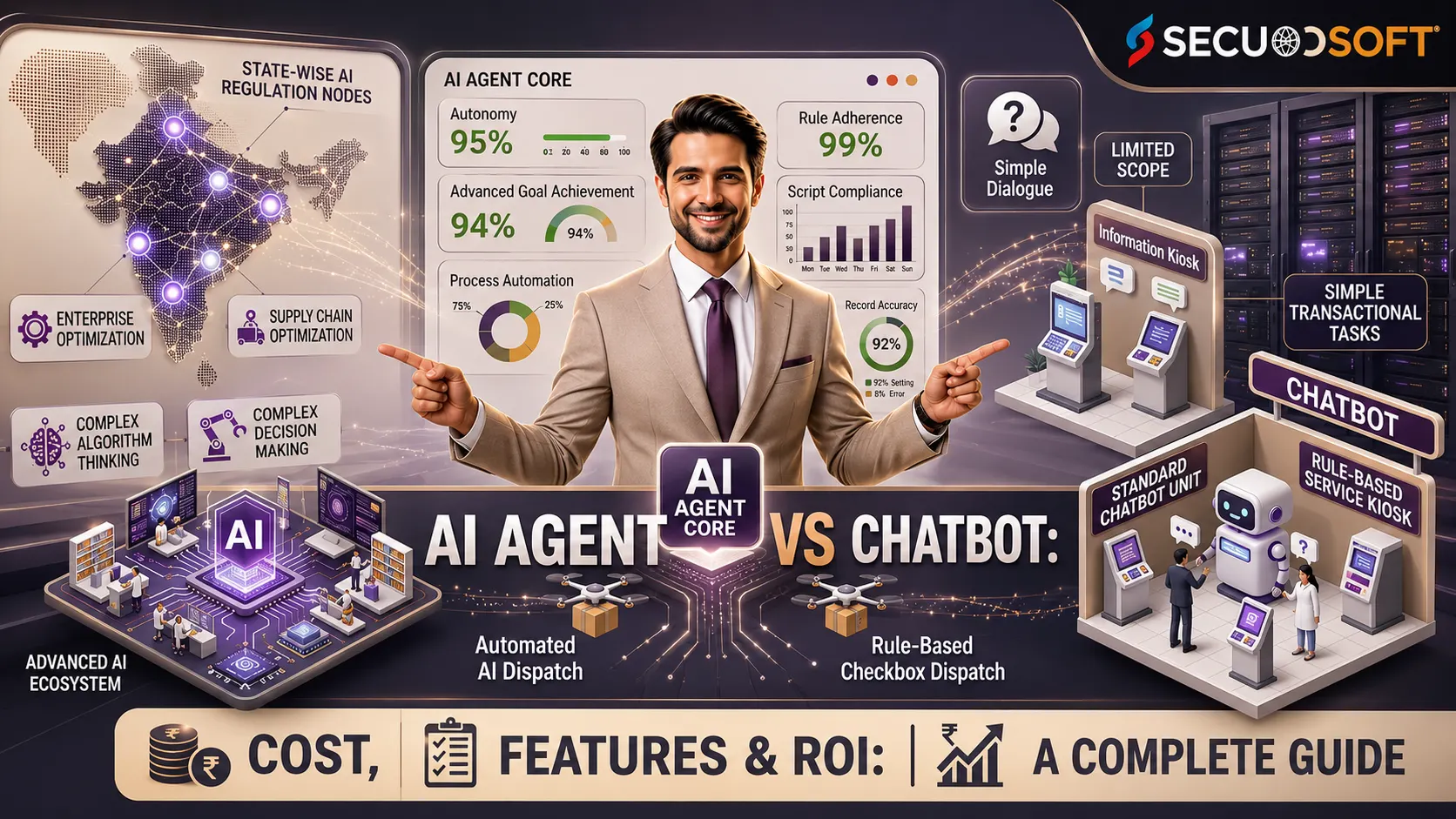
Businesses invested ₹500+ crores in chatbot development over the past five years, yet 73% report disappointing results that fall short of expectations. The culprit? They're deploying yesterday's technology to solve today's problems. A chatbot answering frequently asked questions in 2024 was revolutionary. But in 2026, customers expect more than scripted responses. They expect systems that take action, make decisions, and solve problems autonomously. That's where the fundamental difference between AI agents and chatbots becomes critical.
The distinction isn't semantic, it's transformational. While a chatbot responds to questions by retrieving information, an AI agent reasons about problems, decides on actions, uses available tools, corrects courses based on results, and accomplishes multi-step goals with minimal human intervention. Implementing the wrong technology costs businesses ₹8-30 lakhs in wasted development, frustrated customers due to unmet expectations, and missed opportunities for genuine business transformation.
This guide cuts through the hype to explain exactly what autonomous AI agents are, how they differ fundamentally from traditional chatbots, when each technology creates genuine business value, and how to make implementation decisions that actually deliver measurable ROI rather than expensive tech disappointments.
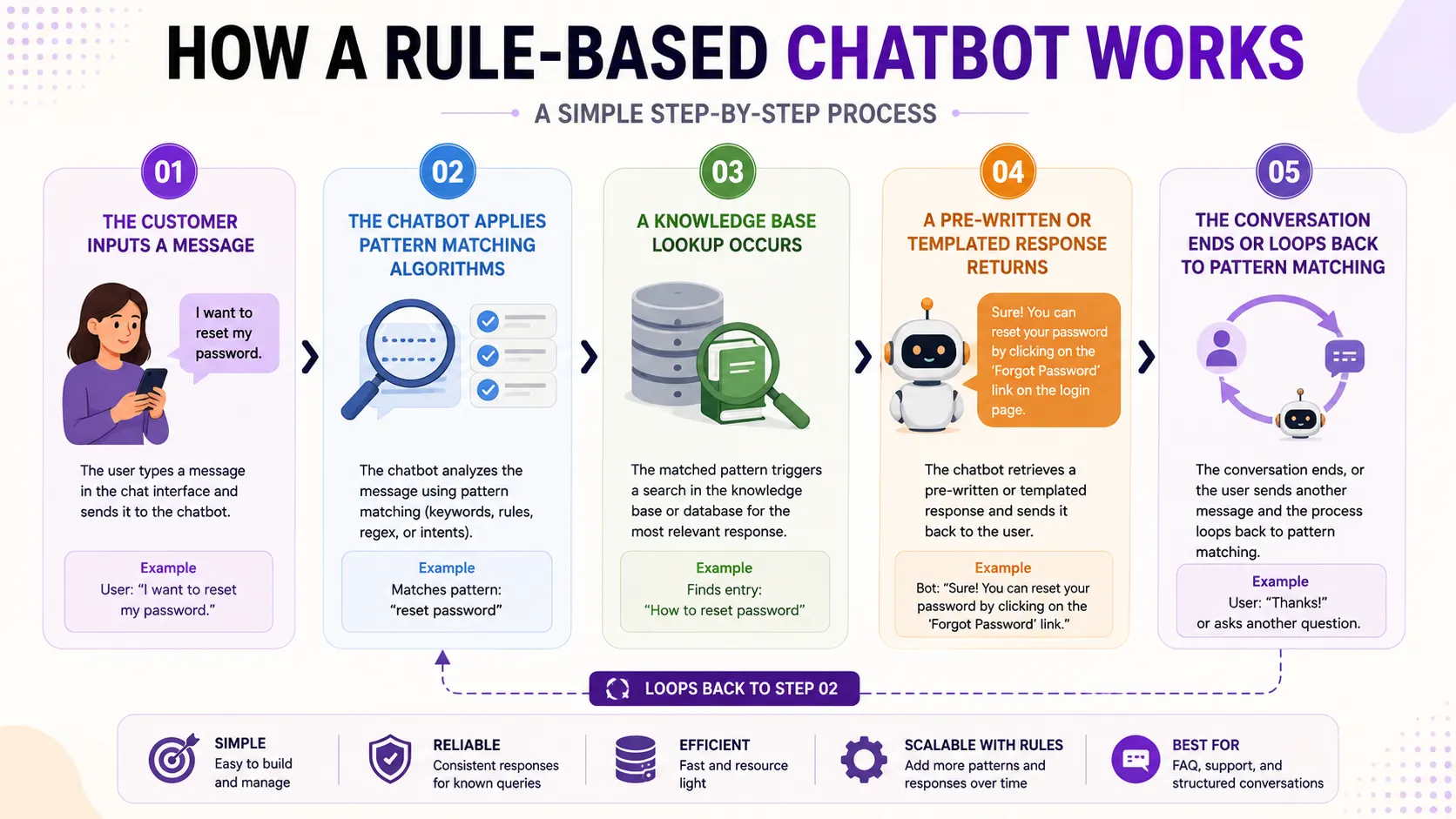
A chatbot (short for "chat robot") follows a predetermined conversation script. When customers type queries, the chatbot matches patterns, retrieves pre-written responses, and displays them back. Think of it as an extremely fast librarian who knows exactly where specific books are shelved but cannot think beyond that.
The customer inputs a message → The chatbot applies pattern matching algorithms → A knowledge base lookup occurs → A pre-written or templated response returns → The conversation ends or loops back to pattern matching
The chatbot operates reactively. It waits for customer input, processes that specific input, and responds. If the customer's question slightly differs from expected patterns, the chatbot either provides a partially relevant answer or escalates to a human agent.
Real-world example: A bank's chatbot can tell you your account balance when you ask "What's my balance?" but becomes confused when you ask "How much money do I have?" even though both questions mean the same thing. It fails to understand context beyond trained patterns.
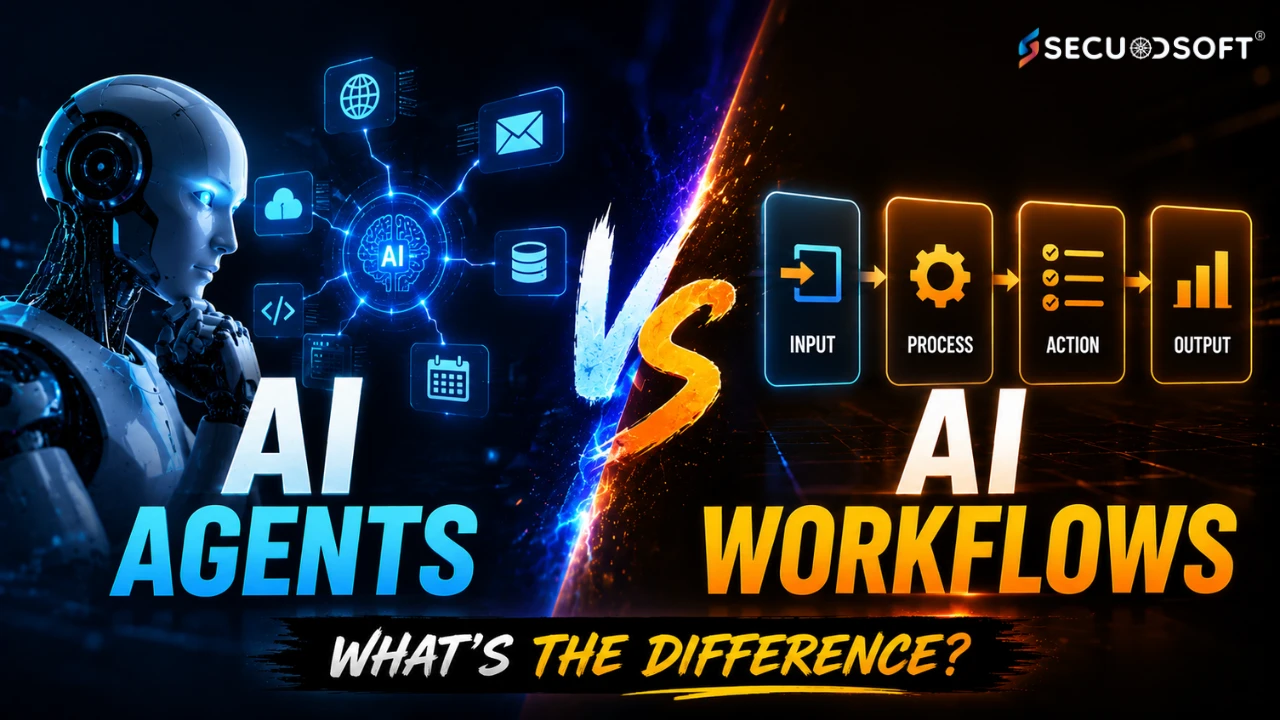
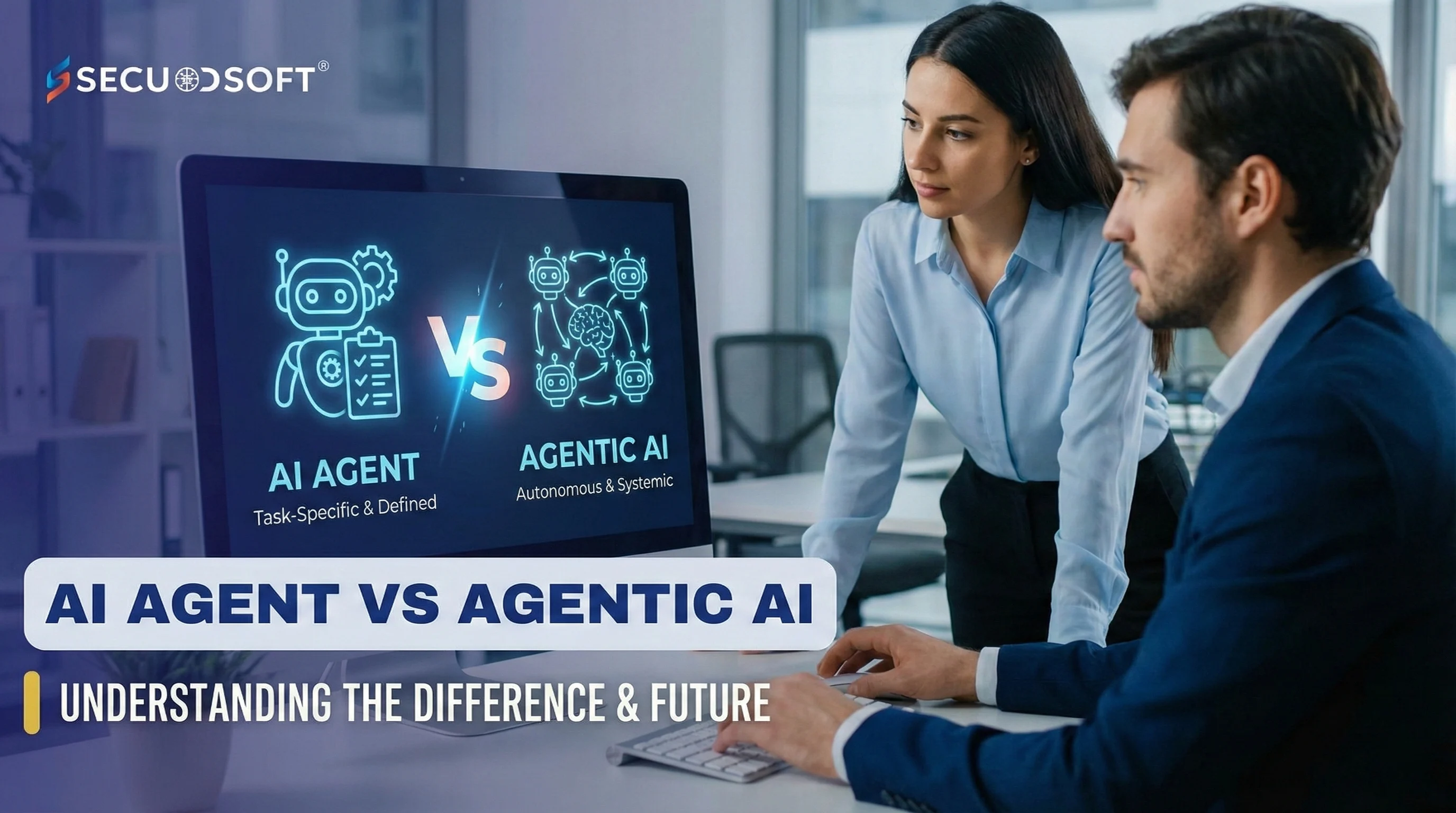
An AI agent is fundamentally different, it's an autonomous system that perceives situations, reasons about objectives, makes decisions, takes actions through available tools, observes results, and adapts its approach accordingly. Rather than waiting for commands, AI agents proactively work toward defined goals.
Modern AI agents are powered by advanced machine learning models capable of understanding context, reasoning through tasks, and continuously improving decision-making based on real-world interactions.
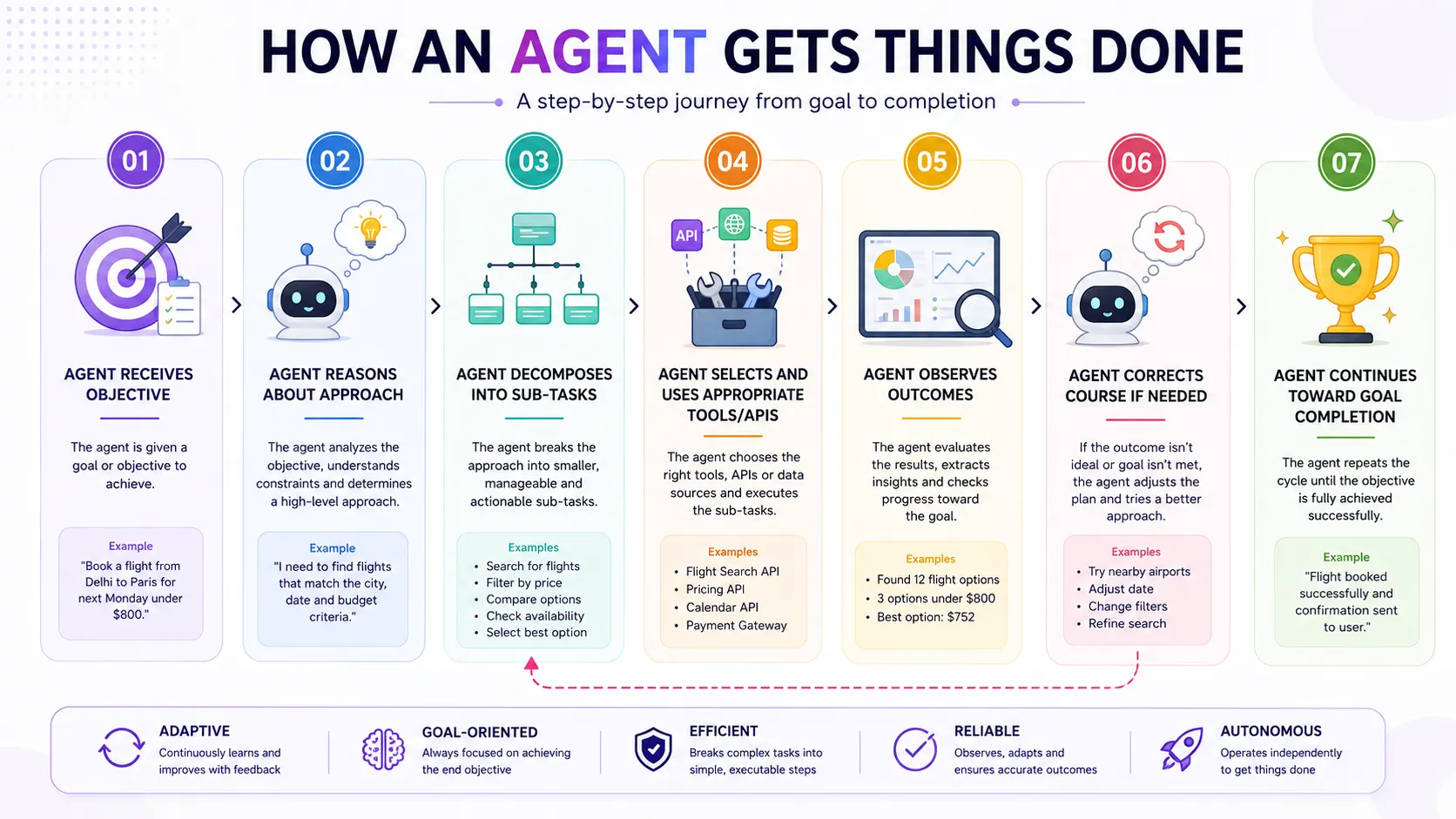
Agent receives objective → Agent reasons about approach → Agent decomposes into sub-tasks → Agent selects and uses appropriate tools/APIs → Agent observes outcomes → Agent corrects course if needed → Agent continues toward goal completion
AI agents demonstrate genuine problem-solving capability. They think beyond pre-programmed responses, discover new solutions, handle complex multi-step processes, and improve their approach based on feedback.
Real-world example: An AI agent assigned "process this customer refund" autonomously: retrieves the original order, checks refund eligibility against policy, processes the refund through payment systems, updates inventory, sends notification emails, logs the transaction, and escalates to management only if policy exceptions arise. All automatically.
| Capability | Traditional Chatbot | AI Agent |
|---|---|---|
| Decision Making | Retrieves pre-written responses | Reasons through problems, makes context-aware decisions |
| Tool Usage | Accesses single knowledge base | Uses multiple tools/APIs dynamically based on situation |
| Multi-Step Tasks | Cannot handle beyond conversation flow | Decomposes complex tasks into steps and executes sequentially |
| Learning Ability | Static knowledge base | Learns from interactions and improves approach |
| Autonomy | Waits for user input | Initiates actions toward goals with minimal supervision |
| Error Recovery | Escalates to human agents | Identifies errors and corrects course automatically |
| Complexity Handling | Struggles with nuance | Handles complex, ambiguous situations |
| Creativity | None, rigid responses | Generates novel approaches to problems |
| API Integration | 1-3 integrations typical | 10-20+ tool integrations possible |
Many enterprise businesses are integrating AI-powered automation platforms with CRM systems, ERP software, and customer service tools to create unified intelligent workflows.
Chatbots operate in conversation mode. They sit waiting for customer messages, respond to those messages, and complete the interaction. The customer drives the conversation entirely. This works perfectly for FAQ answering but fails badly for complex problem-solving requiring multiple steps.
AI agents operate in task mode. You assign them an objective ("improve customer retention by analyzing churn patterns and suggesting interventions"), and they work autonomously toward completion. The agent decides which data to gather, what analysis to perform, what tools to employ, and when human review is needed.
Chatbots provide information. When you ask a chatbot "Can I return this item?" it retrieves your return policy and displays it. You still need to contact customer service to actually initiate the return.
AI agents take action. When you ask an AI agent "Process my return," it checks eligibility against policy, generates a return label, updates your account, arranges pickup, processes the refund, and notifies you automatically.
FAQ automation remains chatbots' strongest use case. If your business receives hundreds of repetitive questions, "What are your business hours?" "How do I reset my password?" "What's your return policy?", chatbots excel. Customers get instant answers 24/7, your support team focuses on complex issues, and implementation is straightforward.
Lead qualification and routing works well with chatbots. They can ask qualifying questions ("What's your company size?" "What's your budget range?") and route qualified leads to appropriate sales team members. This is structured information gathering where pre-defined questions apply universally.
Simple transaction support like helping customers find products, checking inventory status, or providing order status updates leverage chatbot strengths. These are information retrieval tasks with minimal complexity.
First-line support triage benefits from chatbots acting as gatekeepers. They can gather issue information, attempt simple fixes, and intelligently escalate complex problems to human agents with full context already collected.
When deployed appropriately, chatbots deliver genuine value:
A well-implemented FAQ chatbot saves ₹8-15 lakhs annually in support costs for medium-sized businesses, genuine money-saving technology when applied appropriately.
Autonomous process execution represents the biggest AI agent advantage. Rather than conversations, agents accomplish work. Process payroll? Check inventory across warehouses? Generate weekly sales reports? Identify customers at churn risk? AI agents handle these autonomously, requiring human oversight only when exceptions arise.
Complex problem-solving across multiple tools distinguishes agents from chatbots. A customer calls with a billing problem. An AI agent simultaneously accesses the customer database, checks billing records, reviews payment history, queries the product database, consults the refund policy, reviews similar cases, calculates appropriate resolution, and implements it, all while a chatbot would be asking clarifying questions.
Learning and improvement represents the agent advantage that grows over time. As agents encounter situations, they learn. They discover patterns, improve decision-making, optimize tool selection, and become increasingly effective. Chatbots remain static unless someone manually reprograms them.
Proactive action separates agents from chatbots fundamentally. Chatbots wait for customer input. Agents act proactively, identifying opportunities, flagging risks, suggesting improvements, initiating processes. An AI agent assigned "improve inventory turnover" analyzes stock movements, identifies slow movers, suggests pricing adjustments, recommends suppliers for fast-moving items, and implements decisions. Chatbots never initiate anything.
Customer success automation where agents track customer health metrics, identify churn signals, recommend features that solve specific problems, and proactively intervene before customers leave. ROI: 25-40% reduction in churn, ₹50-200 lakh annual value for SaaS companies.
Sales acceleration where agents qualify leads, draft personalized outreach, track engagement, suggest next actions, and schedule follow-ups. Teams close deals 30-50% faster with agent assistance. ROI: ₹3-10 crore annual revenue increase for sales organizations.
Operations automation where agents handle end-to-end processes like employee onboarding, expense approvals, inventory management, and vendor payments. ROI: 40-60% operational cost reduction, process cycle time decreased by 70-80%.
Data analysis and insights where agents analyze business data, discover patterns, generate hypotheses, test them, and recommend actions. Rather than quarterly analysis taking weeks, agents deliver weekly insights continuously. ROI: ₹1-5 crore from optimization opportunities agents identify.
A chatbot successfully answers "How do I reset my password?" but fails when customers ask "My password reset link didn't work and I can't log into my account."
An AI agent handles the failed reset scenario by: checking password reset email delivery, verifying if the link expired, checking account security flags, confirming email address accuracy, resending the link, and monitoring to confirm successful password reset, potentially identifying and fixing the underlying issue preventing reset delivery.
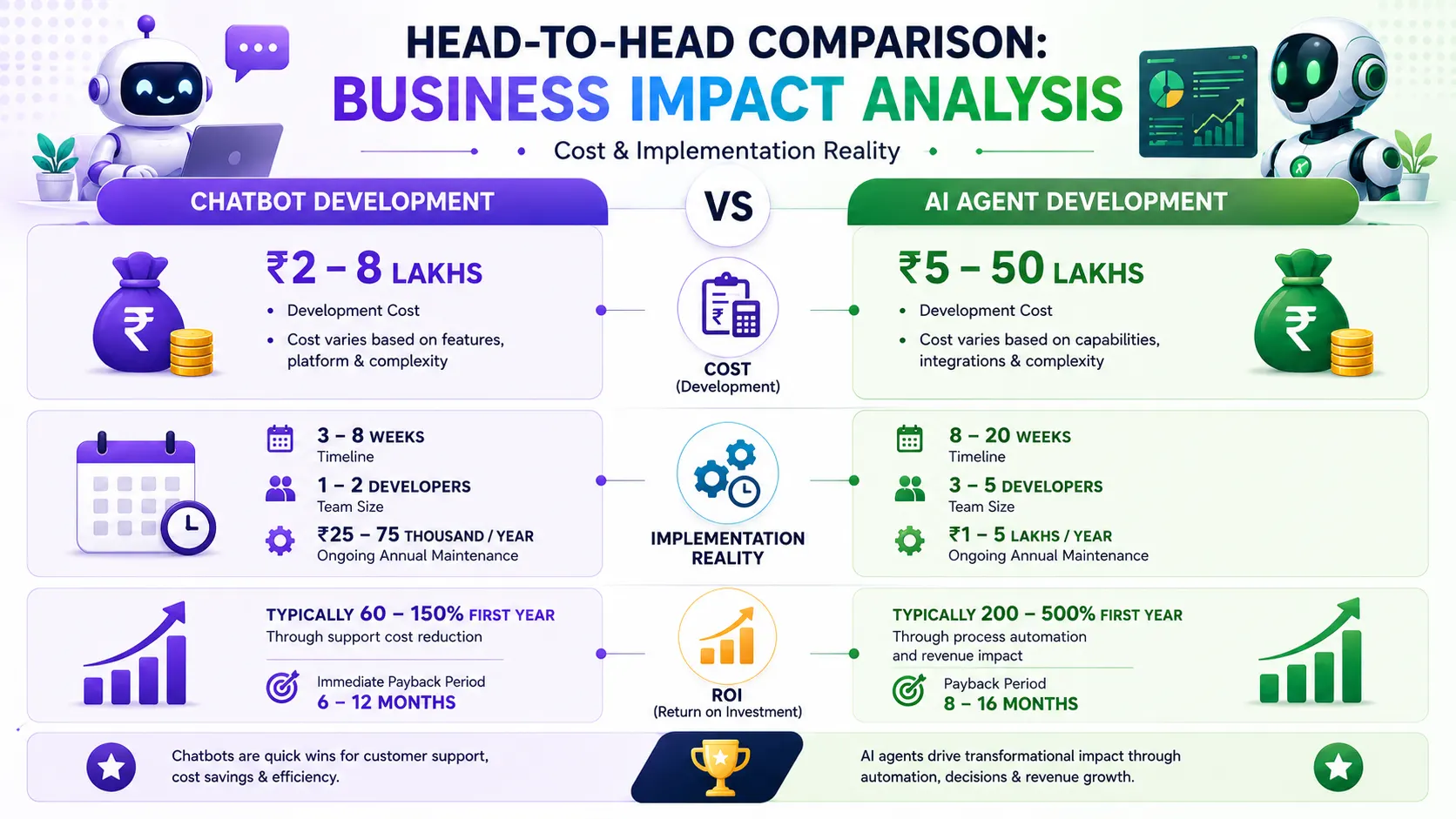
This distinction compounds across every business process. Where chatbots handle 20-30% of inquiries, AI agents handle 60-80%. Where chatbots reduce support cost, AI agents also increase revenue and improve operations simultaneously.
Choose chatbots when: You have high-volume repetitive inquiries (100+ daily) with pre-defined answers, support costs are high and cost reduction is the primary goal, your business model doesn't require proactive action or complex multi-step processes, implementation speed matters more than comprehensive problem-solving, and you have limited budget for AI investment.
Choose AI agents when: Complex multi-step processes dominate your operations (sales, customer success, operations), competitive advantage depends on efficiency or customer experience, you need proactive action beyond answering questions, multiple tools and systems must coordinate, process intelligence and continuous learning create ongoing value, and you can invest appropriately in proper development and training.
Most sophisticated businesses don't choose exclusively. Instead, they deploy:
This hybrid strategy captures chatbot benefits (cost reduction, 24/7 availability) while leveraging agent capabilities where they create outsized business value.
Large Language Models (GPT-4, Claude, Gemini) have fundamentally changed what's possible. These aren't the limited chatbots of 2020. Modern LLMs can reason about complex problems, understand context deeply, generate novel approaches, and handle ambiguity that would have required hand-coding millions of rules previously.
This advances both chatbots and AI agents:
Forward-thinking companies in 2026 are:
Secuodsoft develops scalable AI-powered business solutions that combine conversational AI, intelligent automation, machine learning, and enterprise software integration to help organizations improve efficiency, customer experience, and operational decision-making.
We've built intelligent chatbot systems handling 100,000+ conversations monthly for e-commerce, SaaS, and financial services clients. And we've developed AI agents managing customer onboarding, sales acceleration, and operations automation for enterprise clients.
Our approach prioritizes business outcomes over impressive technology. What specific problem are you solving? How do we measure success? What's the realistic ROI? These questions drive our development.
The debate between AI agents and chatbots is no longer about which technology is “better”, it’s about choosing the right solution for the right business objective. Chatbots remain highly effective for handling repetitive customer queries, basic support automation, and simple workflows, while AI agents introduce a new level of autonomy, reasoning, and decision-making capable of transforming operations, customer engagement, and business productivity. As AI technology continues evolving in 2026, businesses that strategically implement intelligent automation will gain significant advantages in efficiency, scalability, and customer experience.
Whether you're planning a customer support chatbot, an AI-powered business assistant, or a fully autonomous enterprise workflow system, success depends on selecting the right development strategy, integrations, and long-term scalability approach. Partnering with an experienced AI development company ensures your business implements solutions that not only automate conversations but also drive measurable operational and revenue growth in the rapidly evolving AI landscape.
Copyright ©2026 Secuodsoft. All rights reserved.