India's ₹1.4 lakh crore pharmaceutical retail sector is undergoing rapid digital transformation, yet over 60% of the country's 850,000+ pharmacies still rely on manual registers or outdated billing systems, leading to inventory mismanagement, expired drug wastage, billing errors, and regulatory compliance issues that collectively cost the average pharmacy ₹3-12 lakhs annually in lost revenue and penalties. Modern pharmacy management software has revolutionized how medical stores operate, integrating intelligent inventory control, GST-compliant billing, prescription tracking, expiry management, and supplier coordination into seamless workflows that reduce errors by 95% while improving profitability by 25-40%. But here's the challenge: 58% of pharmacy software implementations fail because owners either choose the wrong solution or work with developers who don't understand pharmaceutical operations, resulting in wasted investments of ₹5-25 lakhs and systems that create more problems than they solve.
Whether you're running a standalone chemist shop in Mumbai, a chain of medical stores across Karnataka, a hospital pharmacy in Delhi, or planning to launch an online pharmacy platform, This comprehensive 2026 guide demystifies pharmacy management software development, covering everything from must-have features and realistic pricing to vendor selection criteria and proven implementation strategies that ensure your technology investment delivers measurable returns.
The pharmaceutical landscape has fundamentally changed. Government regulations demand drug traceability, customers expect instant billing, insurance companies require digital claims, and margin pressures force every rupee to count. Off-the-shelf solutions might work for grocery stores, but pharmacies deal with life-critical medications, strict expiry tracking, batch-wise inventory, complex drug interactions, and regulatory compliance that generic software simply cannot handle effectively.
Many pharmacy businesses now prefer custom software development services to build scalable systems tailored to inventory workflows, prescription handling, supplier coordination, and multi-store operations.
Your traditional pharmacy likely faces these daily challenges: maintaining accurate stock levels across thousands of SKUs, tracking multiple batches with different expiry dates, managing supplier returns for near-expiry drugs, handling various payment modes including insurance, maintaining regulatory compliance for Schedule H and X drugs, preventing duplicate billing, and generating accurate GST reports. Each manual process introduces error possibilities and efficiency losses that compound into significant financial impact over time.
Pharmacy management software (also called medical store management software or chemist software) integrates multiple operational aspects into a unified digital ecosystem. Think of it as your pharmacy's central nervous system, coordinating inventory, sales, purchases, accounting, and compliance into harmonious operation.
The customer-facing interface handling prescriptions, over-the-counter sales, returns, and payments with speed and accuracy that manual systems cannot match. Modern pharmacy POS systems process transactions in under 30 seconds compared to 2-3 minutes manually.
The heart of pharmacy operations tracking every tablet, syrup, and injection across batches, expiry dates, and storage locations. Intelligent systems alert you weeks before expiry, suggest reorder quantities based on sales patterns, and prevent stockouts of critical medications.
Streamlines procurement from multiple distributors, compares prices automatically, tracks pending orders, manages credit terms, and handles returns efficiently. Smart systems identify the best supplier for each drug based on price, reliability, and delivery time.
Digital storage and retrieval of customer prescriptions, medication history tracking, drug interaction warnings, and dosage verification. Essential for building customer relationships and ensuring medication safety. Many healthcare businesses are also integrating mobile healthcare applications that allow customers to upload prescriptions, reorder medicines, and track deliveries directly from smartphones.
Automated GST calculations, profit margin tracking, expense management, day-end reconciliation, and comprehensive financial reports that give real-time visibility into pharmacy profitability.
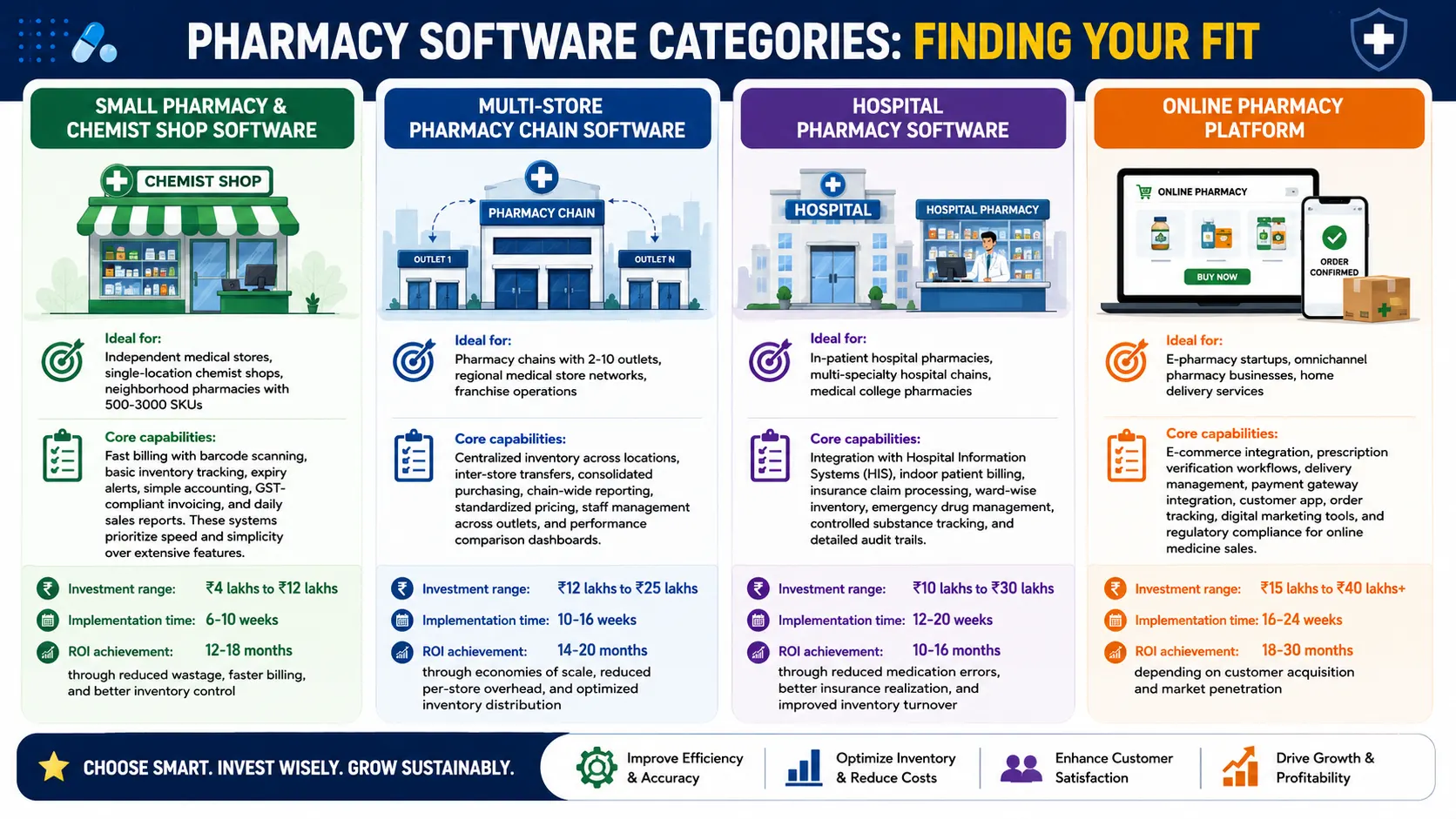
Ideal for: Independent medical stores, single-location chemist shops, neighborhood pharmacies with 500-3000 SKUs
Core capabilities: Fast billing with barcode scanning, basic inventory tracking, expiry alerts, simple accounting, GST-compliant invoicing, and daily sales reports. These systems prioritize speed and simplicity over extensive features.
Investment range: ₹4 lakhs to ₹12 lakhs
Implementation time: 6-10 weeks
ROI achievement: 12-18 months through reduced wastage, faster billing, and better inventory control
Ideal for: Pharmacy chains with 2-10 outlets, regional medical store networks, franchise operations
Core capabilities: Centralized inventory across locations, inter-store transfers, consolidated purchasing, chain-wide reporting, standardized pricing, staff management across outlets, and performance comparison dashboards.
Investment range: ₹12 lakhs to ₹25 lakhs
Implementation time: 10-16 weeks
ROI achievement: 14-20 months through economies of scale, reduced per-store overhead, and optimized inventory distribution
Ideal for: In-patient hospital pharmacies, multi-specialty hospital chains, medical college pharmacies
Core capabilities: Integration with Hospital Information Systems (HIS), indoor patient billing, insurance claim processing, ward-wise inventory, emergency drug management, controlled substance tracking, and detailed audit trails.
Investment range: ₹10 lakhs to ₹30 lakhs
Implementation time: 12-20 weeks
ROI achievement: 10-16 months through reduced medication errors, better insurance realization, and improved inventory turnover
Ideal for: E-pharmacy startups, omnichannel pharmacy businesses, home delivery services
Core capabilities: E-commerce integration, prescription verification workflows, delivery management, payment gateway integration, customer app, order tracking, digital marketing tools, and regulatory compliance for online medicine sales.
Investment range: ₹15 lakhs to ₹40 lakhs+
Implementation time: 16-24 weeks
ROI achievement: 18-30 months depending on customer acquisition and market penetration
Barcode scanning, voice search for medicines, suggested generics popup, automatic discount application, multiple payment mode handling (cash, cards, UPI, insurance), and instant receipt generation. The system should complete a typical transaction in under 20 seconds.
Modern pharmacy billing platforms are increasingly integrated with cloud-based POS systems that allow real-time synchronization across multiple branches, improving operational visibility and reducing billing inconsistencies.
Automatic MRP detection, batch-wise pricing when multiple MRPs exist, margin-based pricing for non-MRP items, scheme and offer application, loyalty point calculation, and senior citizen discount automation.
Digital prescription capture via photo or scan, prescription history for repeat customers, drug interaction warnings, dosage verification, and automatic refill reminders for chronic medication patients.
Advanced pharmacies are now adopting AI & machine learning solutions to predict medicine demand, reduce stock wastage, and automate reorder planning based on purchasing trends and seasonal demand fluctuations.
| Feature | Business Impact | Key Capability |
|---|---|---|
| Batch Management | Prevents wrong batch dispensing | Track each batch separately with unique expiry and MRP |
| Expiry Tracking | Reduces wastage by 40-60% | Auto-alerts 3-6 months before expiry, blocks expired sales |
| Reorder Automation | Eliminates stockouts | Calculates reorder points based on sales velocity |
| ABC Analysis | Optimizes working capital | Classifies inventory by value and movement speed |
| Shelf Management | Improves picking speed | Virtual shelf mapping for quick location identification |
Smart drug inventory management extends beyond your store, it connects with your entire supply chain. Modern systems track which suppliers offer the best prices for specific drugs, maintain credit term histories, flag delayed deliveries, automate purchase order generation based on stock levels, and even suggest optimal order quantities considering discounts and minimum order values.
Return management capabilities handle the unavoidable reality of pharmaceutical retail, near-expiry returns to distributors. The system should track return eligibility windows, generate credit notes automatically, maintain return history for reconciliation, and alert you about upcoming return deadlines.
Indian pharmacy regulations are stringent and penalties severe. Your software must generate all required reports effortlessly:
Narcotic and psychotropic drug registers (Form 10) maintained automatically with every Schedule H and X sale recorded, complete with patient details and prescriber information. Manual maintenance of these registers consumes 30-45 minutes daily, automated systems handle it instantly.
GST-compliant billing and reports including GSTR-1, GSTR-3B preparation support, HSN code-wise summaries, and composition scheme handling. Tax compliance headaches disappear when software handles calculations and report generation automatically.
Drug sales analysis breaking down Schedule H, Schedule H1, Schedule X, OTC, and surgical items separately, essential for regulatory audits and business intelligence.
Understanding cost components helps you evaluate quotes intelligently and avoid hidden surprises post-implementation.
This phase involves pharmacy workflow analysis, software requirement documentation, regulatory compliance planning, integration needs assessment, and technology architecture design. Skipping proper planning to save money inevitably costs more later through rework and missed requirements.
The bulk of investment goes here, building the billing engine, inventory management system, purchase module, reporting framework, and prescription management features. Development time typically spans 8-16 weeks depending on complexity and customization level.
Pharmacy software must be intuitive enough that your staff can use it effortlessly during rush hours. Professional UI/UX design ensures the learning curve is minimal and error rates stay low even under pressure.
Connecting payment gateways, SMS services, barcode systems, accounting software (Tally/QuickBooks), distributor ordering portals, and insurance claim systems. Each integration requires custom development, testing, and ongoing maintenance.
Rigorous testing prevents catastrophic failures like duplicate billing, incorrect inventory deduction, or GST calculation errors that could cost thousands in corrections and customer trust.
Staff training determines software adoption success. Proper training includes hands-on sessions, documentation, and initial support during the critical first weeks of operation.
Ongoing support, bug fixes, software updates, regulatory compliance updates, and technical assistance. Factor this into your total cost of ownership calculations.
Single Store Medical Shop: ₹4,00,000 - ₹10,00,000 Timeline: 6-10 weeks Includes: Billing, inventory, basic reports, GST compliance
2-5 Store Chain: ₹10,00,000 - ₹18,00,000 Timeline: 10-14 weeks Includes: Multi-location management, centralized inventory, consolidated reporting
Large Chain (6-15 stores): ₹18,00,000 - ₹30,00,000 Timeline: 14-20 weeks Includes: Advanced analytics, franchise management, automated replenishment
Hospital Pharmacy: ₹12,00,000 - ₹30,00,000 Timeline: 12-18 weeks Includes: HIS integration, insurance processing, indoor patient billing
Pharmacy owners rightfully ask: "Will this software pay for itself?" Here's how successful implementations typically deliver ROI:
Expiry wastage reduction: Manual tracking misses expirations until it's too late. Automated alerts typically reduce expiry losses from 3-5% to under 1% of inventory value. For a pharmacy with ₹15 lakh average inventory, that's ₹4.5-6 lakh annual savings reduced to ₹1.5 lakh, a ₹3-4.5 lakh annual benefit.
Billing speed improvement: Manual billing averages 2-3 minutes per customer. Software reduces this to 20-30 seconds. Serving 150 customers daily, you save 5-7 hours of staff time worth ₹1.5-2.5 lakhs annually in productivity gains.
Inventory optimization: Better stock management typically reduces working capital requirements by 15-25%. A pharmacy maintaining ₹20 lakh average inventory can free up ₹3-5 lakhs in capital for other uses or reduce interest costs on working capital loans.
Accurate GST compliance: Manual GST errors lead to penalties, interest, and accounting costs. Automated compliance eliminates these recurring expenses averaging ₹50,000-1,50,000 annually.
Theft and pilferage reduction: Digital tracking creates accountability, typically reducing unexplained stock losses by 2-4% of inventory value, worth ₹3-8 lakhs annually for medium pharmacies.
ROI Timeline: Payback in 18.5 months, 65% first-year ROI, 194% three-year ROI
Domain expertise trumps technical skill alone. A developer who understands pharmaceutical operations will ask about your batch tracking needs, expiry management practices, and Schedule H drug handling before discussing technology. Generic software developers who've never worked with pharmacies will miss critical requirements that become expensive problems later.
Portfolio verification matters. Don't just accept claims, ask for live demos of existing pharmacy systems they've built, request reference calls with current clients, and if possible, visit a pharmacy using their software to see real-world operation and performance.
Post-launch support responsiveness determines long-term success. Your pharmacy operates 12-15 hours daily, 365 days a year. Billing system failures or inventory errors demand immediate resolution. Ensure your development partner offers responsive support with defined SLAs, response within 4 hours for critical issues, resolution within 24 hours.
Regulatory awareness is non-negotiable. Your software provider should understand India's Drugs and Cosmetics Act requirements, Schedule H/H1/X drug tracking mandates, GST pharmaceutical taxation nuances, and insurance claim processes. This knowledge prevents compliance disasters that could risk your pharmacy license.
Week 1-2: Data Preparation Inventory stocktaking, supplier database compilation, customer data collection, historical sales analysis, and staff readiness assessment. Clean data input determines system effectiveness, garbage in, garbage out applies absolutely here.
Week 3-4: System Configuration Software customization to your workflows, user access setup, barcode configuration, pricing schemes, tax settings, and integration testing with payment and SMS systems.
Week 5-6: Staff Training Role-based training sessions (billing staff need different skills than inventory managers), hands-on practice with test data, scenario-based training (returns, discounts, insurance claims), and competency assessment before live deployment.
Week 7: Parallel Operation Run both old and new systems simultaneously for one week. This validates software accuracy, identifies any gaps or issues, and builds staff confidence without risking operations.
Week 8: Full Transition Go fully live with new system, decommission old methods, provide on-site support during the first critical days, and address any teething troubles immediately.
Week 9-12: Optimization Fine-tune workflows based on actual usage, add missing reports or features, optimize slow processes, and establish routine operational practices.
Modern pharmacies need more than traditional billing software. They require intelligent systems capable of handling inventory automation, real-time reporting, compliance management, online ordering, and customer engagement from a single platform. Secuodsoft develops custom pharmacy management software that helps healthcare businesses improve efficiency, reduce operational errors, and deliver better customer experiences.
Our pharmacy software solutions are designed to support growing businesses with secure architecture, multi-user access, centralized data management, and seamless integration capabilities, ensuring pharmacies can scale operations without operational complexity.

Pharmacy management software is no longer a luxury for modern medical stores and healthcare businesses, it has become a critical operational necessity in an increasingly competitive and regulated pharmaceutical industry. From intelligent inventory management and GST-compliant billing to expiry tracking, prescription management, and multi-store operations, the right pharmacy software can significantly improve efficiency, reduce revenue leakage, and enhance customer experience.
As pharmaceutical businesses continue embracing digital transformation, investing in scalable and secure pharmacy management solutions helps pharmacies stay competitive while ensuring operational accuracy and regulatory compliance. Whether you operate a standalone chemist shop, a growing pharmacy chain, a hospital pharmacy, or an online medicine delivery platform, choosing the right technology partner plays a crucial role in long-term business success.
Businesses planning to modernize pharmacy operations should work with an experienced pharmacy software development company capable of delivering customized, future-ready, and scalable healthcare technology solutions tailored to evolving business requirements. With the right implementation strategy, pharmacies can achieve faster billing, optimized inventory control, improved customer retention, and stronger profitability while building a more efficient and digitally connected healthcare ecosystem.
Copyright ©2026 Secuodsoft. All rights reserved.