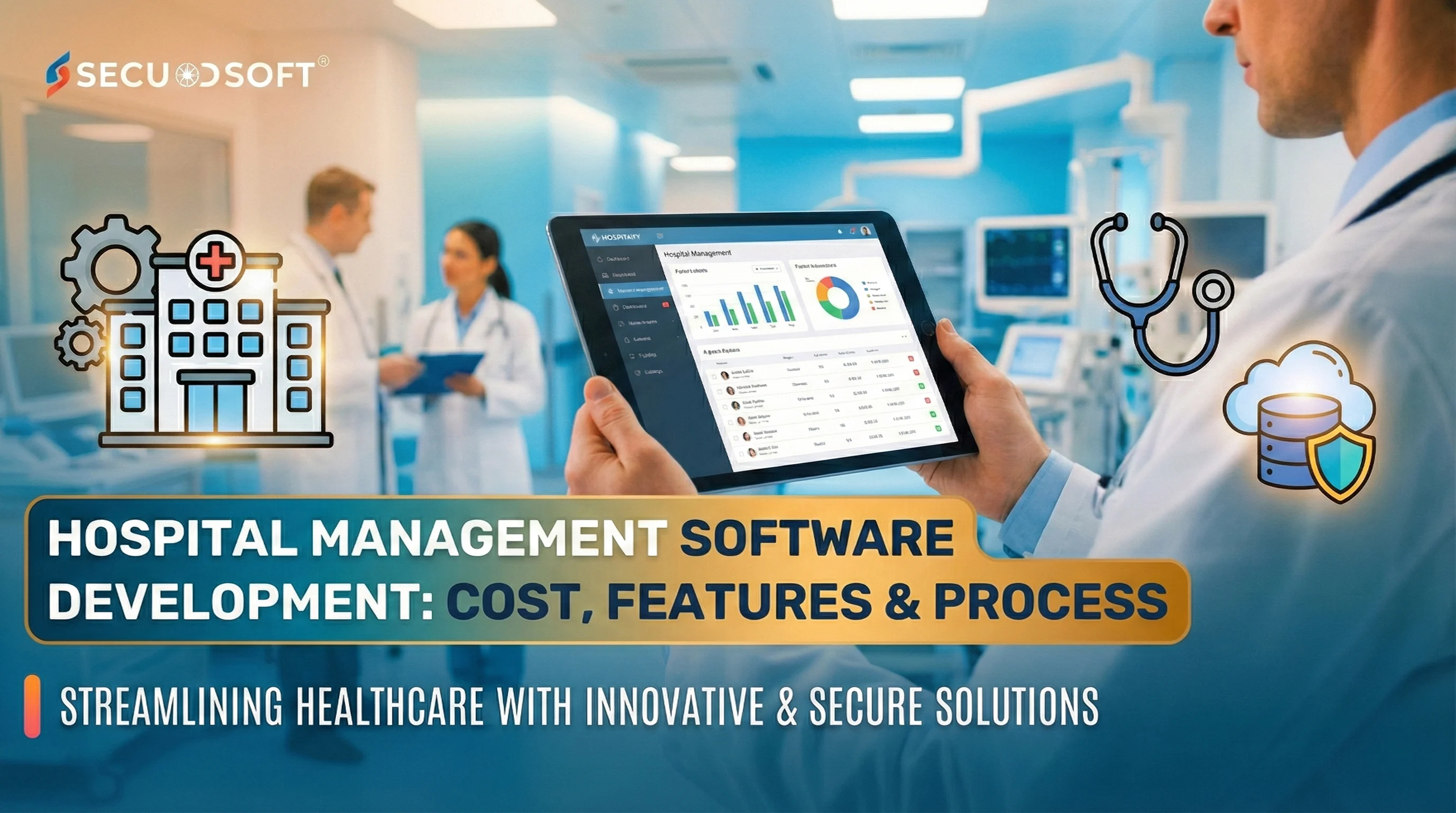
Investing in hospital management software represents one of the most critical financial decisions for healthcare facilities in 2026, yet understanding the true cost of hospital management software in India remains confusing for hospital owners, clinic managers, and healthcare administrators. Pricing varies dramatically, from ₹50,000 for basic cloud solutions to ₹2 crores+ for comprehensive enterprise systems, leaving decision-makers uncertain about realistic budgets and struggling to compare quotes from different vendors. The hospital management software cost depends on numerous factors including facility size, feature requirements, deployment model, customization needs, and vendor expertise, making apple-to-apple comparisons challenging. However, understanding these cost drivers, typical pricing structures, hidden expenses, and cost optimization strategies empowers healthcare facilities making informed investment decisions that balance budget constraints with quality requirements.
This comprehensive pricing guide breaks down HMS cost in India for 2026, examining costs by hospital type, deployment model, feature scope, and vendor category while providing practical strategies for maximizing ROI from your healthcare software investment. Whether you're a 10-bed nursing home in tier-2 cities, a 100-bed multi-specialty hospital in metros, or a diagnostic center chain across India, this guide helps you budgeting accurately, avoiding common pricing pitfalls, and choosing solutions delivering maximum value for your hospital software investment.
Hospital Management Software, also known as Hospital Management System (HMS), Healthcare Management Software, or Hospital ERP Software, is a digital solution designed to manage hospital operations including:
Both hospitals and clinics use similar systems, sometimes referred to as Clinic Management Software or Medical Management System.
Hospital management software cost comprises multiple components beyond just software licensing. Understanding these cost drivers helps setting realistic budgets and evaluating vendor proposals accurately. Facility size and type significantly impact pricing, a 10-bed clinic requires different capabilities than a 500-bed multi-specialty hospital. Vendors price based on bed count, department numbers, user licenses, and transaction volumes, with larger facilities paying proportionally more for software supporting greater complexity and scale.
Feature scope and modules represent the primary cost variable. Basic systems covering patient registration, appointment scheduling, and billing cost substantially less than comprehensive platforms integrating EMR, pharmacy, laboratory, radiology, inventory, HR, and analytics. Each additional module adds development complexity, integration requirements, and ongoing maintenance costs. Hospital software pricing typically follows modular approaches where facilities pay for needed capabilities rather than unused features.
Customization and integration requirements drive costs significantly. Off-the-shelf hospital software with standard features costs 50-70% less than custom hospital management systems built to exact specifications. Integration with existing systems, medical equipment, insurance networks, and government platforms adds complexity and expense. Facilities with legacy systems or specialized equipment face higher integration costs requiring custom development and testing.
Deployment model affects both initial and ongoing costs. Cloud-based HMS minimizes upfront infrastructure investment with no server hardware, no IT staff for maintenance, automatic backups and updates, and predictable monthly subscriptions. However, cloud solutions incur perpetual subscription fees. On-premise hospital software requires significant initial infrastructure investment including servers, networking, backup systems, and IT personnel but eliminates ongoing license fees after initial purchase. Hybrid deployments combining cloud and on-premise elements balance control with convenience at moderate costs.
Vendor type and location influence pricing substantially. International vendors offering global products charge premium prices (₹20-50 lakhs+ annually) but provide proven solutions and extensive support. Indian enterprise vendors price competitively (₹10-30 lakhs) while offering localized features, Indian compliance, and regional support. Indian startups and SMEs provide most affordable options (₹2-10 lakhs) with innovative features but potentially limited track records. Custom Software Development companies like Secuodsoft charge based on development effort (₹1,500-5,000 per hour) delivering tailored solutions matching exact requirements.
Perpetual licensing involves one-time upfront payment purchasing software permanently. Facilities pay initial license fee (₹5-50 lakhs depending on size), annual maintenance (15-20% of license cost), and periodic upgrade fees. This model suits facilities preferring capital expenditure, wanting long-term ownership, having IT infrastructure and staff, and avoiding recurring fees. Total 5-year cost: ₹8-70 lakhs including maintenance.
Subscription/SaaS pricing charges monthly or annual fees for cloud-based access. Facilities pay per user/bed/month (₹500-5,000), include all updates and support, require no infrastructure investment, and scale pricing with usage. This model suits facilities preferring operational expenditure, lacking IT resources, wanting predictable budgets, and needing scalability. Total 5-year cost: ₹6-60 lakhs depending on facility size.
Hybrid pricing combines upfront license fees with ongoing subscriptions for cloud services, support, and updates. This model balances ownership benefits with cloud convenience. Total 5-year cost: ₹10-80 lakhs.
Custom development pricing charges for building tailored solutions. Facilities pay project-based fees (₹5-200 lakhs), own complete software, customize without restrictions, and pay only for needed features. This suits facilities with unique requirements, specific workflows, integration needs, and long-term customization plans. Total cost: ₹8-250 lakhs including development and 5-year maintenance.
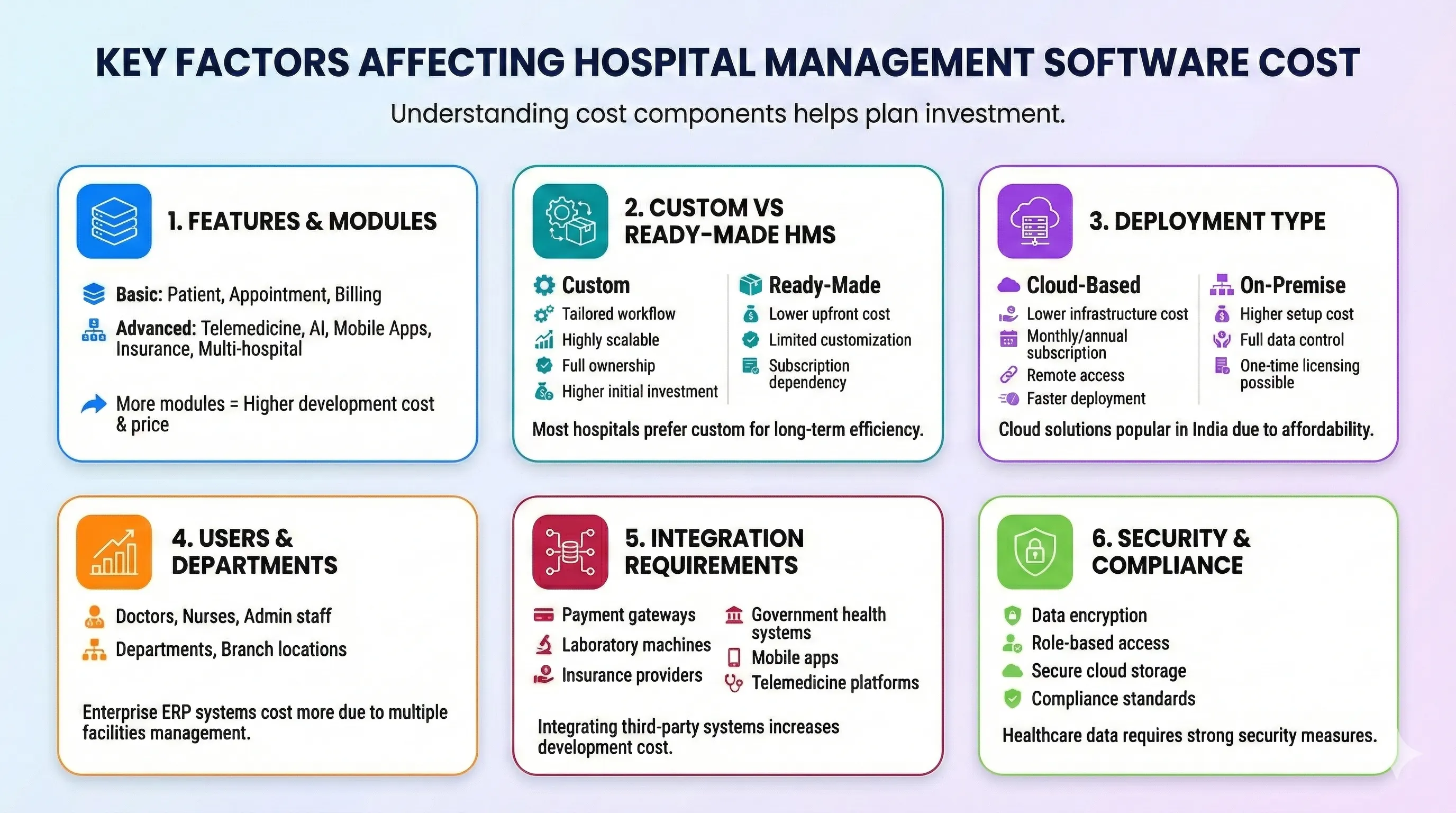
Understanding the cost components helps you plan your investment better.
More modules mean higher development cost.
Basic modules:
Advanced modules:
The more advanced your hospital software, the higher the price.
Custom HMS Software
Ready-Made HMS
Most growing hospitals prefer custom hospital management software for long-term efficiency.
Cloud-Based Hospital Management Software
On-Premise Hospital Software
Cloud solutions are becoming more popular in India due to affordability.
The cost increases with:
Enterprise Hospital ERP systems cost more because they manage multiple facilities.
Integration with third-party systems increases development cost:
Healthcare data requires strong security measures:
Higher security means higher development investment.
Small healthcare facilities require basic clinic management software covering essential operations without complex enterprise features. Cloud-based solutions cost ₹50,000-₹3,00,000 annually including patient registration and appointments, basic billing and payments, prescription management, simple inventory tracking, and standard reports. Popular options include Practo Ray (₹12,000-30,000 annually), Lybrate (₹15,000-40,000 annually), and HealthPlix (₹10,000-25,000 annually) providing affordable cloud access.
Custom basic HMS costs ₹3,00,000-₹8,00,000 as one-time investment covering 5-10 users, web and mobile access, basic modules, and simple integrations. Development timeline: 2-4 months. Annual maintenance: ₹30,000-80,000. This option suits clinics wanting specific features, avoiding subscription fees, and planning long-term ownership.
Medium hospitals need comprehensive hospital management systems integrating clinical and operational modules. Cloud HMS costs ₹3,00,000-₹12,00,000 annually for 20-50 users covering patient management with EMR, billing with insurance processing, pharmacy and laboratory modules, inventory management, basic analytics, and mobile apps. Enterprise options include Cloudpital (₹5-10 lakhs annually), Birlamedisoft (₹4-8 lakhs annually), and eHospital (₹6-12 lakhs annually).
Custom standard HMS costs ₹15,00,000-₹40,00,000 as development investment including comprehensive modules, moderate customization, equipment integrations, and scalable architecture. Development timeline: 6-10 months. Annual maintenance: ₹1.5-4 lakhs. This suits hospitals with specific workflows, integration requirements, and growth plans.
Large multi-specialty hospitals require enterprise hospital ERP systems with advanced capabilities. Cloud enterprise HMS costs ₹12,00,000-₹50,00,000+ annually for 100+ users including all clinical and operational modules, advanced decision support, comprehensive analytics, multi-location support, extensive integrations, and dedicated support. Enterprise solutions include Oracle Healthcare (₹20-50 lakhs annually), SAP for Healthcare (₹25-60 lakhs annually), and leading Indian vendors (₹15-35 lakhs annually).
Custom enterprise HMS costs ₹50,00,000-₹2,00,00,000+ as development investment covering complete hospital operations, specialty-specific modules, complex integrations, custom workflows, and enterprise scalability. Development timeline: 12-24 months. Annual maintenance: ₹5-20 lakhs. These suits hospitals seeking competitive differentiation, unique capabilities, and complete control.
Specialty facilities (dental clinics, eye hospitals, diagnostic labs, physiotherapy centers) benefit from specialized software tailored to specific workflows. Cloud specialty solutions cost ₹80,000-₹5,00,000 annually including specialty-specific features, equipment integration, and industry workflows. Dental software (₹1-3 lakhs annually), diagnostic lab software (₹2-5 lakhs annually), and radiology PACS (₹3-8 lakhs annually) cater to specific needs.
Custom specialty HMS costs ₹5,00,000-₹25,00,000 for development providing competitive advantages through proprietary workflows, unique features, and optimal integration with specialty equipment. Total 5-year cost: ₹8-40 lakhs.
Base software costs form the largest component. Cloud subscriptions range ₹50,000-₹50,00,000 annually based on facility size and features. Perpetual licenses cost ₹5,00,000-₹2,00,00,000 one-time with 15-20% annual maintenance. Custom development ranges ₹3,00,000-₹2,00,00,000 based on scope and complexity. These figures cover core software access without implementation, training, or customization.
One-time implementation expenses include project management (5-10% of software cost), data migration from legacy systems (₹50,000-₹5,00,000), system configuration and customization (₹1,00,000-₹20,00,000), integration with existing systems (₹2,00,000-₹15,00,000 per integration), initial user training (₹50,000-₹5,00,000), and go-live support (₹1,00,000-₹3,00,000). Total implementation: 20-40% of software cost.
On-premise deployments require servers and networking (₹3,00,000-₹25,00,000), backup systems (₹1,00,000-₹5,00,000), workstations and tablets (₹30,000-₹80,000 per unit), printers and peripherals (₹50,000-₹3,00,000), and networking infrastructure (₹1,00,000-₹10,00,000). Cloud deployments eliminate most hardware needs, requiring only client devices.
Integration with external systems adds laboratory equipment interfaces (₹50,000-₹3,00,000 per equipment), radiology PACS integration (₹2,00,000-₹10,00,000), insurance/TPA connectivity (₹1,00,000-₹5,00,000), payment gateway integration (₹50,000-₹2,00,000), government platform APIs (₹1,00,000-₹5,00,000), and mobile app development (₹3,00,000-₹15,00,000). Each integration requires development, testing, and maintenance.
User adoption investments include role-based training programs (₹500-₹2,000 per user), training materials and documentation (₹50,000-₹3,00,000), on-site training support (₹1,00,000-₹5,00,000), change management consulting (₹2,00,000-₹10,00,000), and ongoing refresher training (₹50,000-₹2,00,000 annually). Adequate training ensures ROI realization through proper system utilization.
Recurring maintenance costs cover software updates and patches (included in subscription or 15-20% of license), technical support (email, phone, on-site), bug fixes and issue resolution, performance monitoring, security updates, and backup management. Annual costs: ₹30,000-₹20,00,000 based on software cost and support level.
Often-overlooked expenses include data storage growth (₹20,000-₹2,00,000 annually), bandwidth and connectivity upgrades (₹50,000-₹3,00,000), regulatory compliance updates (₹1,00,000-₹5,00,000), custom report development (₹10,000-₹50,000 per report), additional user licenses beyond initial (₹500-₹5,000 per user), disaster recovery planning (₹1,00,000-₹10,00,000), and software version upgrades (₹50,000-₹10,00,000 every 3-5 years).
Phased implementation reduces initial investment by deploying patient management and billing first (₹3-8 lakhs), adding clinical modules phase 2 (₹5-12 lakhs), and expanding to advanced features phase 3 (₹3-10 lakhs). This spreads costs over 12-36 months, provides early ROI, allows learning-based refinement, and aligns spending with benefit realization. Total cost remains similar but cash flow improves significantly.
Cloud-based HMS eliminates infrastructure investment (saving ₹5-30 lakhs), reduces IT staffing needs (saving ₹5-15 lakhs annually), includes automatic updates and backups, and provides predictable monthly costs. While subscription fees continue perpetually, total 5-year cost often matches or beats on-premise for small-medium facilities lacking IT resources.
Vendor negotiation tactics include requesting competitive quotes (3-5 vendors), leveraging multi-year commitments for discounts (10-25% savings), negotiating bundled pricing for modules, seeking flexible payment terms, clarifying included vs extra-cost items, and ensuring transparent pricing without hidden fees. Indian hospital software vendors often negotiate 15-30% below initial quotes.
Open-source platforms like OpenMRS, Bahmni, or HospitalRun provide free software foundations. Customization, hosting, and support still cost ₹2-15 lakhs but eliminate license fees. This suits facilities with technical expertise, standard workflows, budget constraints, and time for community-driven development. However, factor ongoing maintenance and limited commercial support.
Avoid over-buying by accurately assessing current needs, planning for 2-3 year growth (not 10 years), prioritizing must-have over nice-to-have features, considering user-based vs bed-based pricing, and avoiding enterprise features for small facilities. Right-sized solutions cost 30-50% less than over-specified systems while meeting actual requirements.
Return on investment from hospital management software comes from revenue improvements (15-25% through better billing accuracy, reduced claim denials, and faster collection), cost reductions (10-20% through operational efficiency, reduced errors, and optimized inventory), productivity gains (30-50% in administrative functions), and quality improvements (reducing malpractice risk, improving outcomes, enhancing reputation). Most facilities achieve positive ROI within 18-36 months with well-implemented systems.
5-year TCO for small clinic: ₹4-15 lakhs (cloud) or ₹5-12 lakhs (custom) 5-year TCO for medium hospital: ₹20-60 lakhs (cloud) or ₹25-65 lakhs (custom) 5-year TCO for large hospital: ₹75-300+ lakhs (cloud) or ₹90-350+ lakhs (custom).
TCO includes software costs, implementation, infrastructure, training, maintenance, and support over 5 years. Use TCO for accurate vendor comparison rather than focusing solely on initial costs.
Cheapest options often prove most expensive through poor quality leading to rework, limited functionality hampering operations, inadequate support causing downtime, security vulnerabilities risking data breaches, and difficult scaling requiring replacement. Invest appropriately in quality software from experienced vendors delivering reliable, secure, scalable solutions. The 15-25% premium for quality vendors pays dividends through better performance, support, and longevity.
Secuodsoft a CMMI Level 3 appraised company, provides cost-effective hospital management software combining quality with competitive pricing for Indian healthcare facilities.
Contact Secuodsoft: Level 2, OPTCL Tech Tower, Saheed Nagar, Bhubaneswar, Odisha 751007 Phone: 0674 296 8780 Email: support@secuodsoft.com
Understanding hospital management software cost in India empowers making informed decisions balancing budget constraints with quality requirements. While pricing ranges dramatically from ₹50,000 to ₹2 crores+, the right investment depends on facility size, feature needs, and strategic importance. Focus on total cost of ownership, not just initial prices. Consider ROI through revenue improvements, cost reductions, and quality benefits. Choose vendors with transparent pricing, proven track records, and long-term support commitment.
Hospital software represents strategic investments affecting patient care, operational efficiency, financial performance, and competitive positioning. Under-investing saves money initially but costs more through limited capabilities, poor integration, and eventual replacement. Over-investing wastes resources on unused features and unnecessary complexity. The sweet spot balances current needs with reasonable future growth, prioritizes must-have capabilities, and partners with vendors delivering quality at fair prices.
The Indian healthcare software market offers exceptional value with experienced vendors, competitive pricing, and localized solutions. By understanding cost drivers, comparing options thoroughly, negotiating effectively, and focusing on value over price alone, healthcare facilities can implement systems delivering transformative benefits justifying every rupee invested.
Your hospital management software investment shapes your facility's future. Choose wisely, invest appropriately, and partner with vendors like Secuodsoft committed to your long-term success.
Copyright ©2026 Secuodsoft. All rights reserved.