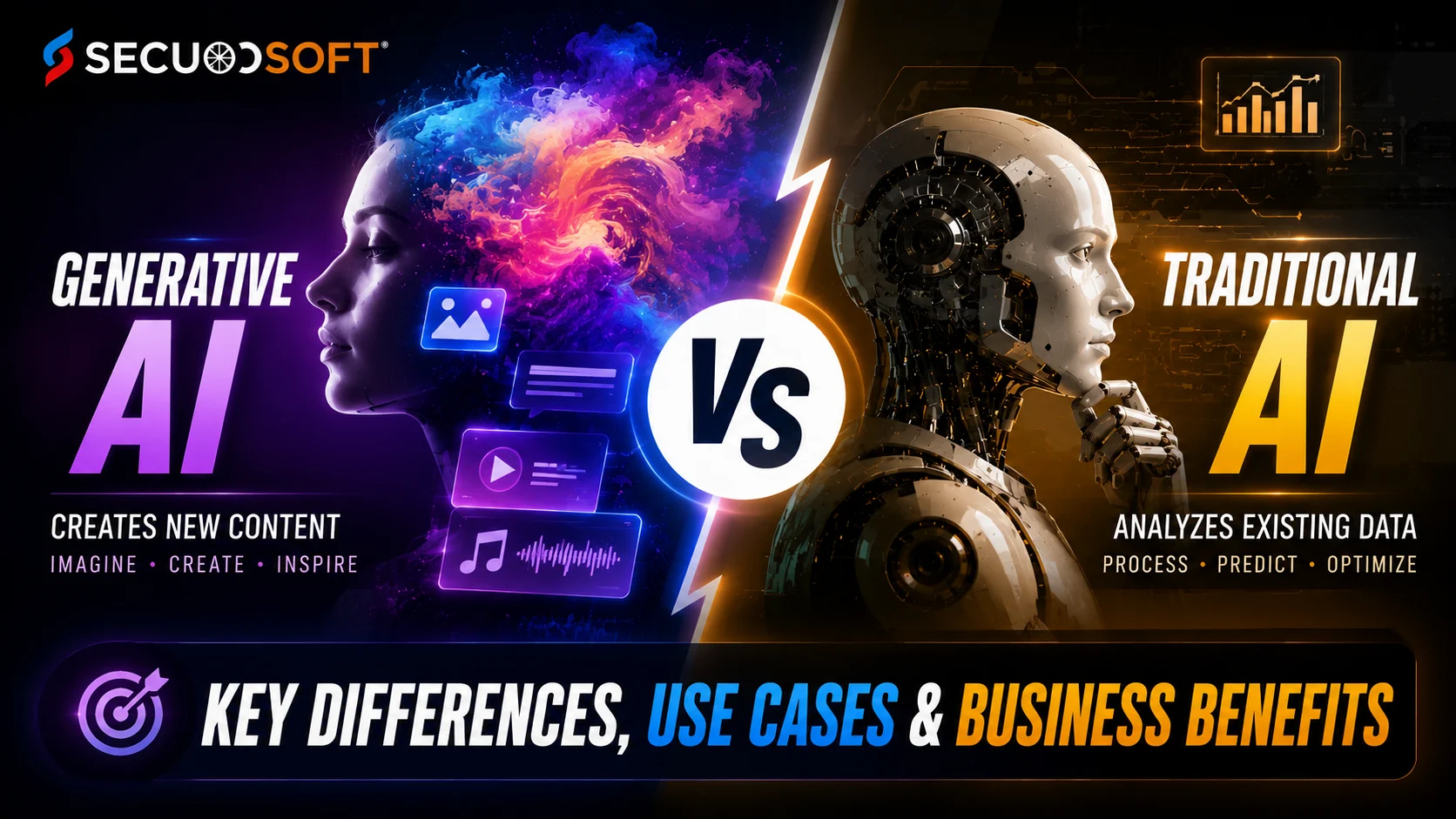
The confusion in business boardrooms is palpable. Someone mentions "AI" and executives immediately envision science fiction scenarios, machines thinking independently, understanding context intuitively, generating novel solutions. But the reality is more nuanced. Most AI implementations running today aren't generative at all. Traditional AI systems have quietly powered business decisions for two decades, predicting customer churn, detecting fraud, optimizing logistics. Now generative AI has arrived, capturing attention with its spectacular capabilities while traditional AI continues quietly delivering steady, measurable business value.
The challenge facing businesses in 2026 isn't choosing between generative and traditional AI, it's understanding their distinct strengths and deploying each where it creates maximum business impact. A financial institution might deploy traditional AI for fraud detection (99.7% accuracy improving year after year) while simultaneously using generative AI for customer support automation (50% reduction in support costs). A manufacturing company might leverage traditional AI's predictive maintenance capabilities (preventing ₹2-5 crore equipment failures) while using generative AI for quality documentation and reporting.
Businesses planning to implement either traditional AI or generative AI often benefit from working with experienced AI development services providers who can evaluate business requirements, recommend the right architecture, and build scalable AI solutions tailored to long-term business goals.
This practical guide clarifies exactly what distinguishes these technologies, when each creates business value, and how to build strategies leveraging both for competitive advantage.
Traditional AI (also called "narrow AI" or "classical AI") is designed to excel at specific, well-defined tasks through pattern recognition and rule-based learning. It learns from historical data, identifies patterns, and makes predictions or decisions based on those patterns.
You train the system on historical data showing examples of the pattern you want it to recognize. An email spam filter learns from thousands of labeled emails (spam vs. legitimate). A credit risk model learns from historical loan applicant data predicting default probability. A customer churn prediction system learns from historical customer behavior identifying signals preceding cancellation.
The system identifies statistical patterns in that data, creates mathematical models capturing those patterns, and applies those models to new situations. When new email arrives, the spam filter evaluates whether it matches spam patterns. When new loan applicant applies, the risk model scores them based on patterns from applicants like them historically.
Real business example: A retail chain deployed traditional AI analyzing 3 years of transaction history (₹50 crore in purchases). The system identified patterns predicting which customers would purchase within the next 30 days, enabling targeted marketing. Campaign conversion rate improved from 2% to 5.2% = additional ₹1 crore revenue annually.
Generative AI learns patterns in data, then generates completely new content that didn't exist in training data. Rather than predicting or classifying existing information, it creates new information.
Large language models like GPT-4 or Claude are trained on massive amounts of text (billions of documents, articles, books). Through this training, they learn statistical relationships between words, concepts, and ideas. They understand not just what words mean individually but how concepts connect and relate.
When you ask a generative AI system a question, it doesn't retrieve answers from a database. Instead, it generates a response by predicting what words logically follow previous words based on learned patterns. It constructs novel responses you've never seen before, customized to your specific question.
Real business example: A consulting firm implemented generative AI for proposal writing. Consultants input project requirements and key points. The system generates initial proposal drafts (40-50% complete), consultants refine them (adding specifics and legal details). Total proposal creation time decreased 70% (from 8 hours to 2.4 hours per proposal). For a firm generating 400 proposals annually = ₹80-120 lakh in labor time freed annually.
| Capability | Traditional AI | Generative AI |
|---|---|---|
| Primary Function | Prediction/classification | Content generation |
| Decision Explainability | High, can show reasoning path | Lower, complex neural networks |
| Adaptability | Specific to trained task | Generalizes across domains |
| Training Data Requirements | Moderate (thousands-millions) | Massive (billions of examples) |
| Speed to Deploy | Fast (weeks to months) | Moderate (months) for custom |
| Accuracy Metrics | 92-99% for specific tasks | 85-95% generally (varies by task) |
| Customization | Through retraining | Fine-tuning or prompting |
| Interpretability | Decision trees explainable | Black-box reasoning |
| Failure Modes | Degradation with out-of-distribution data | Hallucination/confident wrong answers |
| Cost to Deploy | Lower | Higher (compute-intensive) |
| Operational Reliability | Highly predictable | Somewhat unpredictable |
When you need consistent, measurable, explainable results: Traditional AI wins. Fraud detection systems must catch 99%+ of fraudulent transactions while falsely flagging <0.5% of legitimate transactions. The explainability matters, when system flags transaction as fraudulent, you must understand why to provide customer service explanation. Traditional AI excels here.
When you need creativity, context-awareness, and adaptation to novel situations: Generative AI wins. Customer support handling 500 daily inquiries, each unique, requiring human-like understanding of context and ability to generate appropriate responses. Generative AI provides conversational, contextually relevant responses. Traditional AI would require separate model for each question type.
When you need both: Deploy them together. Traditional AI identifies fraud signal triggers and scores transaction risk (quantitative). Generative AI explains to customer why transaction was flagged (qualitative explanation). Combined approach: high accuracy + customer satisfaction.
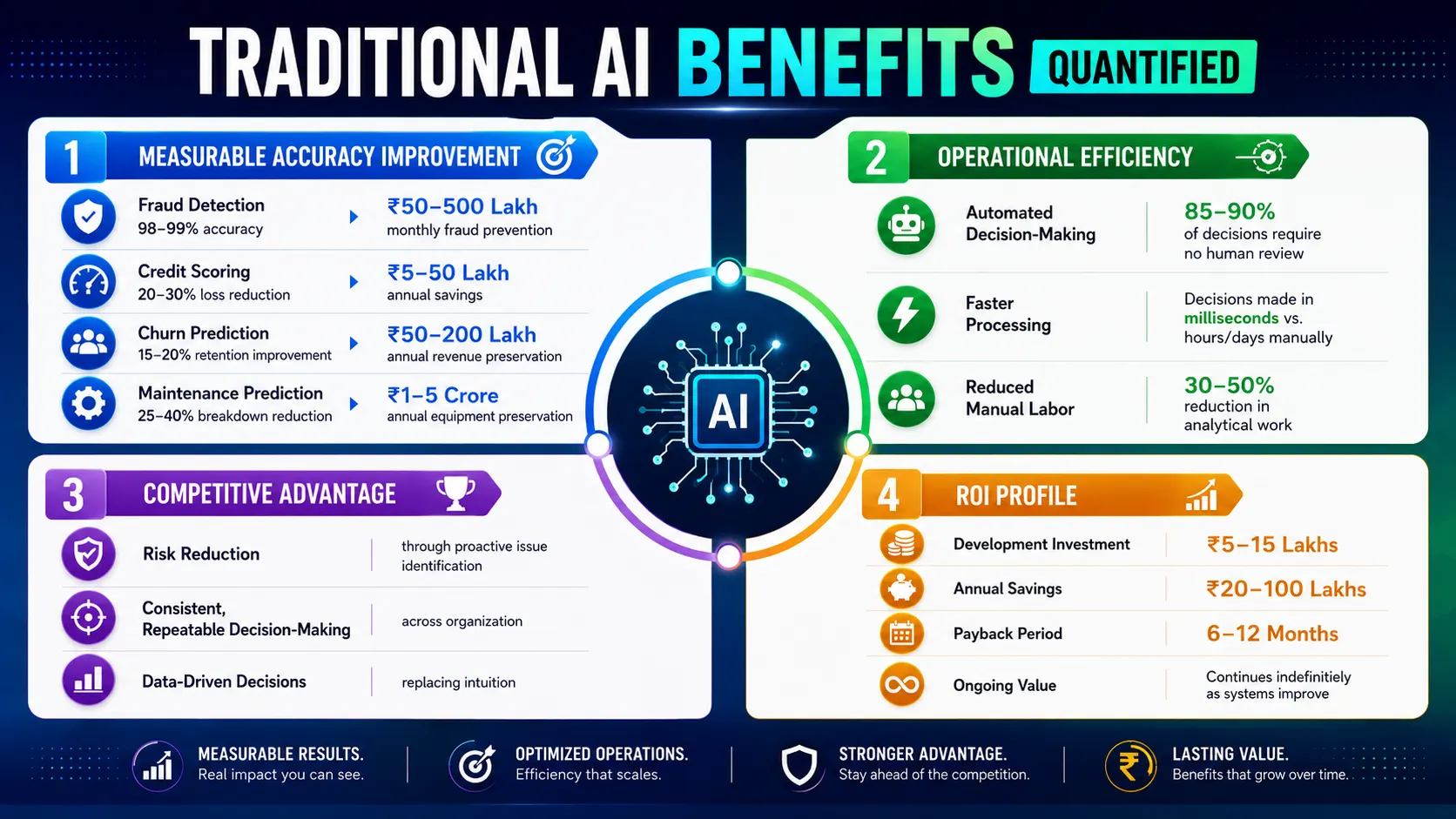
Enterprise banks process millions of transactions daily. Traditional AI models trained on historical fraud patterns identify suspicious transactions achieving 98-99% detection rates while maintaining <0.3% false positive rate. System flags potentially fraudulent transactions for investigation, preventing ₹50-500 lakhs in fraudulent losses monthly.
Manufacturing facilities deploy sensors monitoring equipment (vibration, temperature, sound patterns). Traditional AI models trained on historical equipment failure data predict failures 2-4 weeks in advance with 92-95% accuracy. Maintenance teams address issues preventively rather than reactively, preventing catastrophic failures costing ₹2-5 crore each.
Telecom and SaaS companies deploy traditional AI analyzing customer behavior (usage patterns, support contacts, billing history). System identifies customers at 70-80% churn risk. Sales teams proactively intervene with retention offers, improving retention 15-20% = ₹50-200 lakh revenue preservation annually.
Lending institutions evaluate loan applications using traditional AI scoring thousands of applicants daily. Models trained on historical loan performance data predict default probability. Reduces lending losses 20-30% while maintaining consistent approval rates.
Retail and manufacturing companies predict product demand using traditional AI analyzing sales history, seasonality, promotions, and external factors. Forecast accuracy improves 15-25%, enabling optimal inventory management preventing stockouts and overstocking.
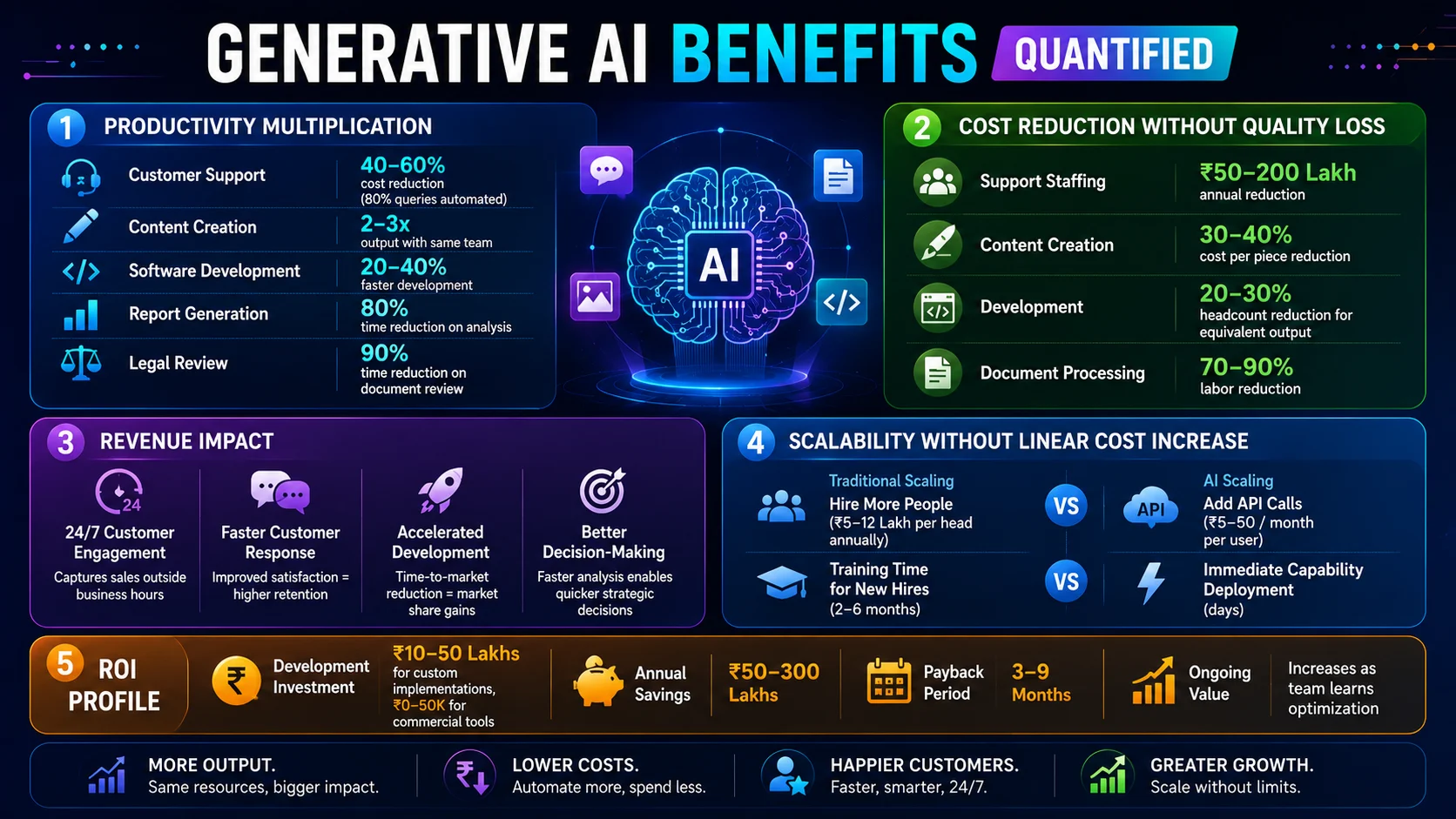
Generative AI chatbots handle 60-80% of customer inquiries (FAQs, order status, technical troubleshooting) across any product/service without requiring training for each question type. Remaining 20-40% of complex issues escalate to humans with full context. Customer satisfaction improves through 24/7 availability, faster first responses, reduced support costs 40-60%.
Businesses generate marketing copy, email campaigns, social media posts, blog content using generative AI. Human copywriters guide AI with briefs, AI generates initial drafts, humans refine. Content production increases 2-3x while costs decrease 30-40%. A marketing team creating 20 posts monthly increases to 50-60 posts with same staffing.
Developers use generative AI (GitHub Copilot, Cursor AI) generating code snippets, functions, and entire code blocks based on descriptions. Development speed increases 20-40%, reducing junior developer ramp-up time, improving code quality through pattern matching against millions of high-quality code examples. Developers focus on architecture and complex problems while AI handles routine coding.
Business analysts ask questions of large datasets in natural language. Generative AI interprets questions, performs analysis, generates insights, and creates visualizations automatically. Analysis that previously took 2-3 days takes 2-3 hours. C-suite gains faster business intelligence enabling quicker decisions.
Law firms extract information from thousands of contracts, identify risks, flag obligations using generative AI. Document review that required paralegals for weeks completes in hours. Legal teams focus on strategy and negotiation while AI handles repetitive analysis.
Organizations fine-tune large language models on proprietary data creating custom models understanding their specific business terminology, customer interactions, and domain expertise. Results: significantly better performance on their specific tasks than generic models.
| Phase | Cost | Timeline |
|---|---|---|
| Data Preparation | ₹25K-₹2L | 2-4 weeks |
| Model Development | ₹1.5L-₹8L | 6-10 weeks |
| Testing & Validation | ₹25K-₹1L | 2-3 weeks |
| Deployment | ₹25K-₹75K | 1-2 weeks |
| Total | ₹2.5L-₹11.75L | 12-20 weeks |
| Phase | Cost | Timeline |
|---|---|---|
| Prompt Engineering | ₹10K-₹50K | 1-2 weeks |
| Fine-tuning (Optional) | ₹50K-₹10L | 3-8 weeks |
| Integration Development | ₹50K-₹5L | 2-6 weeks |
| Testing & Refinement | ₹25K-₹1.5L | 2-4 weeks |
| Total | ₹1.35L-₹16.5L | 8-20 weeks |
You need consistently measurable, explainable, precise decisions in well-defined domains. Fraud detection, credit scoring, maintenance prediction, churn forecasting, all cases where accuracy and explainability matter critically.
Your business problem has clear historical data showing patterns you want to recognize repeatedly. The more historical examples available, the better traditional AI performs.
You need to comply with regulations requiring explainability. Financial decisions, medical diagnoses, legal determinations increasingly require showing why a system made a decision. Traditional AI provides this transparency; generative AI cannot easily explain its reasoning.
Your task scope is narrowly defined. Optimizing for one specific outcome (maximize prediction accuracy) rather than handling open-ended varied scenarios.
You need human-like communication, understanding of context, and ability to handle varied, novel situations. Customer support, content creation, research synthesis, cases where conversational ability matters.
Your use case benefits from creativity and novel generation rather than pattern matching. Creating marketing copy, generating code, synthesizing information into new documents.
You lack large historical datasets but have textual information or domain expertise you can leverage. Generative AI transfers knowledge from massive pre-training rather than requiring you to collect and label training data.
Your business gains from 24/7 availability, rapid deployment, and scalability without hiring. Supporting customers worldwide in multiple languages 24/7 becomes feasible.
You want comprehensive AI strategy. Use traditional AI for precise risk assessment and measurement. Use generative AI for customer interaction and content. Combined approach delivers measurable business value + customer experience improvement.
Successfully integrating AI into existing business workflows usually requires robust custom software development that connects AI models with enterprise applications, databases, CRMs, ERPs, and other operational systems.
Example: Insurance company uses traditional AI to score claims risk (98% accuracy), generative AI to draft claim decisions and communicate with claimants (customer-friendly, consistent tone).
Implementing AI successfully requires more than integrating the latest models. Businesses need solutions that align with their workflows, integrate seamlessly with existing systems, and deliver measurable improvements in efficiency, customer experience, and decision-making. At Secuodsoft, we combine deep software engineering expertise with practical AI implementation strategies to build solutions that solve real business challenges instead of simply showcasing new technology.
From predictive AI models and intelligent automation to generative AI applications powered by large language models, our team develops scalable, secure, and business-focused AI solutions tailored to each organization's objectives. Whether you're looking to automate operations, enhance customer engagement, or unlock insights from enterprise data, we help transform AI investments into long-term competitive advantages.
Generative AI and traditional AI are not competing technologies, they are complementary approaches designed to solve different business challenges. Traditional AI excels at prediction, pattern recognition, and data-driven decision-making, while generative AI empowers businesses with intelligent content creation, natural language interactions, and workflow automation. Understanding these differences enables organizations to invest in the right AI strategy instead of following industry hype.
As AI adoption continues to accelerate in 2026 and beyond, businesses that strategically combine traditional AI with generative AI will be better positioned to improve operational efficiency, enhance customer experiences, and drive long-term innovation. The key to success lies in identifying the right use cases, choosing the appropriate technology, and partnering with an experienced AI development company that can build scalable, secure, and future-ready solutions aligned with your business goals.
Copyright ©2026 Secuodsoft. All rights reserved.