Software Development
Editorial Team
09 Mar 2026
The Indian real estate sector managing ₹200+ trillion in assets faces mounting operational challenges, with 52% of property managers losing ₹8-40 lakhs annually due to inefficient rent collection, poor tenant communication, maintenance tracking chaos, and manual documentation creating operational nightmares that erode profitability and tenant satisfaction. Modern property management software has evolved from basic spreadsheets to comprehensive platforms integrating tenant management, rent collection, maintenance tracking, financial reporting, and owner portals, yet 65% of property management software development projects fail due to inadequate feature planning, poor vendor selection, or unrealistic budgets, wasting ₹10-35 lakhs on systems failing to address critical property management needs. Whether you're managing residential apartments in Mumbai, commercial complexes in Bangalore, co-living spaces in Delhi, vacation rentals in Goa, or industrial properties across India, implementing the right real estate management software can transform operations delivering 40-60% reduction in administrative time, 30-50% improvement in rent collection, 25-35% decrease in maintenance costs, and 50-70% better tenant satisfaction providing competitive advantage in India's booming real estate market.
This comprehensive 2026 guide covers everything about property management software development, from essential features (tenant portals, online rent payment, maintenance management) and realistic pricing (₹5-35 lakhs based on complexity) to technology choices, implementation processes, and proven strategies maximizing ROI from your property technology investment.
Understanding Property Management Software
What is Property Management Software?
Property management software is a comprehensive digital platform integrating all aspects of property operations, from tenant acquisition and lease management to rent collection, maintenance coordination, financial reporting, and owner communication, providing centralized control and visibility over residential, commercial, or mixed-use property portfolios.
Core Functions:
- Property and unit management
- Tenant relationship management
- Rent collection and accounting
- Maintenance and work orders
- Financial reporting and analytics
- Tenant and owner portals
- Document management
- Automated notifications and reminders
Since every property business operates differently, many companies now prefer custom web application development instead of generic SaaS platforms to ensure better flexibility, integrations, and long-term scalability.
Property Management Software vs Manual Operations
| Aspect |
Manual Operations |
Property Management Software |
| Rent Collection |
Cash/checks, 7-10 days |
Online payment, instant (98% faster) |
| Maintenance Tracking |
Phone calls, paper |
Digital ticketing, 60% faster resolution |
| Tenant Communication |
Calls, physical notices |
SMS, email, app (80% time saved) |
| Vacancy Management |
Manual listings, ads |
Auto-posting to portals, 40% faster leasing |
| Financial Reports |
Manual spreadsheets, 2-3 days |
Automated, real-time, instant |
| Document Storage |
Physical files, risk of loss |
Cloud-based, secure, instant access |
| Lease Renewals |
Manual tracking, missed renewals |
Automated reminders, 90% on-time |
| Operational Cost |
Hidden inefficiency costs |
₹5L-35L (saves 8-15x annually) |
Types of Property Management Software
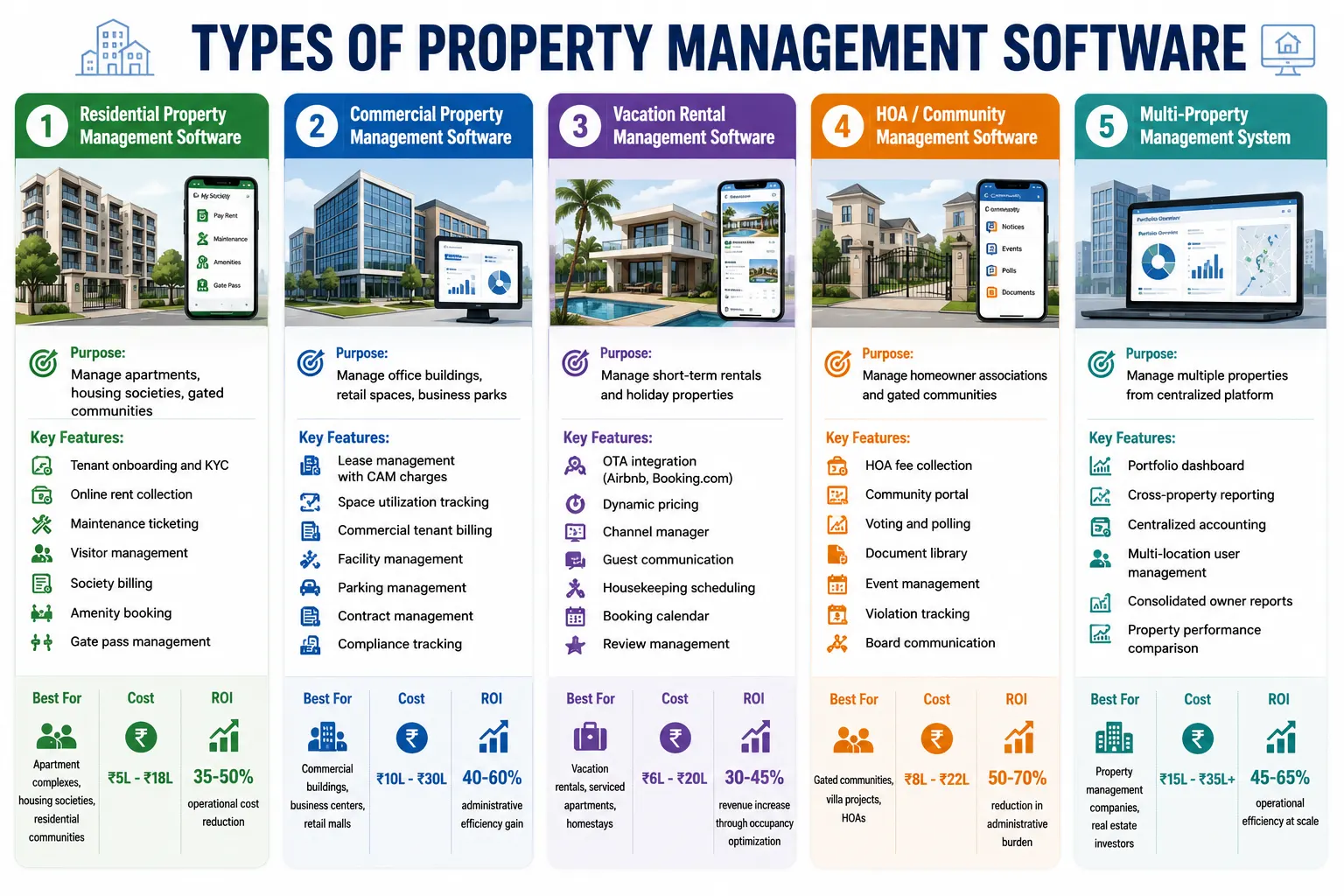
1. Residential Property Management Software
Purpose:Manage apartments, housing societies, gated communities
Key Features:
- Tenant onboarding and KYC
- Online rent collection
- Maintenance ticketing
- Visitor management
- Society billing (maintenance, utilities)
- Amenity booking
- Gate pass management
Modern residential communities are also adopting mobile app development solutions to enable tenants, maintenance teams, and property managers to communicate and manage operations in real time.
Best For:Apartment complexes, housing societies, residential communities Cost: ₹5L - ₹18L ROI: 35-50% operational cost reduction
2. Commercial Property Management Software
Purpose:Manage office buildings, retail spaces, business parks
Key Features:
- Lease management with CAM charges
- Space utilization tracking
- Commercial tenant billing
- Facility management
- Parking management
- Contract management
- Compliance tracking
Commercial real estate companies are increasingly leveraging AI & machine learning solutions to analyze occupancy trends, optimize leasing decisions, and improve operational efficiency across large property portfolios.
Best For:Commercial buildings, business centres, retail malls Cost: ₹10L - ₹30L ROI: 40-60% administrative efficiency gain
3. Vacation Rental Management Software
Purpose:Manage short-term rentals and holiday properties
Key Features:
- OTA integration (Airbnb, Booking.com)
- Dynamic pricing
- Channel manager
- Guest communication
- Housekeeping scheduling
- Booking calendar
- Review management
Best For:Vacation rentals, serviced apartments, homestays Cost: ₹6L - ₹20L ROI: 30-45% revenue increase through occupancy optimization
4. HOA/Community Management Software
Purpose:Manage homeowner associations and gated communities
Key Features:
- HOA fee collection
- Community portal
- Voting and polling
- Document library
- Event management
- Violation tracking
- Board communication
Best For:Gated communities, villa projects, HOAs Cost: ₹8L - ₹22L ROI: 50-70% reduction in administrative burden
5. Multi-Property Management System
Purpose:Manage multiple properties from centralized platform
Key Features:
- Portfolio dashboard
- Cross-property reporting
- Centralized accounting
- Multi-location user management
- Consolidated owner reports
- Property performance comparison
Best For:Property management companies, real estate investors Cost: ₹15L - ₹35L+ ROI: 45-65% operational efficiency at scale
Essential Features of Property Management Software
1. Property & Unit Management
Property Operations:
Property Database
- Property details and documentation
- Unit/floor/wing organization
- Amenity tracking
- Asset management
- Insurance and compliance docs
Unit Management
- Unit specifications (size, type, rent)
- Availability status tracking
- Unit photos and virtual tours
- Occupancy history
- Market rent analysis
2. Tenant Management
Tenant Lifecycle:
| Stage |
Features |
Impact |
| Acquisition |
Online applications, credit checks |
40% faster screening |
| Onboarding |
Digital lease signing, KYC, deposits |
60% paperwork reduction |
| Communication |
Portal, app, SMS, email notifications |
80% inquiry reduction |
| Renewals |
Automated reminders, renewal workflows |
90% on-time renewals |
| Move-out |
Checklist, deposit settlement, exit reports |
50% faster processing |
Many modern property platforms are also integrating AI-powered face recognition systems for digital tenant verification, secure visitor management, and enhanced property security.
3. Rent Collection & Financial Management
Revenue Operations:
Online Rent Collection
- Multiple payment methods (UPI, cards, net banking, wallets)
- Recurring payment setup
- Auto-debit integration
- Payment reminders
- Late fee calculation
- Receipt generation
Financial Management
- Automated invoicing
- Expense tracking
- Bank reconciliation
- Owner disbursements
- GST compliance
- Profit & loss statements
- Cash flow management
4. Maintenance & Work Order Management
Facility Operations:
Maintenance Ticketing
- Tenant can raise tickets via app/portal
- Priority classification (urgent, high, normal)
- Vendor assignment
- Photo/video attachments
- Status tracking
- Resolution timeline
Preventive Maintenance
- Scheduled maintenance calendars
- Asset maintenance tracking
- Vendor management
- Spare parts inventory
- Maintenance history
5. Lease Management
Contract Operations:
- Digital lease creation and signing
- Lease template library
- Renewal tracking with alerts
- Lease clause management
- Escalation calculations
- Security deposit tracking
- Notice period management
6. Reporting & Analytics
Business Intelligence:
Property Reports:
- Occupancy rates and trends
- Rent roll reports
- Delinquency reports
- Vacancy analysis
- Property performance comparison
Financial Reports:
- Income statements
- Balance sheets
- Cash flow reports
- Accounts payable/receivable
- Tax reports
- Owner statements
Operational Reports:
- Maintenance response times
- Tenant satisfaction scores
- Vendor performance
- Staff productivity
7. Tenant & Owner Portals
Self-Service Platforms:
Tenant Portal Features:
- View lease details
- Pay rent online
- Raise maintenance requests
- Access documents
- View announcements
- Communicate with management
Owner Portal Features:
- Property performance dashboards
- Revenue and expense reports
- Occupancy analytics
- Payment disbursement tracking
- Document access
8. Mobile Applications
On-the-Go Management:
- Property manager mobile app
- Tenant mobile app
- Maintenance staff app
- Owner mobile app
- Offline mode capability
- Push notifications
Property Management Software Development Cost
Cost by Property Type and Scale
| Property Type |
Basic Features |
Standard Features |
Advanced Features |
| Small Residential (10-50 units) |
₹5L - ₹10L |
₹10L - ₹15L |
₹15L - ₹20L |
| Medium Residential (50-200 units) |
₹10L - ₹18L |
₹18L - ₹25L |
₹25L - ₹35L |
| Commercial Properties |
₹12L - ₹20L |
₹20L - ₹30L |
₹30L - ₹45L |
| Vacation Rentals |
₹6L - ₹12L |
₹12L - ₹20L |
₹20L - ₹28L |
| Multi-Property Portfolio |
₹15L - ₹25L |
₹25L - ₹40L |
₹40L - ₹60L+ |
Detailed Cost Components
1. Discovery & Planning (10-15%)
Cost: ₹50K - ₹6L
- Property management workflow analysis
- Feature requirement documentation
- Compliance requirements (RERA, local laws)
- Integration planning
- Technology selection
2. Core Development (40-50%)
| Module |
Development Cost |
| Property & Unit Management |
₹1L - ₹8L |
| Tenant Management |
₹1.5L - ₹7L |
| Rent Collection & Accounting |
₹1.5L - ₹8L |
| Maintenance Management |
₹1L - ₹6L |
| Lease Management |
₹75K - ₹5L |
| Reporting & Analytics |
₹1L - ₹6L |
| Document Management |
₹75K - ₹4L |
3. Portal & Mobile App Development (20-25%)
- Admin web portal: ₹2L - ₹8L
- Tenant portal: ₹1.5L - ₹6L
- Owner portal: ₹1.5L - ₹6L
- Mobile apps (iOS + Android): ₹3L - ₹12L
4. Integrations (10-15%)
| Integration Type |
Cost Range |
| Payment Gateways |
₹40K - ₹2L |
| SMS/Email Services |
₹30K - ₹1.5L |
| Accounting Software (Tally, QuickBooks) |
₹60K - ₹2.5L |
| Property Portals (99acres, MagicBricks) |
₹50K - ₹2L |
| OTA (Airbnb, Booking.com) |
₹75K - ₹3L per platform |
| Digital Signature |
₹40K - ₹1.5L |
| KYC/Background Check |
₹50K - ₹2L |
5. Testing & Deployment (10-12%)
Cost: ₹60K - ₹5L
- Functional testing
- Security testing
- Performance testing
- User acceptance testing
- Data migration
- Training and documentation
6. Annual Maintenance (15-20% of development)
Cost: ₹75K - ₹8L/year
- Bug fixes and updates
- Technical support
- Server maintenance
- Feature enhancements
- Security patches
- Compliance updates
Sample Project Cost
Medium Residential Property (100 units, 3 properties)
| Component |
Cost |
Timeline |
| Planning & Design |
₹1.5L |
2 weeks |
| Property & Tenant Management |
₹4L |
6 weeks |
| Rent Collection & Accounting |
₹3.5L |
5 weeks |
| Maintenance Management |
₹2.5L |
4 weeks |
| Portals (Tenant, Owner) |
₹4L |
6 weeks |
| Mobile Apps |
₹5L |
7 weeks |
| Integrations (3) |
₹2L |
3 weeks |
| Testing & Deployment |
₹1.5L |
2 weeks |
| Total |
₹24L |
5-6 months |
| Annual Maintenance |
₹4L |
Ongoing |
ROI and Business Benefits
Expected Returns
Operational Efficiency:
- 50-70% reduction in administrative time
- 60-80% decrease in paperwork
- 95%+ accuracy in financial records
- Real-time operational visibility
Financial Impact:
- 30-50% improvement in rent collection rates
- 40-60% faster rent collection (7 days to 1 day)
- 25-35% reduction in late payments
- 20-30% reduction in accounting costs
Tenant & Owner Satisfaction:
- 50-70% increase in tenant satisfaction
- 80% reduction in support inquiries
- 60% improvement in lease renewals
- 40% increase in positive reviews
Maintenance Optimization:
- 50-60% faster issue resolution
- 25-35% reduction in maintenance costs
- 90% completion tracking
- 40% better vendor management
ROI Calculation Example
Investment: ₹20 lakhs (100-unit residential property)
Annual Benefits:
- Faster rent collection (improved cash flow): ₹8L
- Reduced administrative staff (1 position): ₹5L
- Lower late payment losses: ₹3L
- Maintenance cost optimization: ₹4L
- Improved occupancy (fewer vacancies): ₹6L
- Total Annual Benefit: ₹26L
ROI = (₹26L - ₹20L) / ₹20L × 100 = 30% Payback Period: 9 months 3-Year ROI: 290%
Implementation Process
Phase 1: Discovery (2-3 weeks)
- Current process documentation
- Pain point analysis
- Feature prioritization
- Compliance review (RERA, local laws)
- Budget and timeline planning
Phase 2: Design (2-3 weeks)
- User interface design
- Workflow mapping
- Database architecture
- Integration design
- Security planning
Phase 3: Development (12-20 weeks)
- Weeks 1-5: Core modules (property, tenant, rent)
- Weeks 6-10: Financial and maintenance
- Weeks 11-15: Portals and mobile apps
- Weeks 16-20: Integrations and reporting
Phase 4: Testing (3-4 weeks)
- Functional testing
- Financial accuracy testing
- Security testing
- Performance testing
- User acceptance testing
Phase 5: Deployment (2-3 weeks)
- Data migration from existing systems
- Staff training (property managers, accountants)
- Tenant onboarding
- Soft launch with pilot properties
- Full rollout
Phase 6: Support (Ongoing)
- Technical support helpdesk
- Monthly system health checks
- Quarterly feature updates
- Annual strategic reviews
Why Choose Secuodsoft for Property Management Software Development
Secuodsoft helps real estate businesses streamline property operations through scalable and intelligent property management software solutions tailored for residential, commercial, and multi-property environments. From automated rent collection and tenant management to maintenance workflows, owner portals, and analytics dashboards, we develop centralized platforms that simplify day-to-day property operations while improving tenant satisfaction and operational efficiency.
Our development approach focuses on building secure, cloud-based, and mobile-friendly systems that support real-time property monitoring, digital communication, online payments, and seamless third-party integrations. Whether you manage apartments, gated communities, commercial spaces, co-living properties, or large real estate portfolios, our solutions are designed to adapt to evolving business needs and support long-term scalability.
Our Property Management Software Capabilities
- Tenant and lease management systems
- Online rent collection and billing automation
- Maintenance and work order management
- Tenant and owner self-service portals
- Mobile applications for property operations
- AI-powered analytics and reporting
- Multi-property and multi-location management
- Cloud-based real estate management platforms
- Secure document and financial management
- Third-party integrations (payment gateways, ERP, CRM, accounting software)
Property Segments We Serve
- Residential apartments and housing societies
- Commercial office buildings and business parks
- Retail complexes and shopping malls
- Vacation rentals and serviced apartments
- Co-living and PG management platforms
- Industrial and warehouse properties
- Mixed-use real estate projects
- Gated communities and villa management
Why Businesses Choose Secuodsoft
- Industry-focused custom software development approach
- Scalable architecture for growing property portfolios
- Strong expertise in web and mobile technologies
- Real-time dashboards and operational visibility
- Seamless integration with modern real estate ecosystems
- Dedicated support, maintenance, and future scalability planning

Conclusion
Property management software development has become essential for Indian property managers, real estate investors, and facility managers seeking competitive advantages through operational efficiency, improved tenant satisfaction, and financial optimization in 2026. Investing ₹5-35 lakhs in quality property management software delivers 40-60% administrative efficiency gains, 30-50% improvement in rent collection, and 9-13 month payback periods through streamlined operations, automated workflows, and data-driven decision-making. Success requires understanding essential features (tenant portals, online payments, maintenance tracking), realistic budgeting based on property type and scale, choosing experienced real estate software development companies understanding property management complexities, and proper implementation with comprehensive training. Whether managing residential apartments, commercial buildings, vacation rentals, or multi-property portfolios, partner with proven developers like Secuodsoft who combine technical expertise with real estate domain knowledge, ensuring your investment transforms property operations delivering measurable returns through reduced costs, improved tenant satisfaction, and enhanced owner value.
Frequently Asked Questions
Property management software development costs range from ₹5 lakhs to ₹40 lakhs+ depending on property type, scale, features, and integrations.
Property management software development typically takes 2–10 months based on complexity, features, integrations, and deployment requirements.
Essential features include tenant management, rent collection, maintenance tracking, lease management, reporting, communication tools, and payment integrations.
Ready-made software is faster and affordable, while custom solutions provide full flexibility, ownership, and scalability for unique business needs.
Property management software improves profitability through faster rent collection, reduced vacancies, maintenance optimization, automation, and improved tenant retention.