AWS vs Azure vs Google Cloud is one of the most common comparisons businesses make when planning their cloud strategy. Cloud computing has become the backbone of modern digital transformation, whether you're launching a startup, modernizing enterprise infrastructure, building AI-powered applications, or migrating legacy systems. Choosing the right cloud platform can significantly impact performance, scalability, security, compliance, and long-term operational costs, making it essential to understand how these three leading cloud providers differ before making an investment.
Among the major cloud providers, Amazon Web Services (AWS), Microsoft Azure, and Google Cloud Platform (GCP) dominate the global market. Together, they power millions of businesses worldwide, from startups and SaaS companies to Fortune 500 enterprises and government organizations. Yet despite offering similar core services, each platform has distinct strengths, pricing models, ecosystems, and ideal use cases.
So, which cloud platform is right for your business?
The answer depends on several factors, including your existing technology stack, workload requirements, budget, compliance needs, AI ambitions, and future scalability plans.
This comprehensive guide compares AWS vs Azure vs Google Cloud across performance, pricing, security, AI capabilities, developer experience, and business scenarios to help you make an informed decision in 2026.
Before comparing them, it's important to understand what each provider brings to the market.
Launched in 2006, AWS is the world's largest public cloud platform and the market leader in cloud infrastructure. It offers over 250 cloud services covering computing, storage, networking, databases, analytics, IoT, machine learning, DevOps, and serverless computing.
AWS is known for:
It is widely adopted by startups, SaaS businesses, media companies, fintech firms, and global enterprises.
Microsoft Azure is Microsoft's enterprise-focused cloud platform designed to integrate seamlessly with Windows Server, Microsoft 365, Active Directory, SQL Server, and other Microsoft technologies.
Azure is especially popular among organizations already using Microsoft products because migration and identity management become significantly easier.
Azure excels in:
Large enterprises and government agencies often choose Azure because of its enterprise agreements and existing Microsoft investments.
Google Cloud leverages the same infrastructure powering Google's own products such as Search, Gmail, Maps, and YouTube.
Although Google Cloud entered the enterprise cloud market later than AWS and Azure, it has become a preferred platform for data analytics, machine learning, Kubernetes, and AI-driven workloads.
Google Cloud stands out for:
Companies focused on AI innovation and cloud-native development increasingly prefer GCP.
| Feature | AWS | Microsoft Azure | Google Cloud |
|---|---|---|---|
| Launch Year | 2006 | 2010 | 2011 |
| Global Market Share | Highest | Second | Third |
| Data Center Regions | 35+ | 60+ | 40+ |
| Cloud Services | 250+ | 200+ | 180+ |
| Best For | Startups & Enterprises | Microsoft Businesses | AI & Analytics |
| Hybrid Cloud | Excellent | Outstanding | Good |
| AI & Machine Learning | Excellent | Excellent | Outstanding |
| Kubernetes Support | Excellent | Excellent | Best |
| Enterprise Adoption | Very High | Very High | High |
All three providers offer similar cloud services, but their strengths vary.
| Service Category | AWS | Azure | Google Cloud |
|---|---|---|---|
| Virtual Machines | EC2 | Azure Virtual Machines | Compute Engine |
| Object Storage | S3 | Blob Storage | Cloud Storage |
| Databases | RDS, DynamoDB | Azure SQL | Cloud SQL, Spanner |
| Containers | ECS, EKS | AKS | GKE |
| Serverless | Lambda | Azure Functions | Cloud Functions |
| AI Services | SageMaker | Azure AI | Vertex AI |
| Data Analytics | Redshift | Synapse | BigQuery |
| DevOps | CodePipeline | Azure DevOps | Cloud Build |
Although these services solve similar problems, implementation experience differs considerably.
Cloud pricing remains one of the biggest challenges for businesses because every provider offers multiple pricing models.
These include:
Here's a simplified comparison.
| Pricing Factor | AWS | Azure | Google Cloud |
|---|---|---|---|
| Pay-as-you-go | ✔ | ✔ | ✔ |
| Reserved Discounts | Up to 72% | Up to 72% | Up to 70% |
| Spot Instances | Excellent | Excellent | Excellent |
| Free Tier | 12 Months + Always Free | 12 Months | Always Free Services |
| Cost Optimization Tools | Excellent | Excellent | Excellent |
There is no universal answer.
Generally:
Instead of comparing only hourly pricing, businesses should evaluate the Total Cost of Ownership (TCO), including storage, networking, licensing, support, and operational management.
Performance depends heavily on the geographic location of users and applications.
AWS currently maintains the largest mature cloud infrastructure worldwide.
Azure has one of the broadest enterprise-ready regional networks.
Google Cloud benefits from Google's global private fiber network, delivering excellent network performance and low latency.
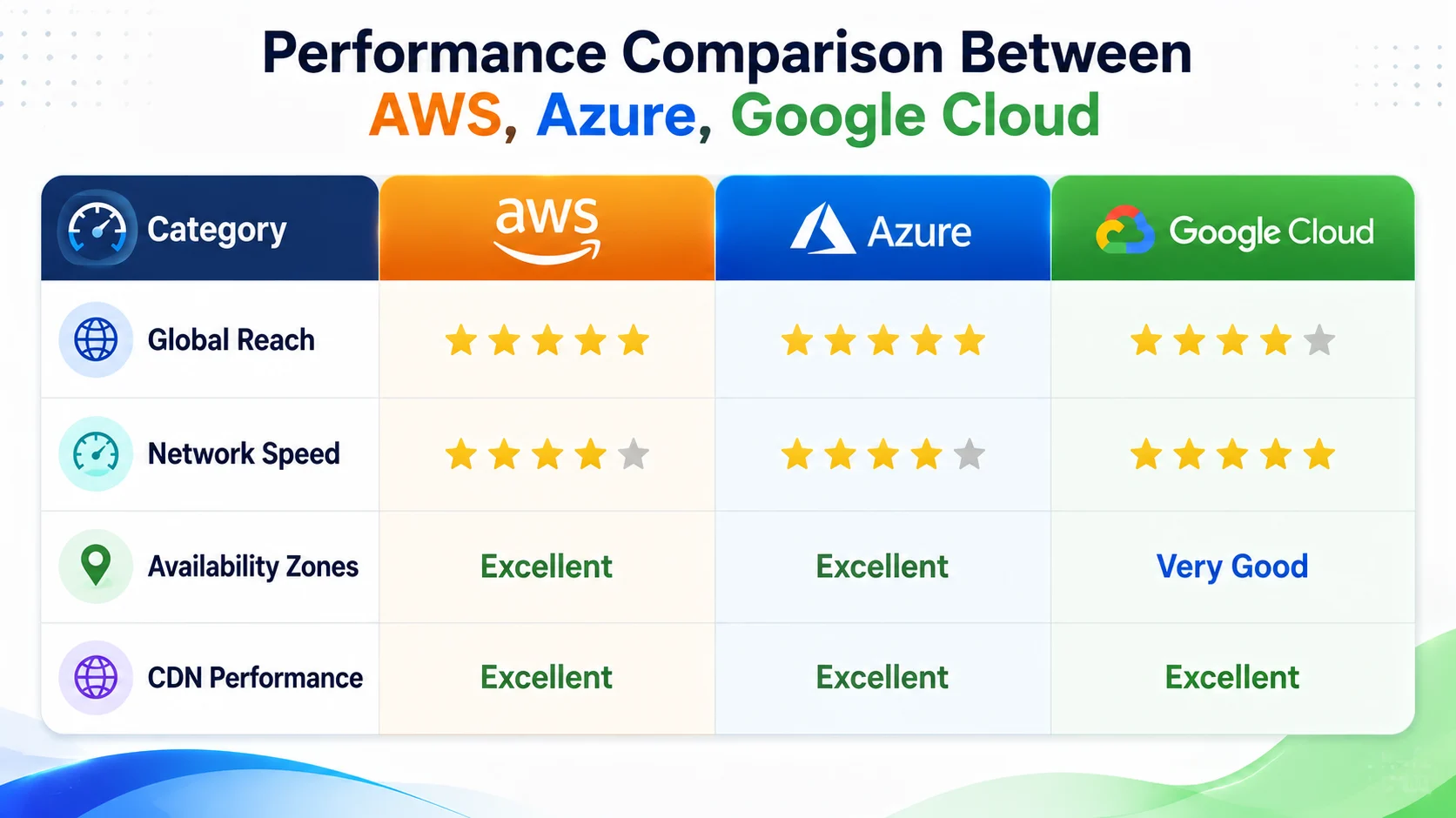
Businesses serving customers across multiple continents should prioritize providers with strong regional availability and disaster recovery capabilities.
Security remains one of the most important considerations when selecting a cloud provider.
Fortunately, all three providers invest billions annually in cybersecurity and maintain compliance with international standards such as:
Each platform follows a shared responsibility model, meaning the provider secures the infrastructure while customers remain responsible for securing applications, identities, and data.
AWS
Microsoft Azure
Google Cloud
Artificial Intelligence has become one of the biggest deciding factors when choosing a cloud platform. While all three providers offer AI and machine learning services, their focus areas differ significantly.
AWS provides a mature ecosystem with services like Amazon SageMaker for building, training, and deploying machine learning models at scale. It is widely adopted by enterprises that require flexibility, extensive integrations, and production-ready ML pipelines.
Microsoft Azure focuses on enterprise AI by integrating Azure AI Services, Azure Machine Learning, and Microsoft Copilot technologies into existing business applications. Organizations already using Microsoft products benefit from a seamless AI ecosystem.
Google Cloud has established itself as a leader in AI innovation. Services such as Vertex AI, BigQuery ML, Gemini models, and Tensor Processing Units (TPUs) make it particularly attractive for businesses building generative AI, predictive analytics, recommendation engines, and large-scale data science solutions.
| Feature | AWS | Azure | Google Cloud |
|---|---|---|---|
| Machine Learning Platform | SageMaker | Azure Machine Learning | Vertex AI |
| Generative AI | Amazon Bedrock | Azure OpenAI Service | Gemini & Vertex AI |
| Big Data Analytics | Redshift | Synapse Analytics | BigQuery |
| AutoML | Yes | Yes | Excellent |
| AI Leadership | Excellent | Excellent | Outstanding |
If AI and advanced analytics are central to your business strategy, Google Cloud currently offers one of the strongest ecosystems for modern AI development, while AWS and Azure provide exceptional enterprise-grade AI capabilities.
Today's businesses rarely rely on a single cloud platform. Many organizations adopt hybrid cloud or multi-cloud strategies to improve flexibility, reduce vendor lock-in, and enhance disaster recovery.
Hybrid cloud combines on-premise infrastructure with public cloud services, while multi-cloud uses services from multiple cloud providers simultaneously.
| Capability | AWS | Azure | Google Cloud |
|---|---|---|---|
| Hybrid Cloud | Excellent | Outstanding | Good |
| Multi-Cloud Management | Good | Excellent | Excellent |
| Kubernetes Support | Excellent | Excellent | Best |
| Edge Computing | Strong | Strong | Strong |
Microsoft Azure is widely regarded as the leader in hybrid cloud due to services like Azure Arc and Azure Stack, making it an ideal choice for enterprises transitioning gradually from on-premise infrastructure.
Google Cloud, on the other hand, excels in Kubernetes and container orchestration through Google Kubernetes Engine (GKE), reflecting Google's original contribution to Kubernetes.
A cloud platform isn't just evaluated by infrastructure, it also needs to empower developers to build, deploy, and manage applications efficiently.
AWS provides the largest collection of developer tools and services, but its extensive portfolio can create a steeper learning curve for beginners.
Best for:
Azure offers an intuitive experience for developers already working within Microsoft's ecosystem.
Integration with Visual Studio, GitHub, Azure DevOps, and Microsoft Entra ID makes development and deployment smoother for enterprise teams.
Best for:
Google Cloud emphasizes simplicity and cloud-native development.
Developers appreciate its clean interface, excellent documentation, Kubernetes leadership, and powerful data analytics tools.
Best for:
| Platform | Advantages | Limitations |
|---|---|---|
| AWS | Largest service portfolio, mature ecosystem, global infrastructure, strong scalability | Complex pricing, steeper learning curve |
| Azure | Excellent Microsoft integration, hybrid cloud leadership, enterprise compliance | Interface can feel overwhelming, some services depend heavily on Microsoft technologies |
| Google Cloud | Outstanding AI capabilities, BigQuery, Kubernetes leadership, developer-friendly | Smaller enterprise ecosystem compared to AWS and Azure |
There is no single "best" cloud provider. The right platform depends on your business goals and technology requirements.
| Business Type | Recommended Platform | Reason |
|---|---|---|
| Startup | AWS or Google Cloud | Fast deployment, scalability, startup programs |
| Small Business | Azure | Easy Microsoft integration and business productivity tools |
| Enterprise | Azure or AWS | Security, compliance, enterprise management |
| AI & Machine Learning | Google Cloud | Vertex AI, Gemini, BigQuery |
| SaaS Company | AWS | Mature cloud services and scalability |
| E-commerce | AWS | High availability and global infrastructure |
| Healthcare | Azure | Strong compliance and hybrid cloud capabilities |
| Banking & Finance | AWS or Azure | Enterprise-grade security and regulatory compliance |
| Government | Azure | Government cloud offerings and compliance |
| Media & Streaming | AWS | Content delivery, storage, and compute services |
Many organizations focus solely on pricing, overlooking factors that have a much greater impact on long-term success.
The cheapest cloud platform isn't always the most cost-effective. Licensing, networking, storage, support, and operational management all contribute to the total cost of ownership.
Businesses already invested in Microsoft technologies often achieve better integration and lower migration costs with Azure, while cloud-native startups may benefit more from AWS or Google Cloud.
Industries such as healthcare, finance, and government must prioritize compliance certifications, identity management, and governance features rather than simply comparing compute prices.
Cloud adoption should support long-term scalability. Businesses expecting rapid growth should evaluate future AI capabilities, global expansion, and automation requirements before selecting a provider.
Migrating to the cloud involves much more than moving applications from on-premise infrastructure to virtual servers. A successful cloud strategy requires careful planning, architecture design, security implementation, performance optimization, and cost management. At Secuodsoft, we help businesses choose the right cloud platform based on their operational requirements, existing technology ecosystem, and long-term growth strategy rather than promoting a one-size-fits-all solution.
Our cloud experts specialize in cloud migration, application modernization, DevOps implementation, containerization, cloud-native development, and managed cloud services across AWS, Microsoft Azure, and Google Cloud Platform. Whether you're building a new SaaS application, migrating enterprise workloads, or implementing a hybrid cloud environment, we deliver secure, scalable, and future-ready cloud solutions that accelerate digital transformation while optimizing performance and operational costs.
Choosing between AWS vs Azure vs Google Cloud isn't about identifying a universally superior platform, it's about selecting the cloud ecosystem that best aligns with your business objectives, technical requirements, and future growth plans. AWS leads with its unmatched service portfolio and mature ecosystem, Azure excels in enterprise integration and hybrid cloud environments, while Google Cloud stands out for AI innovation, analytics, and cloud-native technologies.
As cloud computing continues to evolve in 2026, organizations should evaluate factors beyond pricing, including scalability, security, compliance, developer productivity, AI capabilities, and long-term operational efficiency. By selecting the right cloud platform and partnering with an experienced cloud development company, businesses can build resilient digital infrastructure that supports innovation, improves agility, and delivers sustainable competitive advantage.
Copyright ©2026 Secuodsoft. All rights reserved.