Choosing the right hospital management software development company can be the difference between a transformative digital system that streamlines operations and an expensive failure that disrupts patient care. With over 500 hospital software development companies in India claiming expertise, healthcare facilities face overwhelming choices when seeking the ideal development partner. The wrong decision costs not just money (₹10-50 lakhs wasted on failed projects) but also time (6-18 months of delays), staff frustration, and missed opportunities for operational improvement. However, the right healthcare software development company in India delivers systems that reduce errors by 30%, improve billing accuracy by 25%, enhance patient satisfaction, and provide ROI within 24 months. This comprehensive guide helps hospital administrators, clinic owners, and healthcare decision-makers navigate the complex process of selecting among HMS software companies in India, evaluating custom hospital software developers, comparing capabilities, assessing costs, and ultimately choosing development partners who understand healthcare complexities and deliver reliable, scalable solutions that truly transform operations.
Off-the-shelf hospital management systems serve basic needs but struggle with unique workflows, specialty-specific requirements, legacy system integrations, competitive differentiation, and scalability for growth. Generic solutions force hospitals adapting processes to software rather than software adapting to proven workflows. This misalignment creates inefficiencies, user resistance, workarounds that undermine system benefits, and eventual abandonment requiring expensive replacements.
Custom hospital software addresses these limitations by matching exact workflows and processes, incorporating specialty-specific features (cardiology, orthopedics, oncology), integrating seamlessly with existing systems and equipment, providing competitive advantages through proprietary capabilities, and scaling precisely with organizational growth. A hospital management software development company builds solutions fitting operations like custom-tailored suits rather than off-the-rack compromises.
Regulatory compliance varies by region and specialty requiring tailored implementations. Indian hospitals must comply with Clinical Establishment Act, digital signature requirements, government reporting mandates, insurance claim formats, and data protection regulations. Custom hospital software developers in India build compliance into solutions from inception rather than attempting retrofits.
Specialty workflows differ dramatically across healthcare domains. Cardiac care units need ECG integration, catheterization lab scheduling, and cardiac rehabilitation tracking. Orthopedic departments require DICOM imaging, surgical planning tools, and implant tracking. Cancer centers need chemotherapy protocols, radiation therapy scheduling, and tumor board documentation. Healthcare software development companies with domain expertise create specialty modules delivering genuine clinical value rather than generic features requiring workarounds.
Multi-location coordination challenges hospitals with branches, satellite clinics, or diagnostic centers requiring centralized patient records, consolidated reporting, inventory transfers between locations, and unified billing across facilities. Hospital ERP software companies in India architect systems supporting complex organizational structures rather than single-location assumptions.
Requirement analysis and consulting forms the foundation where experienced hospital management system providers in India conduct stakeholder interviews with doctors, nurses, administrators, and management, document current workflows and pain points, identify automation opportunities, define technical architecture, create detailed specifications, and establish success metrics. This discovery prevents costly mid-project changes and ensures delivered systems meet actual needs.
Custom software development brings requirements to life through database design for patient records and operational data, backend development handling business logic and integrations, frontend development creating user interfaces, mobile app development doctors and patients, API development enabling third-party integrations, and security implementation protecting sensitive healthcare data. Hospital software development companies in India employ full-stack teams covering all technical aspects.
System integration connects HMS with laboratory equipment, radiology PACS systems, pharmacy automation, insurance and TPA networks, payment gateways, government reporting platforms, and telemedicine systems. Integration expertise separates capable developers from amateurs, healthcare facilities contain diverse systems requiring seamless data exchange.
Implementation and deployment services include data migration from legacy systems, user training for all stakeholder groups, phased rollout minimizing disruption, go-live support ensuring smooth transitions, and performance optimization for speed and reliability. HMS software companies in India with implementation experience prevent common pitfalls causing project failures.
Ongoing maintenance and support ensures long-term success through bug fixes and issue resolution, security updates and patches, feature enhancements based on user feedback, performance monitoring and optimization, regulatory compliance updates, and dedicated helpdesk support. Healthcare operations run 24/7, software support must match this availability.
Clinical expertise distinguishes superior developers understanding EMR/EHR requirements, clinical decision support systems, medical documentation standards, clinical workflows and terminology, and evidence-based care protocols. Healthcare software development companies with clinical backgrounds create usable systems doctors and nurses actually adopt rather than resist.
Technology expertise covers modern web frameworks (React, Angular, Vue), mobile development (iOS, Android, Flutter), cloud platforms (AWS, Azure, Google Cloud), database systems (PostgreSQL, MongoDB), AI and machine learning integration, security and encryption standards, and API development and integration. Technical depth ensures systems remain maintainable and scalable as technology evolves.
Regulatory knowledge includes HIPAA compliance for international operations, Indian healthcare regulations, data protection and privacy laws, accreditation standards (NABH, JCI), insurance and billing requirements, and government reporting mandates. Compliance built into development costs far less than retrofitting or facing penalties.
Electronic Medical Records (EMR) provide comprehensive patient documentation including medical history, diagnosis information, treatment plans, medication records, allergy tracking, immunization records, clinical notes and SOAP documentation, and specialty-specific templates. Quality EMR from experienced custom hospital software developers India improves care coordination, supports clinical decisions, and ensures documentation completeness.
Prescription management enables e-prescribing with drug databases, drug interaction checking, allergy alerts, dosage calculations, refill management, pharmacy integration, and digital signature compliance. These features reduce medication errors, a critical patient safety concern.
Laboratory Information System (LIS) handles test ordering and tracking, sample collection and barcoding, equipment integration and auto-results, quality control monitoring, result reporting with reference ranges, critical value alerts, and billing integration. LIS integration eliminates manual result entry errors and accelerates diagnosis.
Radiology and Imaging (RIS/PACS) manages imaging orders and scheduling, DICOM integration with equipment, image storage and retrieval, radiologist workflow and reporting, referring physician access, and long-term archiving. Proper PACS implementation requires specialized expertise often lacking in generic developers.
Patient registration and scheduling streamlines appointment booking online and via phone, queue management and token systems, doctor availability management, automated SMS and email reminders, patient demographics and insurance, and registration desk workflows. Efficient registration improves first impressions and reduces wait times.
Billing and revenue cycle management automates invoice generation, insurance claim processing, TPA coordination, multiple payment modes (cash, card, UPI, insurance), credit management, accounts receivable tracking, and financial reporting. Accurate billing directly impacts hospital revenue, this module justifies HMS investment through improved collections.
Pharmacy management tracks drug inventory and stock levels, expiry date monitoring, supplier management, automated reordering, prescription filling and verification, billing integration, and controlled substance tracking. Pharmacy automation reduces errors, prevents stockouts, and optimizes inventory investment.
Inventory and supply chain manages medical supplies and consumables, surgical instruments tracking, equipment and asset management, purchase orders and receiving, vendor management, and expiry and wastage tracking. Effective inventory management reduces costs 10-15% through optimized stock levels and reduced waste.
Analytics and business intelligence delivers operational dashboards, financial performance metrics, clinical quality indicators, patient satisfaction trends, department utilization analysis, and predictive analytics for planning. Data-driven management improves decisions and identifies improvement opportunities invisible in manual operations.
Mobile applications enable doctor apps for patient access and prescriptions, patient apps for reports and appointments, nurse apps for bedside documentation, and administrative apps for approvals and oversight. Mobile accessibility improves convenience and responsiveness critical for patient and staff satisfaction.
Telemedicine integration supports video consultations, remote patient monitoring, digital prescriptions, online payments, and appointment scheduling. Post-pandemic, telemedicine capabilities became essential rather than optional, forward-thinking hospital management software development companies incorporate telehealth from inception.
AI and automation powers chatbots for patient inquiries, automated appointment reminders, clinical decision support, medical coding assistance, and predictive analytics for readmissions and complications. AI integration differentiates innovative developers from traditional ones.
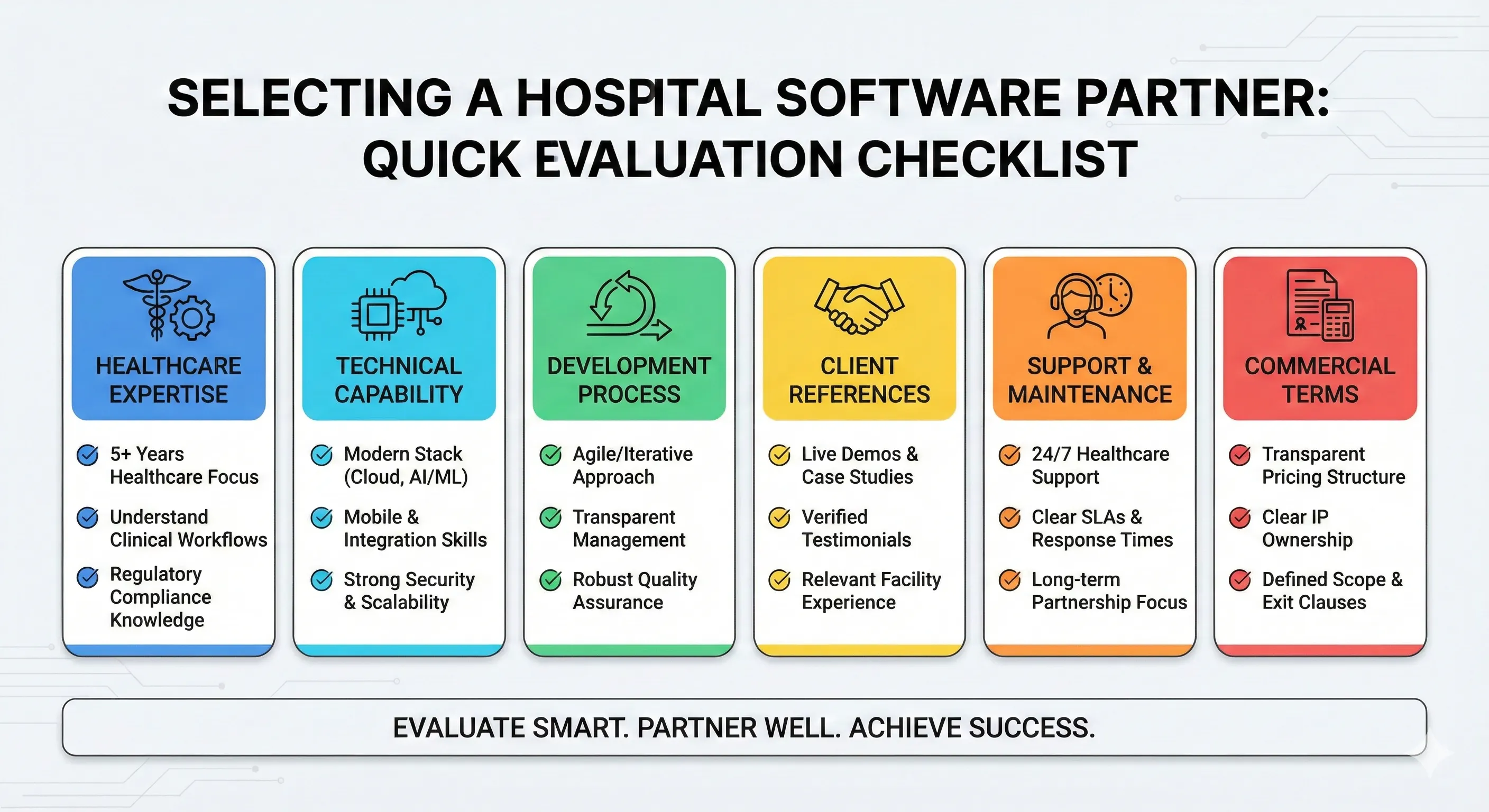
Healthcare Domain Expertise
Technical Capabilities
Development Process
Client References and Portfolio
Support and Maintenance
Commercial Terms
Unrealistic promises indicate inexperience: claims of 50-70% cost savings over competitors (quality costs appropriately), 2-3 month delivery for comprehensive HMS (proper development takes 6-12+ months), zero bugs or issues (all software has bugs, processes for fixing them matter), one-size-fits-all solutions (healthcare requires customization), and guaranteed regulatory approval (compliance requires proper implementation, not guarantees).
Lack of transparency signals problems: vague timelines and deliverables, unwillingness to share references, no live demos of previous work, unclear pricing with hidden costs, reluctance to discuss technical approach, and defensive responses to questions. Trustworthy developers welcome scrutiny and provide clear, detailed information.
Inadequate healthcare knowledge dooms projects: generic software developers without healthcare experience, inability to discuss clinical workflows intelligently, unfamiliarity with regulatory requirements, no clinical advisors or staff, and portfolio lacking healthcare projects. Domain expertise isn't optional, it's essential for HMS success.
Large enterprises (100+ employees) offer comprehensive resources, financial stability, established processes, dedicated support teams, and extensive track records. However, they may assign junior developers, have bureaucratic decision-making, cost premium prices, and provide less customization flexibility. Suitable for large hospitals requiring enterprise-grade solutions and extensive support.
Mid-sized companies (20-100 employees) balance resources with personalization, senior developer involvement, reasonable pricing, proven capabilities, and flexibility. These hospital management system providers in India often provide sweet spot of quality and value for mid-sized hospitals seeking customization without enterprise premiums.
Small companies/startups (5-20 employees) deliver personalized attention, senior developer involvement, competitive pricing, innovation and agility, and direct founder engagement. However, they carry higher risk of limited resources, potential scalability challenges, less financial stability, and smaller support teams. Suitable for clinics and small hospitals with straightforward requirements and budget constraints.
Metropolitan companies (Mumbai, Bangalore, Delhi, Hyderabad) provide access to top talent, exposure to global best practices, modern technology adoption, and comprehensive ecosystem. However, they charge premium rates (₹2,000-5,000 per hour) and may have less availability due to demand.
Tier-2 city companies (Bhubaneswar, Chandigarh, Jaipur, Coimbatore) offer competitive pricing (₹1,500-3,500 per hour), quality talent from top universities, personalized service and commitment, and understanding of regional requirements. Companies like Secuodsoft in Bhubaneswar demonstrate that tier-2 cities deliver world-class quality at better value.
Location impact on costs: Same project may cost ₹30-40 lakhs in Bangalore vs ₹20-28 lakhs in Bhubaneswar while maintaining equal quality. Evaluate based on capabilities rather than location stereotypes.
Communication quality matters tremendously for 6-18 month development projects. Assess English proficiency for clear documentation, responsiveness to emails and calls, willingness to explain technical concepts, cultural understanding and work style compatibility, and conflict resolution approach. Miscommunication causes more project failures than technical limitations.
Work culture alignment includes punctuality and deadline commitment, transparency about challenges and delays, proactive communication of issues, collaborative vs command-and-control approach, and flexibility adapting to your needs. Cultural misfit creates frustration regardless of technical capabilities.
| Component | Percentage of Total | Typical Range |
|---|---|---|
| Software Development | 50-60% | ₹5-90 lakhs |
| UI/UX Design | 10-15% | ₹1-15 lakhs |
| Project Management | 5-10% | ₹50K-10 lakhs |
| Quality Assurance | 8-12% | ₹80K-12 lakhs |
| Implementation | 10-15% | ₹1-18 lakhs |
| Training | 3-5% | ₹30K-5 lakhs |
| First Year Support | 5-8% | ₹50K-8 lakhs |
| Developer Type | Hourly Rate | Best For |
|---|---|---|
| Freelancers | ₹500-2,000 | Very small projects |
| Small Companies | ₹1,000-2,500 | Clinics, simple HMS |
| Mid-sized Companies | ₹1,500-3,500 | Standard hospitals |
| Large Enterprises | ₹2,500-5,000 | Complex, multi-location |
| Offshore Teams | $25-$75 | International projects |
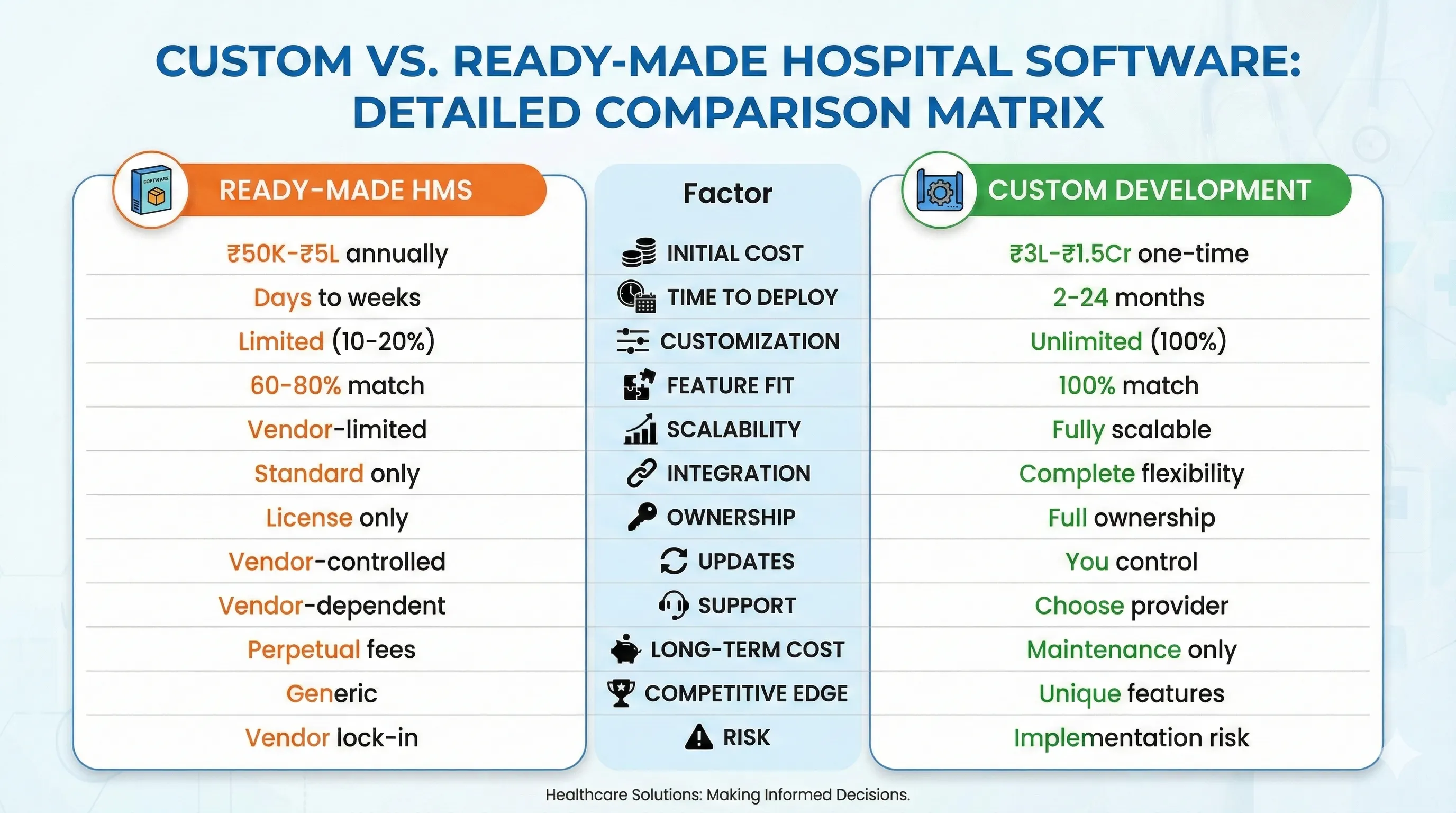
| Factor | Ready-Made HMS | Custom Development |
|---|---|---|
| Initial Cost | ₹50K-₹5L annually | ₹3L-₹1.5Cr one-time |
| Time to Deploy | Days to weeks | 2-24 months |
| Customization | Limited (10-20%) | Unlimited (100%) |
| Feature Fit | 60-80% match | 100% match |
| Scalability | Vendor-limited | Fully scalable |
| Integration | Standard only | Complete flexibility |
| Ownership | License only | Full ownership |
| Updates | Vendor-controlled | You control |
| Support | Vendor-dependent | Choose provider |
| Long-term Cost | Perpetual fees | Maintenance only |
| Competitive Edge | Generic | Unique features |
| Risk | Vendor lock-in | Implementation risk |
Consider Hybrid Approach: Start with ready-made core modules, add custom features for differentiation, migrate to fully custom as organization scales, and balance speed with customization needs.
Domain expertise accelerates development through understanding clinical workflows without explanation, anticipating common requirements and pitfalls, applying healthcare best practices, ensuring regulatory compliance from start, and implementing proper medical data structures. Healthcare software development companies in India with specialty focus complete projects 30-40% faster than generalists learning on your budget.
Proven methodologies reduce risk through established development processes, comprehensive testing procedures, effective change management, user training approaches, and post-launch optimization. Experience comes from making mistakes on previous projects, choose developers who learned on others' budgets, not yours.
Realistic expectations prevent disappointment when experienced hospital software development companies provide honest timelines reflecting actual effort, transparent communication about challenges, proactive identification of risks, and realistic cost estimates. Overpromising followed by delays and overruns damages projects more than honest initial assessments.
Post-launch support determines long-term success through quick bug resolution, feature enhancements based on usage, performance optimization over time, regulatory updates as requirements change, and strategic technology guidance. One-time developers who disappear after go-live leave facilities struggling with unsupported systems.
Continuous improvement comes from analyzing user feedback and usage patterns, identifying optimization opportunities, recommending process improvements, implementing incremental enhancements, and keeping pace with technology evolution. Healthcare operations evolve, software must evolve correspondingly through engaged development partners.
Strategic technology consulting provides guidance on emerging technologies, digital health trends, competitive capabilities, optimization strategies, and future roadmap planning. The best HMS software companies in India act as trusted advisors rather than just vendors.
As a CMMI Level 3 appraised hospital management software development company, Secuodsoft combines deep healthcare domain expertise with cutting-edge technology capabilities, delivering reliable, scalable HMS solutions for healthcare facilities across India.
We believe in transparent, fair pricing reflecting actual effort while delivering exceptional value:
We're confident in our capabilities and welcome comparison with other hospital management software development companies in India. Our work speaks for itself through satisfied clients, successful implementations, and long-term partnerships.
Choosing the right hospital management software development company in India is a critical decision that directly influences operational efficiency, patient care, and long-term growth. With hundreds of options available, healthcare providers must focus on selecting a reliable hospital software development company India that offers strong domain expertise, modern technology capabilities, and transparent processes. The right healthcare software development company India will not only understand complex clinical workflows but also deliver scalable, secure, and fully customized solutions that align perfectly with your hospital’s unique requirements.
Investing in a trusted HMS software company India or experienced custom hospital software developers India ensures seamless integration, better ROI, and future-ready systems that evolve with your organization. Whether you are a clinic or a multi-specialty hospital, partnering with a proven hospital management system provider India or hospital ERP software company India can transform your operations, reduce errors, and enhance patient satisfaction. By prioritizing expertise, customization, and long-term support, you can confidently choose a development partner that drives sustainable success.
Copyright ©2026 Secuodsoft. All rights reserved.