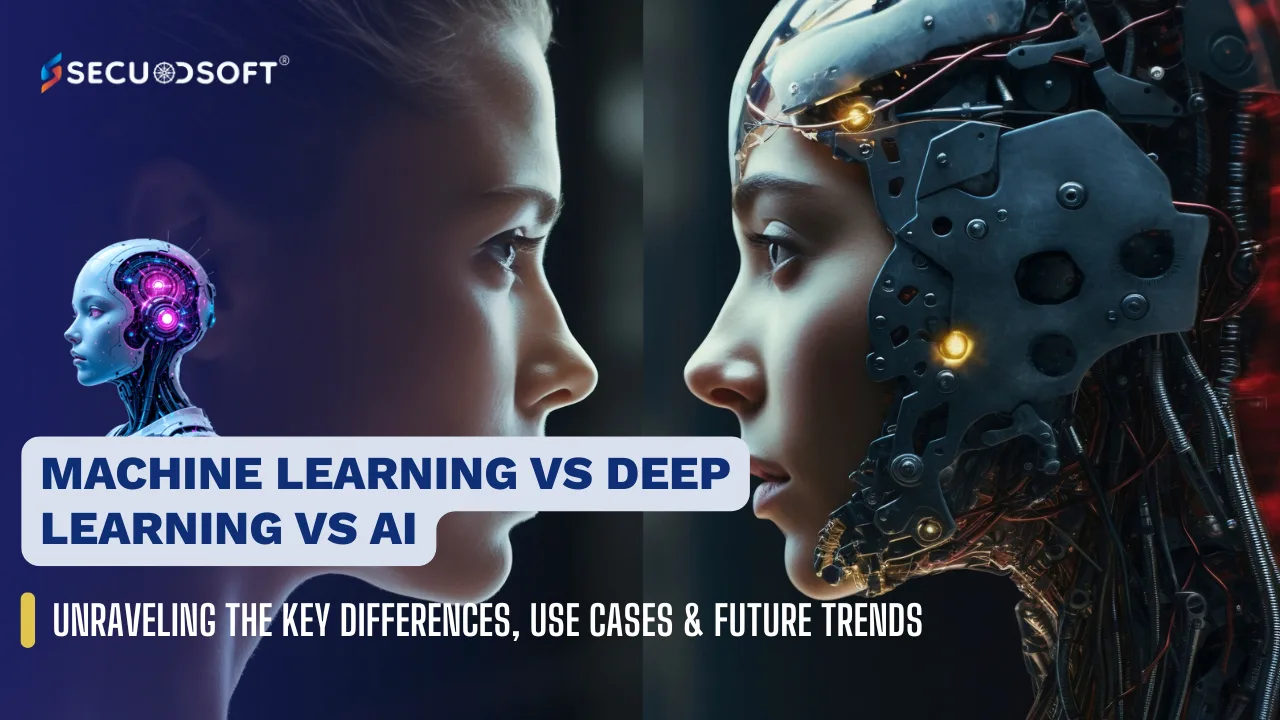
In the rapidly evolving tech landscape of 2026, understanding the machine learning vs deep learning vs AI distinctions is essential for developers, data scientists, and business leaders navigating artificial intelligence applications. With AI projected to add $15.7 trillion to the global economy by 2030, driven by advancements in neural networks and predictive analytics, these technologies aren't interchangeable buzzwords but foundational pillars shaping everything from autonomous vehicles to personalized medicine.
This comprehensive guide breaks down the AI vs machine learning vs deep learning differences, explores their pros and cons, use cases, and future trends, empowering you to choose the right AI ML DL comparison for your projects. Whether you're decoding difference between AI ML DL or weighing machine learning vs deep learning, let's demystify these powerhouses.
Artificial intelligence (AI) represents the broadest category, encompassing any system designed to mimic human intelligence, think reasoning, problem-solving, and learning from data. At its core, AI includes rule-based systems (like expert systems) and advanced subsets like machine learning algorithms, but it extends to robotics, natural language processing (NLP), and computer vision.
In 2026, AI's hallmark is general AI capabilities, evolving beyond narrow tasks to handle multifaceted scenarios, such as ethical decision-making in self-driving cars or generative content via models like Grok-4. Unlike its subsets, AI doesn't require data training; it can operate on predefined rules.
Narrowing from AI, machine learning (ML) is a subset where systems "learn" patterns from data without explicit programming, using algorithms to make predictions or classifications. Supervised learning (labeled data for tasks like spam detection), unsupervised learning (clustering unlabeled data for customer segmentation), and reinforcement learning (trial-and-error for game AI) define its scope.
By 2026, ML dominates predictive modeling in finance and healthcare, with tools like scikit-learn enabling 90% accuracy in fraud detection. ML vs AI difference? ML needs vast datasets and iterative training, making it ideal for scalable data-driven insights but less flexible for non-pattern tasks.
Deep learning (DL) takes ML further as its advanced subset, employing artificial neural networks with multiple layers (hence "deep") to process unstructured data like images or speech. Convolutional neural networks (CNNs) for vision and recurrent neural networks (RNNs) for sequences power this, think ChatGPT's language understanding or Tesla's object recognition.
In 2026, DL's edge shines in computer vision applications and generative AI models, achieving human-level accuracy in medical diagnostics (95%+ via transfer learning). Deep learning vs machine learning boils down to complexity: DL handles raw data autonomously but demands massive compute (GPUs) and datasets.
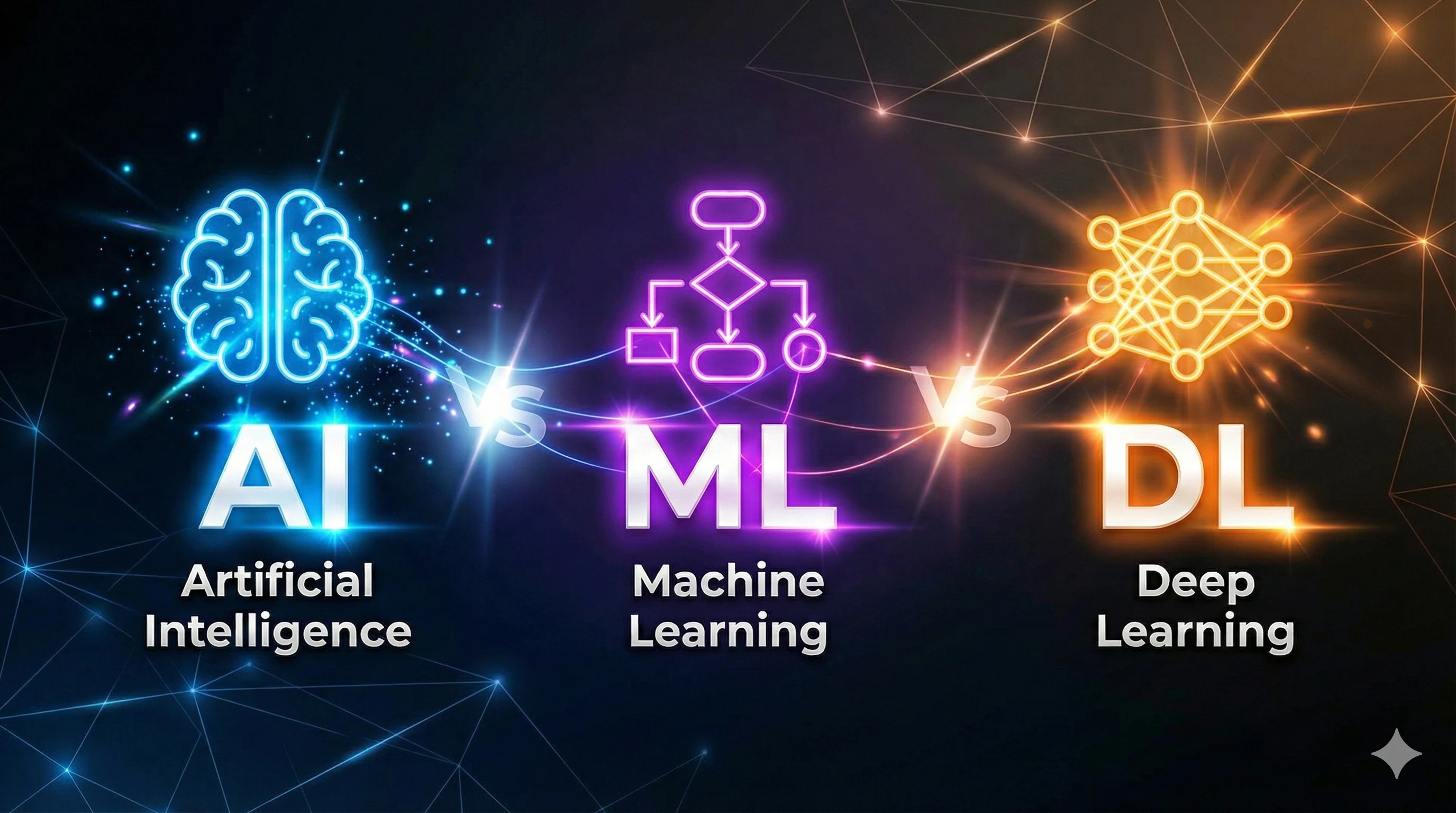
The machine learning vs deep learning vs AI comparison hinges on scope, data needs, and applications. AI is the overarching goal, ML adds learning, DL amplifies with depth.
| Aspect | AI | Machine Learning (ML) | Deep Learning (DL) |
|---|---|---|---|
| Definition | Mimics human intelligence broadly (rules + learning) | Algorithms learn from data patterns | Multi-layered neural networks for complex data |
| Data Requirement | Minimal (rule-based) to high | Labeled and unlabeled datasets | Massive, unstructured data (e.g., images) |
| Examples | Virtual assistants (Siri), robotics | Predictive analytics, recommendation engines | Image classification, speech recognition |
| Strengths | Versatile and explainable | Interpretable and efficient for structured data | High accuracy on unstructured data |
| Limitations | Often narrow (weak AI) | Struggles with raw or high-dimensional data | Black-box models and resource-intensive |
| Use in 2026 | Ethical AI governance | Fraud detection in banking | Autonomous drones and generative art |
This AI vs ML vs DL differences table highlights DL's superiority for big data processing, while ML wins for feature engineering efficiency.
No tech is perfect, here's the balanced pros and cons of AI ML DL to guide your technology stack decisions:
In 2026, hybrid approaches, like ML for interpretability + DL for precision, dominate AI hybrid models, mitigating cons while amplifying pros.
Theory meets practice in these AI ML DL applications:
Deep learning use cases explode in autonomous tech, while machine learning applications anchor reliable predictive maintenance in manufacturing.
Overwhelmed by the difference between AI ML DL? Follow this flowchart for 2026:
Tools like TensorFlow (DL/ML) or PyTorch bridge gaps. For beginners, start with ML's scikit-learn; scale to DL as datasets grow. AI career paths favor hybrids, data scientists blending all three command 20% higher salaries.
By late 2026, expect explainable AI (XAI) to demystify DL's black boxes, federated learning for privacy in ML, and quantum AI accelerating computations. Edge AI deployments will make DL ubiquitous in IoT, while ML evolves for sustainable green computing. The convergence? Neuromorphic chips blurring lines, promising 100x efficiency gains.
Stay ahead: Experiment with Hugging Face for DL prototypes or Kaggle for ML challenges.
Grasping machine learning vs deep learning vs AI differences is step one, implementing them is where magic happens. That's Secuodsoft Technology's wheelhouse: As Bhubaneswar's AI trailblazer, we craft custom AI solutions blending ML for predictive analytics (e.g. fraud detection with 95% accuracy) and DL for vision tasks (like crop monitoring for agri-clients, boosting yields 25%). Our AI development services have powered 50+ Indian firms, from fintech automating 70% of queries to manufacturing optimizing supply chains with hybrid models, delivering 40% ROI in under 6 months.
What sets us apart? Agile teams leveraging PyTorch/TensorFlow for scalable prototypes, ethical XAI for transparent DL, and India-tuned federated learning for data sovereignty. Starting at ₹2 lakhs for MVPs, we make AI ML DL integration accessible, whether you're prototyping an ML forecaster or deploying DL diagnostics. Ready to bridge theory and triumph? Book a free consultation from Secuodsoft today, let's engineer your 2026 edge.
Navigating machine learning vs deep learning vs AI in 2026 means grasping their synergies, not silos, for innovation. From AI's visionary scope to DL's precision and ML's reliability, each drives transformative technologies uniquely. Whether optimizing neural network performance or tackling supervised vs unsupervised learning, the right choice amplifies impact.
What's your next project, ML for analytics or DL for vision? Share below, let's decode it together.
Copyright ©2026 Secuodsoft. All rights reserved.