Software Development
Editorial Team
14 April 2026
Choosing the right CRM development company can be the difference between a transformative customer relationship management system that drives 30-40% sales growth and a costly failure that disrupts operations costing ₹15-50 lakhs in wasted investment. As businesses across India recognize CRM as essential rather than optional—with the CRM market projected to reach $128 billion globally by 2028—the challenge isn't whether to implement CRM but how to select among 500+ CRM development companies in India claiming expertise. Generic off-the-shelf CRM solutions like Salesforce or Zoho serve basic needs but force businesses adapting processes to software rather than software adapting to proven workflows, creating inefficiencies, user resistance, and eventual abandonment. Custom CRM development addresses these limitations by matching exact workflows, incorporating industry-specific features, integrating seamlessly with existing systems, and providing competitive advantages through proprietary capabilities. This comprehensive 2026 guide helps businesses navigate the complex process of selecting the best CRM development company in India, evaluating vendors, understanding costs (₹3 lakhs to ₹1 crore+), comparing development approaches, and implementing CRM solutions that deliver measurable ROI through improved sales efficiency, enhanced customer satisfaction, and data-driven decision-making.
Understanding CRM Development Services
What is CRM Development?
CRM development services involve creating customer relationship management software tailored to specific business requirements, workflows, and industry needs. Unlike implementing pre-built platforms, CRM development builds solutions from ground up or extensively customizes existing frameworks to match unique processes, integrations, and competitive strategies.
Types of CRM Development
| CRM Type |
Description |
Best For |
Cost Range |
| Custom CRM Development |
Built from scratch for unique needs |
Complex workflows, specific industries |
₹10L - ₹1Cr+ |
| CRM Customization |
Extensive modification of platforms (Salesforce, Zoho) |
Standard base with custom features |
₹5L - ₹30L |
| CRM Integration |
Connecting CRM with existing systems |
Adding CRM to current tech stack |
₹3L - ₹15L |
| Cloud CRM Development |
SaaS-based CRM solutions |
Multi-location, remote teams |
₹8L - ₹50L |
| Industry-Specific CRM |
Tailored for sectors (healthcare, real estate) |
Specialized requirements |
₹12L - ₹75L |
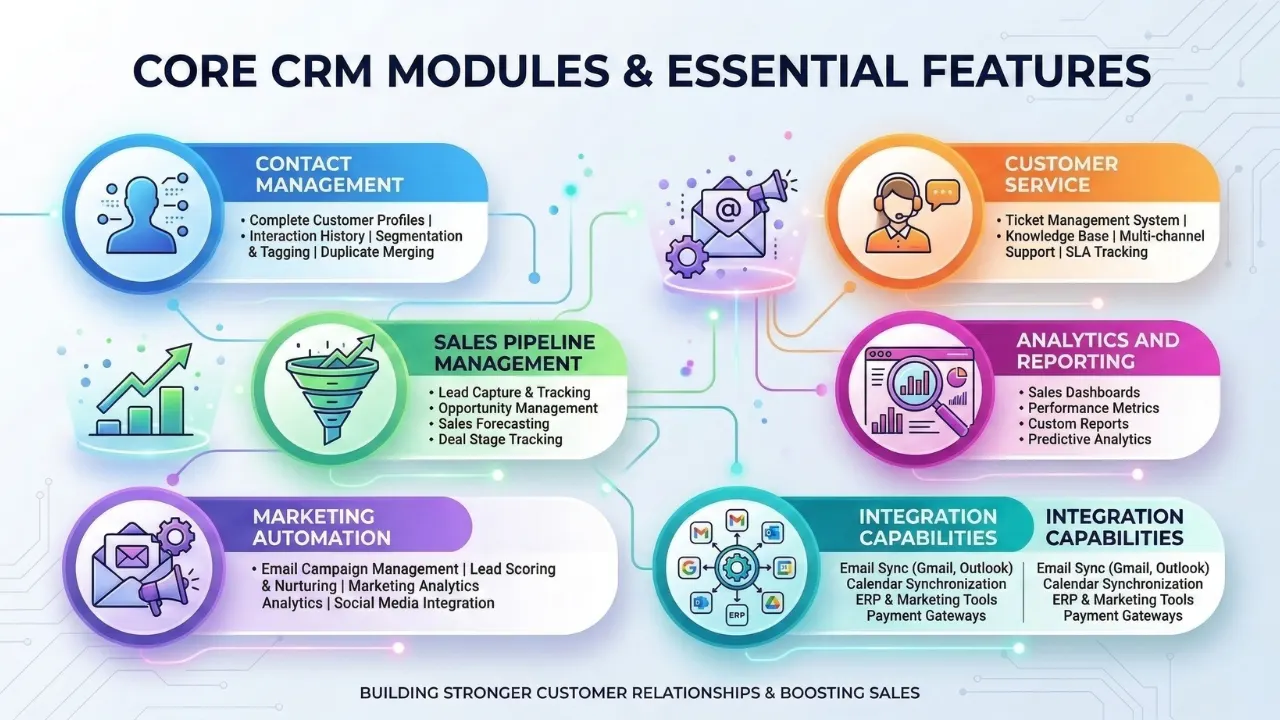
Core CRM Modules
Contact Management
- Customer database with complete profiles
- Interaction history tracking
- Segmentation and tagging
- Duplicate detection and merging
Sales Pipeline Management
- Lead capture and tracking
- Opportunity management
- Sales forecasting
- Quote and proposal generation
- Deal stage tracking
Marketing Automation
- Email campaign management
- Lead scoring and nurturing
- Marketing analytics
- Social media integration
Customer Service
- Ticket management system
- Knowledge base
- Multi-channel support
- SLA tracking
Analytics and Reporting
- Sales dashboards
- Performance metrics
- Custom reports
- Predictive analytics
Integration Capabilities
- Email integration (Gmail, Outlook)
- Calendar synchronization
- ERP connectivity
- Marketing tools integration
- Payment gateway integration
Complete CRM Development Cost Breakdown
Cost Matrix by Business Size
| Business Size |
Basic CRM |
Standard CRM |
Advanced CRM |
Enterprise CRM |
| Small (1-20 users) |
₹3L - ₹8L |
₹8L - ₹15L |
₹15L - ₹25L |
₹25L - ₹40L |
| Medium (20-100 users) |
₹8L - ₹15L |
₹15L - ₹30L |
₹30L - ₹50L |
₹50L - ₹80L |
| Large (100-500 users) |
₹15L - ₹30L |
₹30L - ₹60L |
₹60L - ₹1Cr |
₹1Cr - ₹2Cr+ |
Detailed Cost Components
1. Discovery and Consulting (10-15% of total) Cost: ₹1,00,000 - ₹10,00,000
- Business process analysis
- Requirement documentation
- Workflow mapping
- Technology selection
- Architecture design
- Project planning and ROI modeling
2. UI/UX Design (10-15% of total) Cost: ₹1,50,000 - ₹12,00,000
- User research and personas
- Wireframes and mockups
- Interactive prototypes
- Visual and responsive design
- Usability testing
3. Development (40-50% of total) Cost: ₹5,00,000 - ₹60,00,000
| Development Area |
Percentage |
Cost Range |
| Backend Development |
20-25% |
₹2L - ₹25L |
| Frontend Development |
15-20% |
₹1.5L - ₹20L |
| Database Design |
5-10% |
₹50K - ₹10L |
| API Development |
5-10% |
₹50K - ₹8L |
| Mobile App (Optional) |
15-20% |
₹3L - ₹15L |
4. Integration (15-20% of total) Cost: ₹2,00,000 - ₹20,00,000
- Email platforms (₹50,000 - ₹2,00,000)
- ERP systems (₹2,00,000 - ₹10,00,000)
- Marketing automation (₹1,00,000 - ₹4,00,000)
- Payment gateways (₹75,000 - ₹2,50,000)
- Communication tools (₹50,000 - ₹2,00,000)
- Analytics platforms (₹75,000 - ₹3,00,000)
5. Testing and QA (10-15% of total) Cost: ₹1,00,000 - ₹8,00,000
- Functional testing
- Performance and load testing
- Security testing
- User acceptance testing
- Cross-browser/device testing
6. Deployment and Training (5-10% of total) Cost: ₹50,000 - ₹5,00,000
- Server setup and configuration
- Data migration from existing systems
- User training programs
- Documentation creation
- Go-live support
7. Annual Maintenance (15-20% of development cost) Cost: ₹1,00,000 - ₹15,00,000/year
- Bug fixes and updates
- Security patches
- Performance optimization
- Feature enhancements
- Technical support
- server maintenance
Sample Project Cost Example: Mid-Sized Real Estate CRM (50 Users)
| Component |
Cost |
Timeline |
| Discovery & Planning |
₹1,50,000 |
2 weeks |
| UI/UX Design |
₹2,50,000 |
4 weeks |
| Backend Development |
₹8,00,000 |
12 weeks |
| Frontend Development |
₹6,00,000 |
10 weeks |
| Mobile App |
₹4,00,000 |
8 weeks |
| Integration (ERP, Email) |
₹3,00,000 |
4 weeks |
| Testing & QA |
₹2,00,000 |
3 weeks |
| Deployment & Training |
₹1,00,000 |
2 weeks |
| Total Implementation |
₹28,00,000 |
6 months |
| Annual Maintenance |
₹4,50,000 |
Ongoing |
How to Choose the Best CRM Development Company
Evaluation Criteria Checklist
CRM Development Expertise
- 5+ years CRM development experience
- 30+ successful CRM implementations
- Expertise in both custom and platform-based CRM
- Knowledge of latest CRM technologies
- Industry-specific CRM experience
Questions to Ask
- How many CRM projects have you completed?
- Can you show case studies from our industry?
- What CRM technologies do you specialize in?
- Do you have certified developers (Salesforce, Microsoft)?
Technology Stack and Capabilities
| Technology |
Importance |
Why It Matters |
| Backend |
Critical |
Python, Node.js, .NET, Java |
| Frontend |
Critical |
React, Angular, Vue.js |
| Database |
Critical |
PostgreSQL, MySQL, MongoDB |
| Cloud Platforms |
High |
AWS, Azure, Google Cloud |
| Mobile |
Medium |
iOS, Android, React Native |
| Integration |
High |
API development, middleware |
Portfolio and Case Studies
What to Look For
- Live CRM systems you can demo
- Similar industry implementations
- Client testimonials with measurable metrics
- Before/after process improvements
- ROI achieved for clients
Red Flags
- No live demos available
- Only generic portfolio pieces
- Cannot provide client references
- Vague about project outcomes
Development Methodology
| Methodology |
Pros |
Best For |
| Agile/Scrum |
Flexibility, regular feedback |
Most projects |
| Iterative |
Incremental delivery |
Complex systems |
| DevOps |
Continuous deployment |
Ongoing development |
Must-Haves
- Regular sprint demonstrations
- Client feedback incorporation
- Transparent project tracking
- Change management process
- Quality assurance throughout
Security and Compliance
Essential Capabilities
- Data encryption (in transit and at rest)
- Role-based access control
- Audit trails and logging
- GDPR/data privacy compliance
- Regular security audits
- Backup and disaster recovery
Pricing Transparency
Look For
- Detailed cost breakdowns
- Clear scope definition
- Milestone-based payments
- No hidden charges
- Flexible engagement models
Warning Signs
- Vague pricing estimates
- Reluctance to provide breakdowns
- Too cheap to be true pricing
- Significant cost variations between proposals
Post-Development Support
Critical Services
| Support Type |
Description |
Typical Cost |
| Bug Fixes |
Issues within warranty period |
Usually included |
| Maintenance |
Regular updates, security patches |
15-20% annually |
| Feature Additions |
New functionality |
Project-based |
| Technical Support |
User assistance, troubleshooting |
₹50K - ₹3L/month |
| Training |
New user onboarding |
₹25K - ₹1L/session |
Top 10 CRM Development Companies in India 2026
| Sl. No. |
Company Name |
| 1 |
Secuodsoft |
| 2 |
TCS (Tata Consultancy Services) |
| 3 |
Infosys |
| 4 |
Tech Mahindra |
| 5 |
Wipro |
| 6 |
Zensar Technologies |
| 7 |
Kellton Tech |
| 8 |
Clarion Technologies |
| 9 |
Iflexion |
| 10 |
Cynoteck |
Custom CRM vs Off-the-Shelf : Detailed Comparison
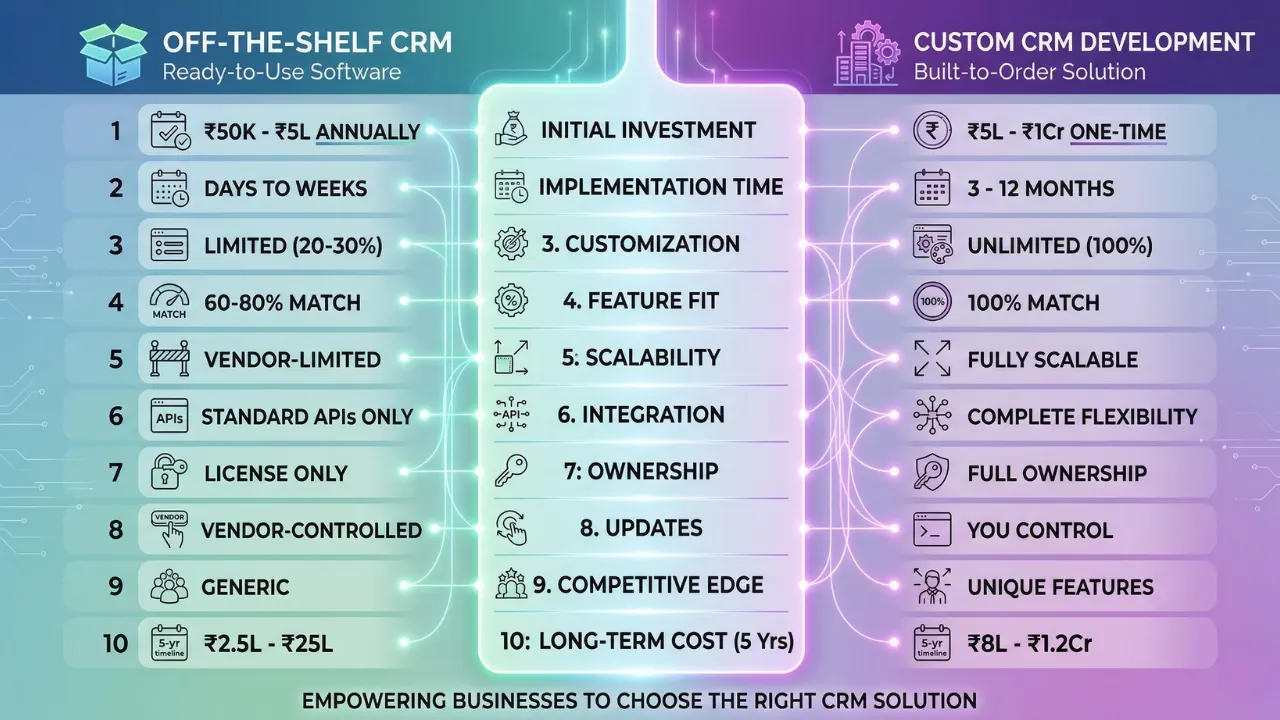
Complete Comparison Matrix
| Factor |
Off-the-Shelf CRM |
Custom CRM Development |
| Initial Cost |
₹50K - ₹5L annually |
₹5L - ₹1Cr one-time |
| Implementation Time |
Days to weeks |
3-12 months |
| Customization |
Limited (20-30%) |
Unlimited (100%) |
| Feature Fit |
60-80% match |
100% match |
| Scalability |
Vendor-limited |
Fully scalable |
| Integration |
Standard APIs only |
Complete flexibility |
| Ownership |
License only |
Full ownership |
| Updates |
Vendor-controlled |
You control |
| Competitive Edge |
Generic |
Unique features |
| Long-term Cost (5 years) |
₹2.5L - ₹25L |
₹8L - ₹1.2Cr |
When to Choose Custom CRM Development
Choose Custom When
- Unique business processes not matching standard CRM
- Complex workflows requiring extensive customization
- Industry-specific requirements (real estate, healthcare)
- Need integration with proprietary systems
- Competitive differentiation important
- Long-term investment (5+ years)
- 50+ users requiring specific features
- Data control and security paramount
- Existing systems requiring deep integration
When Off-the-Shelf Works
Choose Off-the-Shelf When
- Standard sales/marketing processes
- Small team (under 20 users)
- Limited budget (under ₹5 lakhs)
- Quick deployment needed (weeks)
- No unique requirements
- Prefer operational vs capital expenditure
- Minimal integration needs
CRM Development Process: Step-by-Step
Phase 1: Discovery and Planning (2-4 weeks)
Activities
- Stakeholder interviews
- current process documentation
- Pain point identification
- requirement gathering
- Feature prioritization
- technology selection
Deliverables
- BRD (Business Requirements Document)
- technical architecture
- project timeline
- cost estimate
Phase 2: Design (3-6 weeks)
| Stage |
Output |
Duration |
| Research |
User personas, journey maps |
1 week |
| Wireframes |
Low-fidelity layouts |
1-2 weeks |
| Mockups |
High-fidelity designs |
2-3 weeks |
| Prototype |
Interactive clickable demo |
1-2 weeks |
Phase 3: Development (12-24 weeks)
- Week 1-4: Core infrastructure — database design, user authentication, basic contact management
- Week 5-8: Sales modules — lead management, opportunity tracking, pipeline visualization
- Week 9-12: Marketing features — campaign management, email integration, lead scoring
- Week 13-16: Service modules — ticket management, knowledge base, customer portal
- Week 17-20: Analytics — dashboards, reports, forecasting
- Week 21-24: Integration & polish — third-party integrations, performance optimization, UI refinements
Phase 4: Testing (3-6 weeks)
- Functional testing (all features work)
- Integration testing (systems communicate)
- Performance testing (handles load)
- Security testing (data protected)
- User acceptance testing (meets needs)
- Cross-browser compatibility and mobile responsiveness
Phase 5: Deployment (2-3 weeks)
Option A: Phased Rollout — Week 1: Sales team only; Week 2: Marketing team added; Week 3: Full organization.
Option B: Pilot Program — One department/location first, gather feedback and refine, then gradual expansion.
Phase 6: Training and Adoption (2-4 weeks)
- Admin training (system configuration)
- End-user training (daily operations)
- Power user training (advanced features)
- Documentation delivery and video tutorials
Phase 7: Ongoing Support
- Bug fixes (immediate)
- Feature requests (quarterly releases)
- Performance monitoring and security updates
- User support helpdesk
Benefits and ROI of Custom CRM
Business Impact
Sales Efficiency:
- 27% average increase in sales revenue
- 35% reduction in sales cycle length
- 40% improvement in lead conversion
- 30% increase in customer lifetime value
Productivity Gains:
- 44% time savings on administrative tasks
- 50% faster report generation
- 60% improvement in data accuracy
- 38% faster customer response times
Customer Satisfaction:
- 32% increase in customer satisfaction scores
- 45% improvement in retention rates
- 28% increase in customer engagement
- 35% boost in referral rates
ROI Calculation Example
Investment:
- Development: ₹25,00,000
- Implementation: ₹3,00,000
- Training: ₹1,00,000
- Year 1 maintenance: ₹4,00,000
- Total Year 1: ₹33,00,000
Returns (Annual):
- Revenue increase (15%): ₹75,00,000
- Time savings (30%): ₹25,00,000
- Error reduction: ₹8,00,000
- Customer retention improvement: ₹15,00,000
- Total Benefits: ₹1,23,00,000
ROI = (₹1.23Cr - ₹33L) / ₹33L × 100 = 273%
Payback Period: 14 months
CRM Development Process: Step-by-Step
Phase 1: Discovery and Planning (2-4 weeks)
Activities
- Stakeholder interviews
- Current process documentation
- Pain point identification
- Requirement gathering
- Feature prioritization
- Technology selection
Deliverables
- Project roadmap
- Requirement specification document
- Wireframes or initial prototypes
- Technology stack confirmation
Why Choose Secuodsoft for CRM Development
As a CMMI Level 3 appraised company, Secuodsoft delivers comprehensive CRM development services combining technical excellence with deep business understanding.
Our CRM Expertise
Track Record:
- 60+ successful CRM implementations
- 95% client satisfaction rate
- Average project delivery: on-time, on-budget
- 90% clients see ROI within 18 months
Industries Served:
- Real estate and property management
- Healthcare and medical practices
- Financial services and insurance
- E-commerce and retail
- Education and training
- Manufacturing and distribution
Transparent Pricing
| Package |
Investment |
Users |
Timeline |
| Starter |
₹5L - ₹12L |
1-20 |
3-4 months |
| Professional |
₹12L - ₹30L |
20-100 |
4-6 months |
| Enterprise |
₹30L - ₹1Cr+ |
100+ |
6-12 months |
What's Included:
- Complete development
- UI/UX design
- Testing and QA
- Deployment
- Training
- 6 months support
- Documentation
Why Businesses Choose Secuodsoft
Industry Expertise
- Deep CRM knowledge
- Vertical-specific solutions
- Proven methodologies
Quality Standards
- CMMI Level 3 processes
- Comprehensive testing
- Security-first development
Competitive Pricing
- 25-35% cost advantage (tier-2 city)
- Transparent pricing
- Flexible payments
Client Success
- Real estate CRM: 40% sales increase
- Healthcare CRM: 50% efficiency gain
- Finance CRM: ₹35L annual savings
Conclusion
Choosing the best CRM development company in India determines whether your investment delivers transformative results or becomes a costly failure. Success requires evaluating vendors on CRM expertise, technology capabilities, portfolio quality, pricing transparency, and post-launch support rather than selecting based solely on cost. Whether pursuing custom CRM development for unique workflows or extensive platform customization, understanding costs (₹3-100 lakhs), timelines (3-12 months), and implementation best practices ensures maximum ROI. Partner with experienced CRM development companies like Secuodsoft who combine technical excellence with business understanding, delivering solutions that improve sales efficiency, enhance customer satisfaction, and drive measurable business growth.
Frequently Asked Questions (FAQ)
Custom CRM development cost in India ranges from ₹5 lakhs to ₹1 crore+ depending on complexity and features. Small business CRM (1-20 users, basic features) costs ₹5-12 lakhs, medium enterprise CRM (20-100 users, advanced features) ranges ₹12-40 lakhs, and large enterprise CRM (100+ users, complex workflows) costs ₹40 lakhs-₹1 crore+. Cost components include discovery and consulting (10-15%), UI/UX design (10-15%), development (40-50%), integration (15-20%), testing (10-15%), and deployment (5-10%). Annual maintenance adds 15-20% of development cost. Custom development costs more initially than off-the-shelf CRM (₹50K-₹5L annually) but delivers better ROI long-term through perfect workflow fit, competitive advantages, and full ownership. Industry-specific CRM (healthcare, real estate) costs 20-30% more due to specialized requirements.
CRM development timeline ranges from 3-12 months depending on scope. Simple CRM (basic contact and sales management) takes 3-4 months including discovery (2 weeks), design (3 weeks), development (8-10 weeks), testing (2-3 weeks), and deployment (2 weeks). Standard CRM (sales, marketing, service modules) requires 4-7 months with discovery (3 weeks), design (4-5 weeks), development (14-20 weeks), testing (3-4 weeks), and deployment (2-3 weeks). Complex enterprise CRM (custom workflows, extensive integration) needs 8-12 months covering comprehensive discovery (4-6 weeks), detailed design (6-8 weeks), development (24-32 weeks), rigorous testing (5-7 weeks), and phased deployment (4-6 weeks). Timeline factors include feature complexity, integration requirements, data migration needs, team size, and organizational readiness. Rushed timelines compromise quality—proper discovery, testing, and user adoption ensure successful implementations delivering promised ROI.
The custom CRM vs off-the-shelf decision depends on requirements, budget, timeline, and strategic importance. Choose off-the-shelf CRM (Salesforce, Zoho, HubSpot) when workflows match standard sales/marketing processes (60-80% fit), team size is small (under 50 users), budget is limited (under ₹10 lakhs), quick deployment needed (weeks not months), no unique competitive requirements, and prefer subscription pricing. Benefits include lower initial cost (₹50K-₹5L annually), faster implementation (days-weeks), proven features, regular updates, and extensive integrations. Choose custom CRM development when workflows are unique (requiring 50%+ customization), industry-specific requirements (healthcare, real estate), existing systems need deep integration, competitive differentiation important, long-term investment (5+ years), 50+ users with specific needs, and data control paramount. Benefits include perfect process fit, competitive advantages through unique features, full ownership (no recurring fees after development), unlimited customization, and complete control. Hybrid approach works too—customize Salesforce/Zoho extensively (₹5-30 lakhs) balancing customization with platform benefits.
Essential CRM features include contact management (complete customer profiles, interaction history, segmentation), sales pipeline management (lead tracking, opportunity management, deal stages, forecasting, quote generation), marketing automation (email campaigns, lead scoring, analytics, social media integration), customer service (ticket management, knowledge base, multi-channel support, SLA tracking), analytics and reporting (sales dashboards, performance metrics, custom reports, predictive analytics), and mobile access (iOS/Android apps, offline capability, location features). Integration capabilities are critical including email (Gmail, Outlook), calendar synchronization, ERP connectivity, marketing tools, payment gateways, and communication platforms. Advanced features providing competitive advantages include AI-powered lead scoring, predictive analytics, workflow automation, custom module builder, role-based permissions, audit trails, API for custom integrations, and industry-specific modules. Security features include data encryption, role-based access control, audit logging, backup and recovery, and compliance (GDPR, HIPAA).
CRM adoption success requires strategic planning beyond just software implementation. Pre-implementation strategies include involving users in requirement gathering (creates ownership), demonstrating clear benefits (how CRM makes their work easier), addressing concerns early (resistance usually stems from fear of change), and securing executive sponsorship. During implementation provide comprehensive training through role-specific sessions (sales, marketing, service have different needs), hands-on practice with real data, train-the-trainer approach for scalability, video tutorials for reference, and ongoing support during transition. Post-implementation tactics include starting with must-use features (make CRM mandatory for critical processes), gamification (leaderboards, achievements for usage), regular feedback sessions (address pain points quickly), continuous improvement (add requested features), and celebrating wins (share success stories). Technical enablers include intuitive user interface (minimal clicks for common tasks), mobile accessibility (use CRM anywhere), integration with daily tools (email, calendar auto-sync), performance optimization (fast load times), and automation (reduce manual data entry). Monitor adoption metrics (login frequency, data entry completion, feature usage) and intervene when adoption lags. Partner with CRM development companies like Secuodsoft who emphasize user experience and provide comprehensive training ensuring high adoption rates delivering ROI.