The numbers reveal a stark reality about inventory management in Indian businesses. Most companies lose 15-25% of annual revenue to inventory mismanagement. Overstocking ties up ₹50-200 lakhs in working capital unnecessarily. Stockouts lose sales when inventory sits available but undiscovered. Manual spreadsheet systems create accounting discrepancies causing write-offs of ₹5-30 lakhs annually. The cumulative cost of poor inventory visibility reaches ₹80-400 lakhs per year for mid-sized businesses.
Yet 58% of Indian businesses still manage inventory through spreadsheets, manual registers, and disconnected systems that create more problems than they solve. They're aware something's wrong but uncertain whether the solution justifies the investment.
This benchmark guide cuts through that uncertainty. It explains exactly what a custom inventory management system costs, what business problems it actually solves, which features deliver measurable ROI, and how to evaluate whether custom development makes financial sense for your specific business.
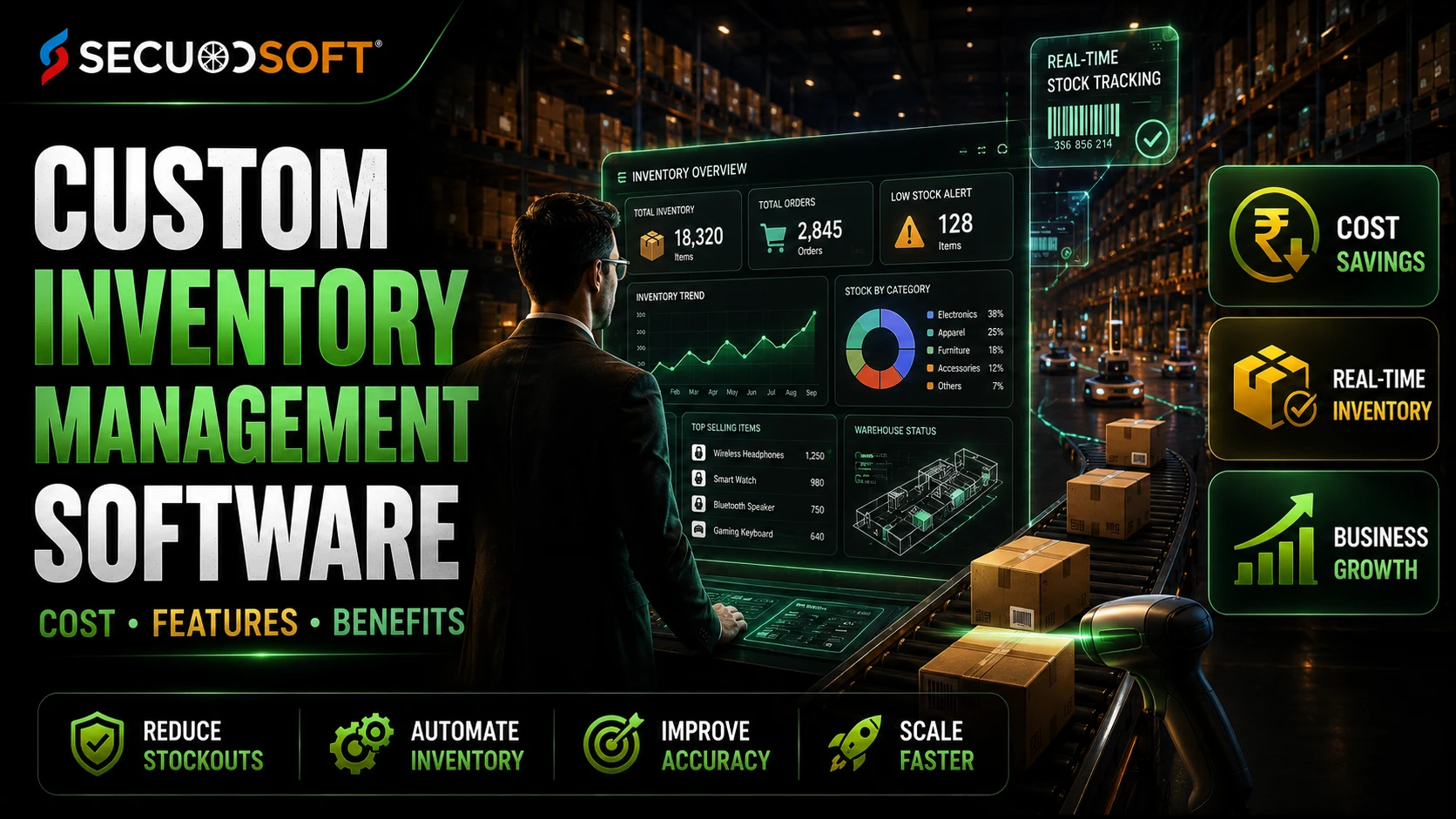
Custom inventory management software is a tailor-made solution designed around a business's unique inventory workflows, products, warehouses, suppliers, and operational requirements. Unlike off-the-shelf inventory software, custom solutions can be developed to match specific business processes, integrate with existing systems, and scale as operations grow.
Businesses commonly use custom inventory management software to:
Custom inventory management software is especially valuable for manufacturers, distributors, retailers, logistics companies, pharmaceutical businesses, and enterprises with complex inventory operations.
Before discussing solutions, understanding the problem clarifies why custom inventory management software becomes essential business infrastructure.
Inventory accuracy problems plague spreadsheet-based systems. Manual data entry errors, forgotten updates, lost transaction records create discrepancies where physical stock doesn't match system records. Companies conducting annual inventory counts discover 8-15% variance between recorded and actual inventory. Those discrepancies represent unaccounted losses or unrecorded assets requiring write-offs.
Stockout situations frustrate customers and lose sales. Without real-time visibility across locations or suppliers, businesses can't effectively prevent stockouts. When inventory appears unavailable during sales conversations, customers buy from competitors instead. For seasonal products, missing peak season demand windows means missing entire revenue cycles.
Overstocking consumes working capital without generating returns. Businesses purchase excess inventory for bulk discounts, thinking they're saving money, then watch products age, require markdowns, or expire. That excess inventory sitting in warehouses costs storage fees while the capital invested could have been deployed elsewhere.
Supplier coordination failures extend lead times unnecessarily. Without visibility into current stock levels and demand patterns, businesses either wait too long to place orders (then face stockouts) or order too early (creating excess inventory). Manual supplier communication through phone calls and emails creates delays and miscommunication.
Multi-location management becomes impossible with spreadsheets. As businesses expand to multiple stores, warehouses, or fulfillment centers, spreadsheet-based tracking breaks down. Managers don't know which location has inventory, can't optimize stock distribution, and waste time searching across multiple documents.
Labor-intensive processes consume valuable team time. Counting inventory, updating spreadsheets, reconciling discrepancies, preparing reports, all manual work that should be automated. A team managing 5,000+ SKUs across multiple locations spends 20-40% of time on non-value-added inventory administration.
Forecasting becomes guesswork without historical data analysis. Without pattern recognition across seasons and trends, demand planning becomes intuition-based rather than data-driven. Businesses over-purchase in some seasons and under-purchase in others.
Total impact: A ₹100 crore revenue business with poor inventory management can lose ₹15-25 crore annually through combined inefficiencies.
Off-the-shelf inventory software like SAP, Tally, or cloud platforms (Zoho Inventory, Cin7) serve general needs adequately for standard operations. But businesses with unique requirements, specialized industries, complex multi-location setups, proprietary processes, specific integrations, find generic software forcing them into ill-fitting workflows.
Custom inventory management software is purpose-built for your exact business. It reflects your processes rather than forcing you to adapt to software's assumptions. Businesses often choose custom software development services when off-the-shelf inventory platforms cannot support their workflows, integrations, or scalability requirements.
Real example: A multi-location jewelry retail chain had specific requirements, tracking inventory by weight, stone type, and purity, managing consignment inventory separately, handling inter-store transfers with approval workflows, and maintaining separate accounting for gold/silver. No commercial software accommodated all requirements. Custom development costing ₹18 lakhs eliminated workflow friction, improved accuracy to 99.8%, and saved ₹3 lakhs annually in faster processes.
| Feature | Custom Inventory Management Software | Off-the-Shelf Software |
|---|---|---|
| Business-Specific Workflows | Fully Customized | Limited |
| Integration Flexibility | Unlimited | Limited |
| Ownership | Complete Ownership | Subscription-Based |
| Scalability | High | Depends on Vendor |
| Reporting & Analytics | Custom Dashboards | Standard Reports |
| Security Controls | Customizable | Vendor Controlled |
| Long-Term Costs | Lower for Large Businesses | Recurring Subscription Costs |
For businesses with unique inventory processes, multiple locations, or industry-specific compliance requirements, custom inventory management software often delivers significantly higher long-term value than generic solutions.
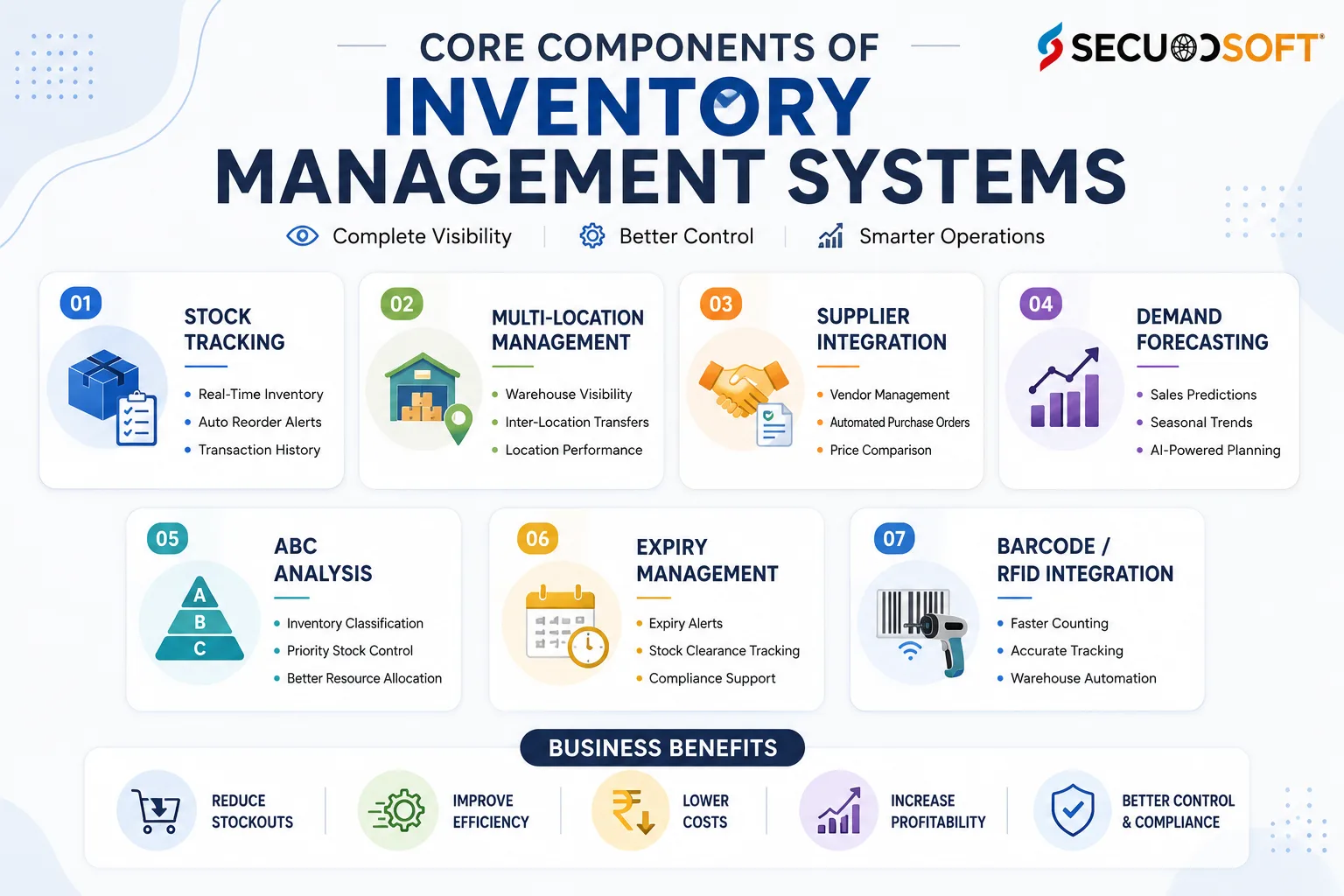
An effective inventory software development solution integrates multiple interconnected modules working together to provide complete visibility and control.
Stock Tracking monitors inventory levels in real-time across all locations. When stock reaches predetermined reorder points, the system triggers purchase orders automatically. Historical tracking maintains complete transaction audit trails showing every receipt, sale, adjustment, and discrepancy.
Multi-location Management enables businesses to track stock across warehouses, stores, and distribution centers from a single dashboard. The system manages inter-location transfers, auto-allocates orders to closest stock location, and provides location-wise profitability analysis.
Supplier Integration automates vendor communication. The system maintains supplier catalogs with pricing, lead times, and terms. It compares prices across suppliers, suggests optimal vendors, generates purchase orders automatically, and tracks goods receipt against POs.
Demand Forecasting uses historical sales data and seasonal patterns to predict future demand. Machine learning models improve accuracy over time. The system suggests purchase quantities preventing both stockouts and overstocking. Advanced forecasting capabilities are increasingly powered by AI and machine learning development services.
ABC Analysis classifies inventory by value and movement. "A" items (high value, fast-moving) receive close monitoring and frequent replenishment. "C" items (low value, slow-moving) require less attention, reducing operational complexity.
Expiry Management tracks expiration dates and automatically flags near-expiry stock for clearance. For pharmaceutical, food, and chemical businesses, this prevents regulatory violations and product loss.
Barcode/RFID Integration enables fast, accurate inventory counting and transactions. Barcode scanning confirms receipt, prevents misplacement, and speeds up warehouse operations.
Inventory system costs vary dramatically based on complexity, integrations, and current technology foundation.
Ideal for: Retailers, traders, manufacturers with single location and 500-2,000 SKUs
Timeline: 8-12 weeks Annual maintenance: ₹40,000-₹75,000 Implementation approach: Use standard templates, minimal customization
ROI: Typically, 15-18 months through inventory accuracy improvement and reduced count time
Ideal for: Multi-location businesses, 2,000-10,000 SKUs, specialized inventory handling
Timeline: 12-16 weeks Annual maintenance: ₹1.50L-₹3L Implementation approach: Moderate customization, significant integration work
ROI: Typically, 10-14 months through working capital optimization, reduced labour, better forecasting
Ideal for: Large corporations, 10,000+ SKUs, complex supply chains, multiple business units
Timeline: 16-24 weeks Annual maintenance: ₹3L-₹7L Implementation approach: Extensive customization, complex integrations, phased rollout
ROI: Typically, 8-12 months through comprehensive operational transformation
| Module | Cost Range |
|---|---|
| Stock Management Engine | ₹75K - ₹5L |
| Purchase Order System | ₹50K - ₹3L |
| Multi-location Management | ₹50K - ₹4L |
| Demand Forecasting | ₹1L - ₹7L |
| Reporting & Analytics | ₹75K - ₹4L |
| User Interface & UX | ₹50K - ₹3L |
| Integration | Cost |
|---|---|
| Accounting Software | ₹50K - ₹2.5L |
| E-commerce Platform | ₹75K - ₹3L |
| CRM System | ₹50K - ₹2L |
| Shipping & Logistics | ₹50K - ₹2.5L |
| Barcode/RFID Systems | ₹40K - ₹1.5L |
| Warehouse Automation | ₹1L - ₹10L |
Multi-Store Retail Chain (10 stores, 5,000 SKUs)
| Component | Cost |
|---|---|
| Core Inventory System | ₹4,50,000 |
| Multi-location Module | ₹2,00,000 |
| E-commerce Integration | ₹1,50,000 |
| POS Integration | ₹1,00,000 |
| Mobile App (Staff) | ₹1,50,000 |
| Barcode Integration | ₹75,000 |
| Custom Reports | ₹50,000 |
| Testing & QA | ₹1,00,000 |
| Deployment & Training | ₹75,000 |
| Total Development | ₹13,50,000 |
| Annual Maintenance | ₹2,00,000 |
Manual systems: 85-92% accuracy (8-15% variance between records and physical count) Custom system: 99.5%+ accuracy (discrepancies under 0.5%)
Financial impact: Reduces write-offs for discrepancies from 2-3% of inventory value to near-zero Example: ₹5 crore average inventory value saves ₹1-1.5 lakhs annually through improved accuracy
Overstocking reduces: From 25-35% excess inventory to 8-12% safety stock Inventory turnover increases: From 4-6x annually to 8-12x annually (faster cash conversion)
Financial impact: Frees up ₹50-200 lakhs in working capital
Manual inventory processes: 25-40% of warehouse team time Automated system: 5-10% of team time
Financial impact: Reduces headcount requirement by 30-50% or enables team to manage 2-3x more inventory
Example: Warehouse team of 10 people can be reduced to 7 (3 positions worth ₹15-20 lakhs annually saved)
Manual/intuition-based: 60-70% forecast accuracy (high overstocking or stockouts) ML-powered forecasting: 85-95% accuracy
Financial impact: Reduces excess inventory markdowns and lost sales from stockouts
Example: 20% reduction in stockout situations = 2-3% revenue recovery on ₹100 crore business = ₹2-3 crore additional revenue
Current stockout frequency: 1 in 10 customer requests finds inventory unavailable After implementation: 1 in 50 requests (95% fill rate improvement)
Financial impact: Captures previously lost sales
Example: 500 daily customer requests × 2% lost sales currently × ₹3,000 average order value = ₹3 lakhs daily lost sales = ₹1 crore annually
After system: Recovers ₹80-90 lakhs through improved fill rates
Mid-market manufacturing business: ₹50 crore annual revenue, 5 locations, 8,000 SKUs, current inventory ₹8 crore
Investment: ₹15 lakhs custom inventory system
| Benefit | Calculation | Value |
|---|---|---|
| Working Capital Freed | ₹1.5 crore × 8% cost | ₹12 lakhs |
| Labor Reduction | 2 FTE × ₹7.5L avg cost | ₹15 lakhs |
| Forecasting Accuracy | 15% reduced excess stock | ₹10 lakhs |
| Stockout Recovery | Improved fill rate | ₹25 lakhs |
| Reduced Obsolescence | Better expiry tracking | ₹5 lakhs |
| Accounting Accuracy | Reduced write-offs | ₹3 lakhs |
| Total Annual Benefit | - | ₹70 lakhs |
First Year: ₹70 lakhs benefit - ₹15 lakhs investment - ₹2 lakhs maintenance = ₹53 lakhs net benefit = 353% ROI Payback period: 2.6 months 3-Year ROI: 1,050%
This ROI profile explains why custom inventory management system development represents high-value business investment.
Phase 1: Requirement Clarity (2 weeks) Understanding exact business processes, pain points, and desired outcomes determines system design. Many failures result from inadequate requirement gathering.
Phase 2: Integration Planning (2 weeks) Mapping how the inventory system connects to existing business systems prevents post-implementation surprises and expensive rework.
Phase 3: Data Migration (2-4 weeks) Transferring historical inventory data accurately ensures continuity and enables forecasting model training.
Phase 4: Configuration & Testing (4-6 weeks) Comprehensive testing before go-live prevents operational disruption.
Phase 5: Phased Rollout (2-4 weeks) Deploying to one location first, then expanding prevents enterprise-wide failures while issues are still contained.
Developing an inventory management system is not just about tracking stock levels. The real challenge is creating a solution that aligns with your business processes, integrates with existing systems, supports future growth, and delivers measurable operational improvements.
At Secuodsoft, we focus on building custom inventory management software tailored to the unique needs of each business. Whether you're managing inventory across multiple warehouses, tracking thousands of SKUs, handling supplier coordination, or automating purchase workflows, we develop solutions designed around your operations, not generic templates.
Our team works closely with businesses to understand inventory challenges, identify inefficiencies, and build software that improves visibility, reduces manual effort, and supports data-driven decision-making. From real-time inventory tracking and automated stock replenishment to advanced reporting and system integrations, every solution is developed with scalability, performance, and long-term business value in mind.
Businesses partner with Secuodsoft because we combine technical expertise with a practical understanding of inventory operations, helping organizations reduce inventory costs, improve stock accuracy, and gain complete control over their supply chain processes.
Real-time inventory visibility often depends on robust web application development services capable of handling large transaction volumes.
Custom inventory management software is more than just a tool for tracking stock, it is a strategic investment that helps businesses improve inventory accuracy, reduce operational costs, optimize working capital, and make better data-driven decisions. As inventory operations become increasingly complex across multiple locations, suppliers, and sales channels, relying on manual processes or generic software can limit growth and profitability.
By investing in a custom inventory management solution tailored to your business needs, you can streamline operations, gain real-time visibility into inventory performance, and build a scalable foundation for future growth. The right solution not only improves efficiency today but also creates long-term competitive advantages as your business expands.
Copyright ©2026 Secuodsoft. All rights reserved.