Software Development
Editorial Team
02 May 2026
The Indian restaurant industry's ₹4.2 trillion market faces mounting operational challenges, with 40% of restaurants failing within the first year due to poor inventory management, inefficient billing, staff coordination issues, and lack of customer insights costing businesses ₹5-15 lakhs annually in wastage and lost revenue. Modern restaurant management software development has evolved from simple billing systems to comprehensive platforms integrating POS, inventory, kitchen management, online ordering, and customer analytics, yet 65% of restaurant software projects fail due to inadequate features, poor vendor selection, or unrealistic budgets leading to ₹8-25 lakhs wasted investments. Whether you're operating a quick-service restaurant in Mumbai, a fine-dining establishment in Delhi, a cloud kitchen in Bangalore, or managing multiple bar and restaurant outlets across India, implementing the right hotel and restaurant management software can transform operations delivering 30-50% efficiency gains, reducing food costs 15-25%, improving table turnover 20-35%, and increasing revenue 25-40% through better customer engagement.
This comprehensive 2026 guide covers everything about restaurant management software development, from essential features (POS billing, inventory tracking, kitchen display systems) and realistic cost breakdowns (₹3-30 lakhs based on complexity) to technology choices, implementation processes, and proven strategies for maximizing ROI from your restaurant software investment while ensuring seamless operations across front-of-house, kitchen, and management functions.
Understanding Restaurant Management Software
What is Restaurant Management Software?
Restaurant management software is a comprehensive platform integrating all aspects of restaurant operations, from order taking and billing to inventory management, kitchen operations, customer relationship management, and analytics, into a unified digital system eliminating manual processes and providing real-time operational visibility.
Building such a unified platform requires deep expertise in architecture, scalability, and real-time data processing. Many restaurant owners prefer investing in custom web application development to ensure their system aligns perfectly with operational workflows, integrates seamlessly with third-party services, and scales as their business grows across multiple locations.
Core Functions
- POS billing and payment processing
- Inventory and stock management
- Kitchen display system (KDS)
- Sales and analytics reporting
- Staff and table management
- Online ordering integration
- Customer engagement and loyalty
- Accounting and financial reports
Restaurant Software vs Generic POS Systems
| Feature |
Generic POS |
Restaurant Management Software |
| Scope |
Billing only |
Complete operations |
| Inventory |
Basic tracking |
Recipe-level with wastage |
| Kitchen Integration |
❌ No |
✅ KDS, order routing |
| Table Management |
❌ Limited |
✅ Floor plans, reservations |
| Menu Management |
❌ Basic |
✅ Modifiers, variants, combos |
| Multi-location |
❌ No |
✅ Centralized management |
| Analytics |
❌ Basic sales |
✅ Deep operational insights |
| Online Ordering |
❌ No |
✅ Integrated platform |
| Cost |
₹2L - ₹5L |
₹5L - ₹30L |
Types of Restaurant Management Systems
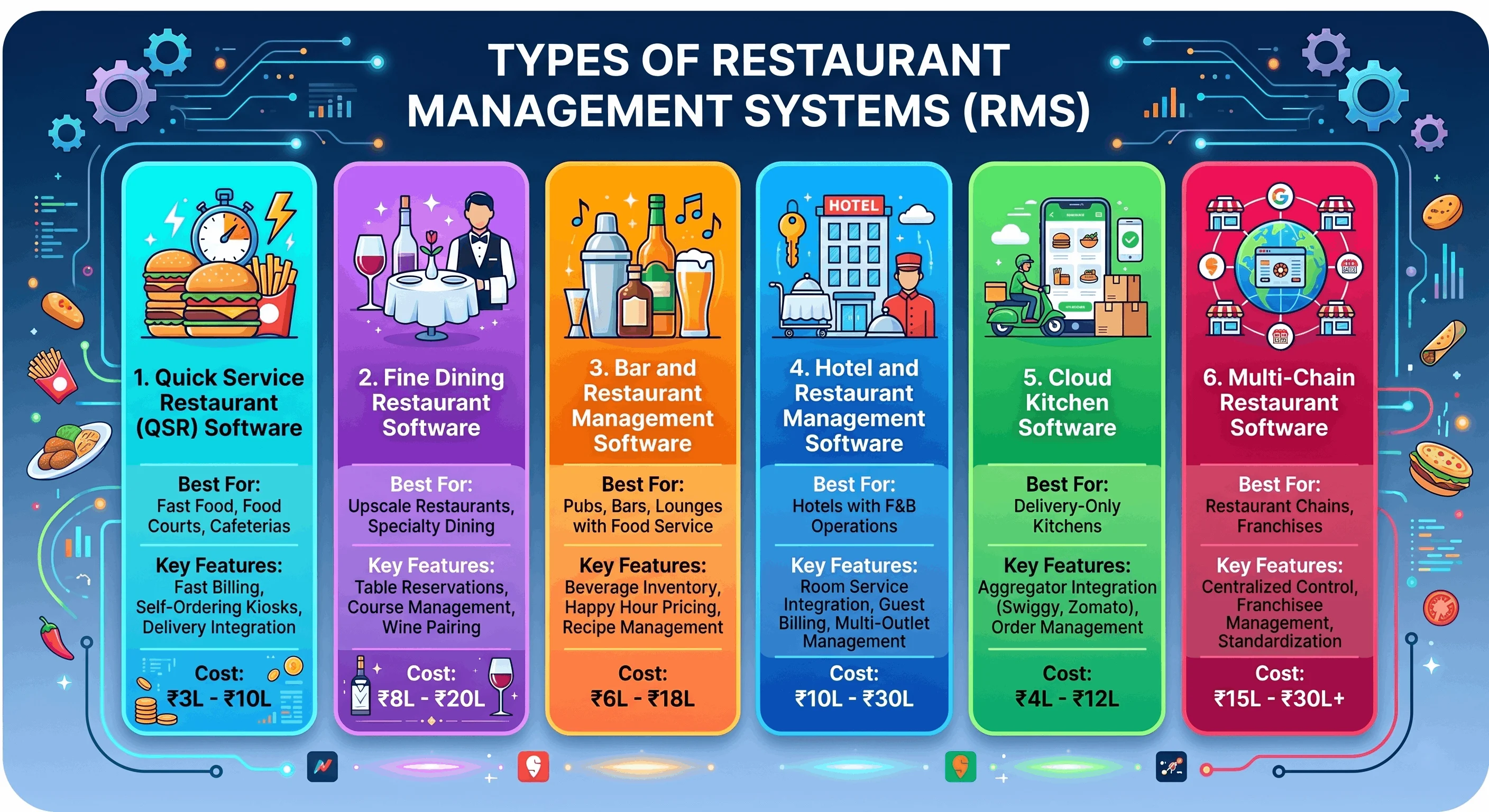
1. Quick Service Restaurant (QSR) Software
Best For: Fast food, food courts, cafeterias Key Features: Fast billing, self-ordering kiosks, delivery integration Cost: ₹3L - ₹10L
2. Fine Dining Restaurant Software
Best For: Upscale restaurants, specialty dining Key Features: Table reservations, course management, wine pairing Cost: ₹8L - ₹20L
3. Bar and Restaurant Management Software
Best For: Pubs, bars, lounges with food service Key Features: Beverage inventory, happy hour pricing, recipe management Cost: ₹6L - ₹18L
4. Hotel and Restaurant Management Software
Best For: Hotels with F&B operations Key Features: Room service integration, guest billing, multi-outlet management Cost: ₹10L - ₹30L
5. Cloud Kitchen Software
Best For: Delivery-only kitchens Key Features: Aggregator integration (Swiggy, Zomato), order management Cost: ₹4L - ₹12L
6. Multi-Chain Restaurant Software
Best For: Restaurant chains, franchises Key Features: Centralized control, franchisee management, standardization Cost: ₹15L - ₹30L+
Essential Features of Restaurant Management Software
1. Point of Sale (POS) System
Core POS Capabilities
Billing & Payment
- Fast order entry with modifiers
- Multiple payment modes (cash, cards, UPI, wallets)
- Split billing and partial payments
- Invoice generation with GST
- Discount and coupon management
- Tip handling
Order Management
- Dine-in, takeaway, delivery distinction
- KOT (Kitchen Order Ticket) printing
- Order modifications and cancellations
- Rush/delayed order marking
- Course-wise firing (for fine dining)
Table Management
- Visual floor plan
- Table status (occupied, reserved, available)
- Table merging/splitting
- Seat-wise ordering
- Wait time tracking
2. Kitchen Display System (KDS)
Kitchen Operations:
| Feature |
Benefit |
| Digital Order Display |
Eliminates paper KOTs, reduces errors |
| Priority Marking |
Rush orders highlighted |
| Preparation Timers |
Tracks cooking times |
| Order Routing |
Auto-routes to stations (grill, salad, etc.) |
| Completion Tracking |
Notifies servers when ready |
| Recipe Display |
Shows ingredient details |
3. Inventory Management
Comprehensive Inventory Features
Stock Tracking
- Real-time stock levels
- Multi-location inventory
- Recipe-level tracking
- Ingredient usage monitoring
- Automated reordering
- Supplier management
Purchase & Waste Management
- Purchase order generation
- Goods receipt notes
- Vendor management
- Wastage tracking and analysis
- Stock transfer between outlets
- FIFO/LIFO implementation
Recipe & Cost Management
- Recipe creation with ingredients
- Standard portions and costing
- Menu engineering analysis
- Food cost percentage tracking
- Price optimization
4. Online Ordering & Delivery
With the rise of digital ordering, many restaurants are also investing in mobile app development to create branded food ordering apps that eliminate aggregator commissions and improve customer retention through direct engagement.
Digital Ordering Integration:
| Channel |
Features |
Integration Cost |
| Own Website/App |
Custom branding, no commission |
₹2L - ₹8L |
| Aggregators |
Swiggy, Zomato, Uber Eats integration |
₹50K - ₹2L |
| QR Code Ordering |
Contactless dine-in ordering |
₹30K - ₹1L |
| WhatsApp Ordering |
Conversational ordering |
₹40K - ₹1.5L |
5. Customer Relationship Management
Customer Engagement
- Customer database with preferences
- Order history and favorite items
- Loyalty programs and points
- Birthday/anniversary offers
- Feedback collection
- Marketing campaigns (SMS, email, push)
- Customer segmentation
6. Reporting & Analytics
Restaurants looking to gain deeper insights are increasingly adopting AI-powered analytics solutions to predict demand, optimize menu pricing, and enhance customer experiences through data-driven decisions.
Essential Reports
Daily Operations
- Sales summary (hourly, daily)
- Category-wise sales
- Payment mode breakdown
- Server performance
- Table turnover rates
Financial Reports
- P&L statements
- Food cost percentage
- Labor cost analysis
- Expense tracking
- Tax reports (GST)
Inventory Reports
- Stock valuation
- Slow-moving items
- Wastage reports
- Purchase history
- Variance analysis
Customer Analytics
- Customer acquisition
- Repeat customer rate
- Average order value
- Popular items
- Peak hours analysis
7. Staff Management
HR & Operations
- Attendance tracking
- Shift scheduling
- Role-based access control
- Server performance metrics
- Commission calculations
- Leave management
8. Multi-Location Management
Chain/Franchise Features
- Centralized dashboard
- Location-wise performance
- Menu standardization
- Pricing control
- Inventory transfers
- Consolidated reporting
Restaurant Management Software Development Cost
Cost by Restaurant Type
| Restaurant Type |
Basic Features |
Advanced Features |
Enterprise |
| Small Cafe/QSR |
₹3L - ₹6L |
₹6L - ₹10L |
₹10L - ₹15L |
| Fine Dining |
₹5L - ₹10L |
₹10L - ₹18L |
₹18L - ₹25L |
| Bar & Restaurant |
₹6L - ₹12L |
₹12L - ₹18L |
₹18L - ₹22L |
| Hotel Restaurant |
₹8L - ₹15L |
₹15L - ₹25L |
₹25L - ₹35L |
| Cloud Kitchen |
₹4L - ₹8L |
₹8L - ₹12L |
₹12L - ₹18L |
| Multi-Chain |
₹12L - ₹20L |
₹20L - ₹30L |
₹30L - ₹50L+ |
Detailed Cost Components
1. Discovery & Planning (10-15%)
Cost: ₹50K - ₹4L
- Restaurant workflow analysis
- Feature requirement documentation
- Menu structure planning
- Integration requirements
- Hardware specifications
2. UI/UX Design (10-15%)
Cost: ₹75K - ₹5L
- POS interface design
- Kitchen display design
- Customer-facing screens
- Mobile app design (if applicable)
- Responsive web design
3. Core Development (40-50%)
Backend Development:₹2L - ₹12L
- Database architecture
- Business logic
- API development
- Payment gateway integration
- Cloud infrastructure setup
POS Application:₹1.5L - ₹8L
- Billing interface
- Order management
- Table management
- Payment processing
Kitchen Display System:₹75K - ₹4L
- Order routing logic
- Real-time updates
- Station management
Inventory Module:₹1L - ₹5L
- Stock tracking
- Recipe management
- Purchase orders
- Supplier management
Reporting Module:₹75K - ₹3L
- Report generation
- Analytics dashboard
- Data visualization
4. Integrations (15-20%)
| Integration Type |
Cost Range |
| Payment Gateways |
₹30K - ₹1.5L |
| Accounting Software |
₹50K - ₹2L |
| Delivery Aggregators |
₹40K - ₹2L per platform |
| Loyalty Programs |
₹60K - ₹2.5L |
| SMS/Email Services |
₹25K - ₹1L |
| Hardware (POS, printers) |
₹30K - ₹2L per terminal |
5. Mobile Apps (Optional)
| App Type |
Cost |
| Customer App (iOS + Android) |
₹2L - ₹8L |
| Manager App |
₹1L - ₹4L |
| Waiter App |
₹75K - ₹3L |
6. Testing & QA (10-15%)
Cost: ₹60K - ₹4L
- Functional testing
- Payment testing
- Load testing
- Hardware integration testing
- User acceptance testing
7. Deployment & Training (5-10%)
Cost: ₹40K - ₹3L
- Software installation
- Hardware setup
- Data migration
- Staff training
- Documentation
8. Annual Maintenance (15-20% of development cost)
Cost: ₹75K - ₹6L/year
- Bug fixes and updates
- Server maintenance
- Technical support
- Feature enhancements
- Security updates
Sample Project Cost
Medium-Sized Fine Dining Restaurant
| Component |
Cost |
Timeline |
| Planning & Design |
₹1.5L |
2 weeks |
| POS Development |
₹4L |
6 weeks |
| KDS Development |
₹2L |
3 weeks |
| Inventory System |
₹2.5L |
4 weeks |
| CRM & Loyalty |
₹1.5L |
3 weeks |
| Reporting Module |
₹1.5L |
2 weeks |
| Integrations (3) |
₹1.5L |
3 weeks |
| Testing |
₹1L |
2 weeks |
| Deployment |
₹75K |
1 week |
| Total |
₹16.25L |
5-6 months |
| Annual Maintenance |
₹2.5L |
Ongoing |
Annual Maintenance ₹2.5L Ongoing
ROI and Business Benefits
Expected Returns
Operational Efficiency Gains
- 40-60% faster order processing
- 50-70% reduction in billing errors
- 20-35% improved table turnover
- 30-45% reduction in inventory wastage
- 25-40% better staff productivity
Financial Impact:
| Benefit Category |
Annual Impact |
How Achieved |
| Food Cost Reduction |
₹3L - ₹15L |
Better inventory control, waste reduction |
| Revenue Increase |
₹5L - ₹25L |
Higher table turnover, online orders |
| Labor Cost Savings |
₹2L - ₹10L |
Improved efficiency, optimized scheduling |
| Reduced Errors |
₹1L - ₹5L |
Accurate billing, order tracking |
| Customer Retention |
₹2L - ₹12L |
Loyalty programs, better service |
ROI Calculation Example
Investment
- Software Development: ₹15L
- Hardware: ₹3L
- Training: ₹50K
- Total: ₹18.5L
Annual Benefits
- Food cost savings (20%): ₹8L
- Revenue increase (15%): ₹12L
- Labor optimization: ₹4L
- Error reduction: ₹2L
- Total Annual Benefit: ₹26L
ROI = (₹26L - ₹18.5L) / ₹18.5L × 100 = 41% Payback Period: 10 months
Business Improvements
Customer Experience
- 30% increase in satisfaction scores
- 50% faster service
- Personalized recommendations
- Better feedback management
- 40% higher repeat customers
Operational Control
- Real-time visibility across operations
- Data-driven menu optimization
- Accurate cost tracking
- Predictive inventory management
- Fraud prevention
Implementation Process
Phase 1: Planning (2-3 weeks)
Step 1: Requirements Analysis
- Current workflow documentation
- Pain point identification
- Feature prioritization
- Budget allocation
- Success metrics definition
Step 2: Restaurant-Specific Planning
| Restaurant Aspect |
Planning Focus |
| Menu |
Categories, modifiers, combos, pricing |
| Operations |
Floor plan, kitchen stations, service flow |
| Inventory |
Suppliers, recipes, stock levels |
| Staff |
Roles, shifts, access levels |
| Integrations |
Payment gateways, aggregators, accounting |
Phase 2: Design (2-3 weeks)
POS Interface Design
- Quick access to popular items
- Modifier selection flow
- Payment screen layout
- Receipt design
Kitchen Display
- Order priority visualization
- Station-wise filtering
- Timer displays
- Alert mechanisms
Phase 3: Development (12-20 weeks)
Sprint-Based Development
Weeks 1-4: Core POS
- Basic billing
- Order entry
- Payment processing
Weeks 5-8: Table & Kitchen Management
- Floor plan implementation
- KDS development
- Order routing
Weeks 9-12: Inventory System
- Stock tracking
- Recipe management
- Purchase orders
Weeks 13-16: Reporting & CRM
- Analytics dashboard
- Customer loyalty
- Marketing automation
Weeks 17-20: Integrations & Polish
- Third-party integrations
- Performance optimization
- UI refinements
Phase 4: Testing (3-4 weeks)
Testing Scenarios
Functional Testing
- All order types (dine-in, takeaway, delivery)
- Payment modes
- Discount calculations
- Report accuracy
Integration Testing
- Payment gateway transactions
- Aggregator order sync
- Printer connectivity
- Hardware compatibility
Load Testing
- Peak hour simulation
- Concurrent orders
- Multiple terminals
User Acceptance Testing
- Staff testing with real scenarios
- Manager approval
- Feedback incorporation
Phase 5: Deployment (2-3 weeks)
Deployment Strategy
Week 1: Soft Launch
- Install in one outlet/section
- Test with limited menu
- Monitor closely
- Gather feedback
Week 2: Parallel Operation
- Run new and old systems together
- Verify data accuracy
- Build staff confidence
Week 3: Full Launch
- Complete switchover
- Old system decommissioning
- Final optimizations
Training Program
- Manager training (2 days)
- Server training (1 day)
- Kitchen staff training (half day)
- Ongoing support during transition
Phase 6: Optimization (Ongoing)
Continuous Improvement
- Weekly performance reviews
- Menu optimization based on data
- Feature additions based on needs
- Regular updates and enhancements
Technology Stack
Recommended Technologies
| Component |
Technology Options |
Best Choice |
| Backend |
Node.js, Python, .NET |
Node.js (real-time updates) |
| Database |
PostgreSQL, MySQL, MongoDB |
PostgreSQL (reliability) |
| Frontend (POS) |
React, Angular, Electron |
Electron (desktop app) |
| Mobile Apps |
React Native, Flutter |
Flutter (performance) |
| Cloud |
AWS, Azure, Google Cloud |
AWS (scalable) |
| Payment |
Razorpay, PayU, Stripe |
Razorpay (India-focused) |
| Analytics |
Custom, Tableau, Power BI |
Custom (tailored insights) |
Why Choose Secuodsoft for Restaurant Software Development
Secuodsoft, a CMMI Level 3 appraised company, delivers comprehensive restaurant management software development services for your custom needs combining hospitality industry expertise with state of the art technology.
Industries Served
- Quick service restaurants (QSR)
- Fine dining establishments
- Bars and pubs
- Hotel F&B operations
- Cloud kitchens
- Restaurant chains and franchises
- Café and bakery chains
Conclusion
Restaurant management software development in 2026 represents essential investment for Indian restaurants seeking competitive advantages through operational efficiency, cost control, and superior customer experience. Success requires understanding restaurant-specific features (POS billing, KDS, inventory management), realistic cost planning (₹3-30 lakhs based on restaurant type), choosing appropriate technology stacks, and partnering with experienced restaurant software development companies who understand both technology and hospitality operations. Whether operating a small café, bar and restaurant, hotel restaurant, or multi-chain franchise, investing in quality restaurant management software delivers 30-50% efficiency gains, 15-25% cost reductions, and 25-40% revenue increases through better operations and customer engagement. Focus on clear requirements, proper planning, staff training, and continuous optimization for maximum ROI. Partner with proven developers like Secuodsoft who combine technical expertise with hospitality industry knowledge, ensuring your restaurant software transforms operations delivering measurable business results.
Frequently Asked Questions (FAQ)
Restaurant management software development cost in India ranges from ₹3 lakhs to ₹30 lakhs+ depending on restaurant type and features. Small cafes and QSRs need basic POS and inventory costing ₹3-6 lakhs taking 2-3 months. Fine dining restaurants require advanced features including table management, course handling, and wine inventory ranging ₹5-18 lakhs over 3-5 months. Bar and restaurant management software with beverage inventory and recipe management costs ₹6-18 lakhs. Hotel and restaurant management software integrating room service and multi-outlet operations ranges ₹10-30 lakhs requiring 5-8 months. Cloud kitchen software with aggregator integration costs ₹4-12 lakhs. Multi-chain systems with centralized control exceed ₹15 lakhs. Cost components include planning (10-15%), UI/UX design (10-15%), core development (40-50%), integrations (15-20%), testing (10-15%), and deployment (5-10%). Annual maintenance adds 15-20% of development cost. Hardware costs separate (₹50K-₹3L per outlet). Choose based on restaurant size, outlet count, required features, and growth plans.
Restaurant management software development timeline ranges from 2-12 months depending on complexity. Basic POS and inventory system for small restaurants takes 2-3 months including planning (2 weeks), design (2 weeks), development (6-8 weeks), testing (2-3 weeks), and deployment (2 weeks). Standard system with POS, KDS, inventory, CRM, and online ordering requires 3-5 months covering detailed planning (3 weeks), UI/UX design (3 weeks), development (10-16 weeks), comprehensive testing (3-4 weeks), and deployment (2-3 weeks). Advanced systems for fine dining or hotels need 5-7 months with sophisticated features and integrations. Multi-chain enterprise solutions require 7-12 months including complex development, multi-location setup, and phased rollout. Timeline factors include feature scope, integration requirements, custom vs off-the-shelf components, team size and experience, and restaurant operational complexity. Proper planning, development, testing, and staff training ensure successful implementations.
Essential features include POS billing system, kitchen display system, inventory management, table management, online ordering integration, reporting and analytics, CRM and loyalty programs, and staff management. Additional features include menu engineering, multi-location management, accounting integration, delivery fleet management, contactless payments, and offline mode. Feature prioritization depends on restaurant type such as QSR, fine dining, bar, or cloud kitchen.
Ready-made software costs ₹30K-₹3L annually with quick deployment and proven features, suitable for small to medium restaurants with standard needs. Custom software costs ₹5-30 lakhs with longer timelines but offers full customization, ownership, scalability, and competitive advantage. Hybrid approach can also work depending on growth and budget.
Restaurant software improves profitability through food cost reduction (15-25%), revenue increase (25-40%), labor optimization (15-25%), and error reduction. It enhances efficiency with faster order processing, reduced manual work, better decision-making, and fraud prevention. Typical ROI can reach 41% with payback in under a year.