Mobile App Development
Editorial Team
16 April 2026
The Indian ride-hailing market is projected to reach $12 billion by 2026, creating unprecedented opportunities for entrepreneurs and businesses entering taxi booking app development. While Uber and Ola dominate the market, regional players capturing niche segments such as premium services, intercity travel, women-only rides, and eco-friendly transport are thriving with custom taxi booking apps generating ₹5–50 lakhs in monthly revenue. However, 60% of taxi app startups fail within the first year due to poor planning, inadequate features, technical issues, or choosing inexperienced taxi booking app development companies, leading to ₹10–30 lakhs in wasted investments. Success in this competitive market requires understanding essential features like real-time tracking, multiple payment options, and driver management, along with realistic cost expectations (₹3–25 lakhs depending on complexity), the right technology stack, and experienced development partners.
This comprehensive 2026 guide covers everything you need to know about taxi booking app development, from must-have features and development costs to monetization strategies, technology choices, and step-by-step implementation processes that help you launch a successful taxi booking platform in 3–6 months.
Understanding Taxi Booking App Market in India
Market Opportunity
The rapid expansion of digital infrastructure and smartphone penetration has significantly boosted the demand for taxi booking apps across India. Both metropolitan and emerging cities are witnessing increased adoption of ride-hailing services, creating a strong market for new entrants.
Key Statistics
- Market Size: $12 billion by 2026
- Annual Growth Rate: 18–22%
- Active Users: 150+ million Indians
- Daily Rides: 5+ million bookings
- Average Ride Value: ₹200–500
Emerging Opportunities
- Tier 2 and Tier 3 cities (under-penetrated markets)
- Premium and luxury ride services
- Intercity and outstation travel solutions
- Women-only ride services
- Eco-friendly electric vehicle fleets
- Medical transport and ambulance services
- Student and corporate shuttle services
Business Models
| Model |
Description |
Revenue Potential |
Best For |
| Commission-Based |
Platform fee per ride (15-25%) |
₹10L-₹1Cr/month |
General taxi services |
| Subscription |
Monthly driver/rider subscriptions |
₹5L-₹50L/month |
Premium services |
| Corporate Contracts |
B2B employee transportation |
₹15L-₹2Cr/month |
Enterprise solutions |
| Advertising |
In-app ads and promotions |
₹2L-₹20L/month |
High user base apps |
| Surge Pricing |
Dynamic pricing during peak hours |
20-40% revenue boost |
Urban markets |
Essential Features of Taxi Booking App
1. Passenger App Features
Core Features
User Registration & Profile
- Mobile number/email registration
- Social media login (Google, Facebook)
- Profile management
- Ride history
- Saved locations (home, work)
- Emergency contacts
Ride Booking
- Current location detection (GPS)
- Destination selection
- Ride type selection (sedan, SUV, luxury)
- Fare estimation before booking
- Multiple pickup points
- Schedule rides in advance
- Ride sharing options
Real-Time Tracking
- Live driver location on map
- ETA (estimated time of arrival)
- Route visualization
- Driver details (name, photo, rating)
- Vehicle details (model, number)
- SOS/emergency button
Payment Integration
- Multiple payment options (cash, cards, UPI, wallets)
- In-app wallet
- Automatic fare calculation
- Ride receipts and invoices
- Promo codes and discounts
- Split payment options
Rating & Reviews
- Rate driver after ride
- Provide feedback
- View driver ratings before booking
- Report issues
Notifications
- Booking confirmations
- Driver arrival alerts
- Ride status updates
- Payment confirmations
- Promotional offers
Advanced Features
| Feature |
Benefit |
Development Cost |
| Multi-Stop Rides |
Add multiple destinations |
₹50,000 - ₹1,50,000 |
| Ride Sharing |
Split costs with others |
₹1,00,000 - ₹3,00,000 |
| Favorite Drivers |
Book preferred drivers |
₹30,000 - ₹80,000 |
| Ride Scheduling |
Book rides in advance |
₹40,000 - ₹1,00,000 |
| In-App Chat/Call |
Communicate with driver |
₹60,000 - ₹1,50,000 |
| Ride Insurance |
Additional safety coverage |
₹1,00,000 - ₹2,50,000 |
| Loyalty Programs |
Reward frequent riders |
₹80,000 - ₹2,00,000 |
2. Driver App Features
Driver Registration
- Personal details submission
- Document upload (license, RC, insurance)
- Vehicle details
- Background verification integration
- Bank account details for payments
Ride Management
- Accept/reject ride requests
- Navigation to pickup location
- Start/end ride functionality
- View passenger details
- Route optimization
- Earnings tracker
Availability Status
- Online/offline toggle
- Set availability hours
- Break management
- Heat map for high-demand areas
Earnings & Payments
- Daily/weekly earnings summary
- Ride history with earnings
- Commission breakdown
- Instant payout options
- Tax documentation
Driver Support
- In-app customer support
- FAQ section
- Emergency assistance
- Training resources
3. Admin Panel Features
Dashboard & Analytics
- Total rides (daily/weekly/monthly)
- Revenue tracking
- Active users and drivers
- Growth metrics
- Geographic distribution
- Average ratings
User Management
- View/edit user profiles
- User verification
- Block/unblock users
- Activity logs
- Support ticket management
Driver Management
- Driver approvals
- Document verification
- Performance tracking
- Commission management
- Incentive programs
- Driver ratings and reviews
Ride Management
- Real-time ride monitoring
- Ride history and logs
- Cancellation tracking
- Dispute resolution
- Surge pricing control
Financial Management
- Payment gateway integration
- Transaction logs
- Commission settings
- Driver payouts
- Refund management
- Financial reports
Content Management
- Manage promotional banners
- Push notifications
- Promo codes and offers
- City and service area management
- Vehicle type and pricing management
Taxi Booking App Development Cost Breakdown
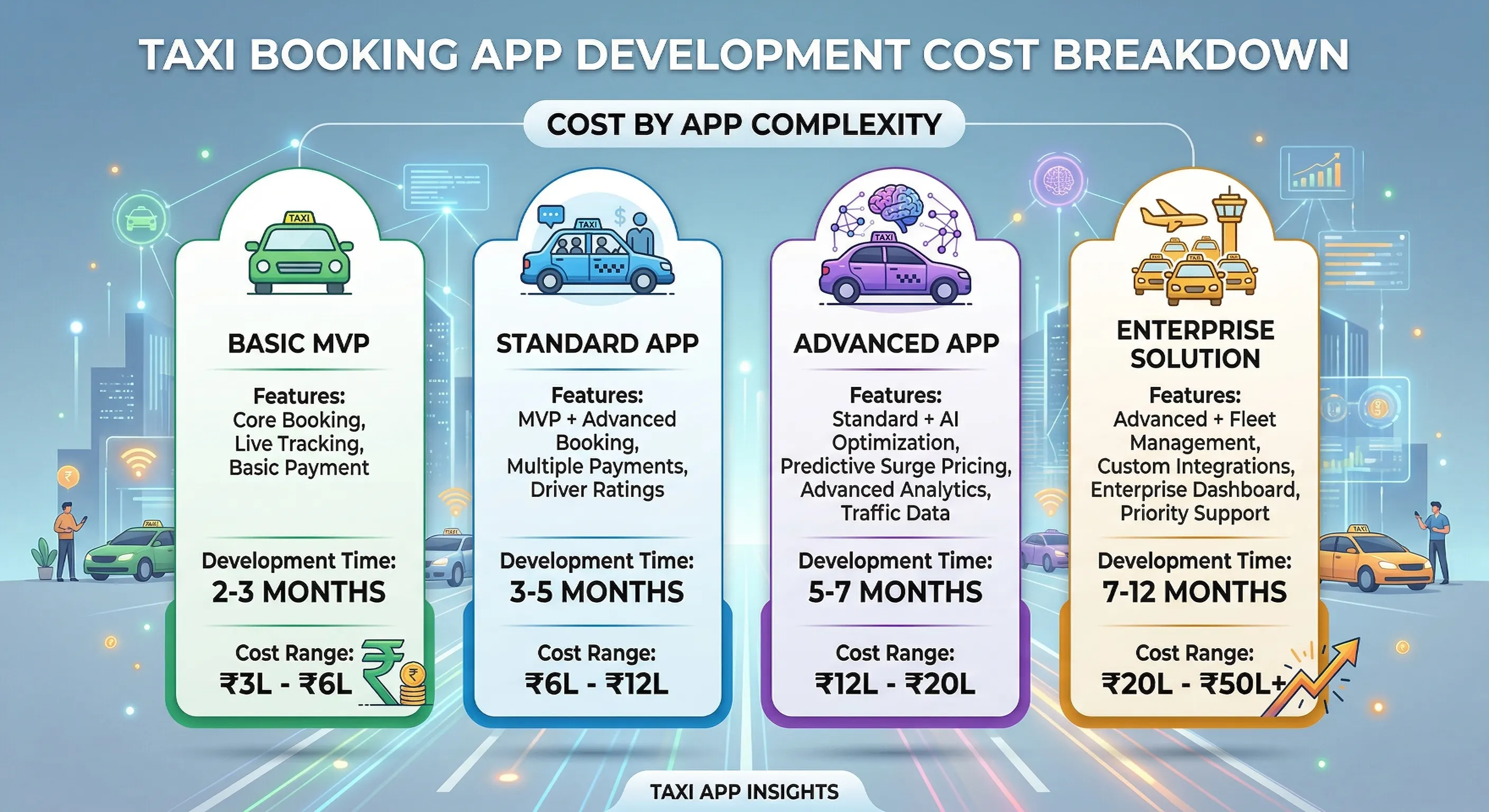
Cost by App Complexity
| App Type |
Features |
Development Time |
Cost Range |
| Basic MVP |
Core booking, tracking, payment |
2-3 months |
₹3L - ₹6L |
| Standard App |
MVP + advanced features |
3-5 months |
₹6L - ₹12L |
| Advanced App |
Standard + AI, analytics |
5-7 months |
₹12L - ₹20L |
| Enterprise Solution |
All features + customization |
7-12 months |
₹20L - ₹50L+ |
Detailed Cost Components
1. Planning & Design (15–20% of total)
Cost: ₹50,000 – ₹5,00,000
Includes:
- Market research
- Competitor analysis
- Feature planning
- UI/UX design
- Wireframing
- Prototyping
- Brand identity
2. App Development (50–60% of total)
| Component |
Cost Range |
Timeline |
| Passenger App (iOS) |
₹1,50,000 - ₹6,00,000 |
6-12 weeks |
| Passenger App (Android) |
₹1,50,000 - ₹6,00,000 |
6-12 weeks |
| Driver App (iOS) |
₹1,00,000 - ₹4,00,000 |
5-10 weeks |
| Driver App (Android) |
₹1,00,000 - ₹4,00,000 |
5-10 weeks |
| Admin Panel (Web) |
₹2,00,000 - ₹8,00,000 |
8-16 weeks |
| Backend Development |
₹2,00,000 - ₹10,00,000 |
10-20 weeks |
This phase includes frontend and backend development, API integrations, and building scalable architecture for the taxi booking platform.
3. Third-Party Integrations (10–15% of total)
Essential integrations:
| Integration |
Purpose |
Cost |
| Google Maps API |
Navigation, location tracking |
₹20,000 - ₹1,00,000 |
| Payment Gateway |
Online payments |
₹30,000 - ₹1,50,000 |
| SMS Gateway |
OTP, notifications |
₹15,000 - ₹50,000 |
| Push Notifications |
Firebase/OneSignal |
₹20,000 - ₹60,000 |
| Analytics |
Google Analytics, Mixpanel |
₹25,000 - ₹80,000 |
| Cloud Storage |
AWS/Azure |
₹30,000 - ₹1,50,000 |
- Payment gateways (UPI, cards, wallets)
- Maps and navigation (Google Maps API)
- SMS and notification services
- Analytics tools
- Cloud services and hosting
4. Testing & QA (10–15% of total)
Cost: ₹40,000 – ₹3,00,000
- Functional testing
- Performance testing
- Security testing
- Device compatibility testing
- Load testing
- User acceptance testing
5. Deployment & Launch (5–8% of total)
Cost: ₹30,000 – ₹2,00,000
- App store submissions (iOS, Android)
- Server setup and configuration
- Database optimization
- Security implementation
- Initial marketing setup
6. Maintenance & Support (Annual)
Cost: ₹1,00,000 – ₹8,00,000/year (15–20% of development cost)
- Bug fixes
- Performance optimization
- Feature updates
- Server maintenance
- Security patches
- Technical support
Cost Optimization Strategies
How to Reduce Development Cost
1. Start with MVP
- Launch with core features only
- Add advanced features based on user feedback
- Savings: 40–50% on initial investment
2. Use Cross-Platform Development
- React Native or Flutter instead of native
- Single codebase for iOS and Android
- Savings: 30–40% on app development
3. Utilize Ready-Made Solutions
- White-label taxi app platforms
- Pre-built backend infrastructure
- Savings: 50–60% but less customization
4. Offshore Development
- Tier 2 city developers (Bhubaneswar, Chandigarh)
- Savings: 25–35% compared to metro rates
5. Phased Launch
- Start with single city
- Expand gradually
- Savings: Manageable cash flow
Step-by-Step Taxi App Development Process
Phase 1: Planning & Strategy (2–3 weeks)
Step 1: Market Research
- Analyze competitors (Uber, Ola, local players)
- Identify target audience
- Study local regulations
- Determine unique value proposition
Step 2: Define Business Model
- Choose revenue model
- Set commission structure
- Plan pricing strategy
- Design incentive programs
Step 3: Feature Prioritization
| Priority |
Features |
Justification |
| Must-Have |
Booking, tracking, payment, driver app |
Core functionality |
| Should-Have |
Ratings, notifications, ride history |
User experience |
| Nice-to-Have |
Ride sharing, loyalty program |
Competitive advantage |
Step 4: Technology Selection
- Choose tech stack
- Select cloud provider
- Identify third-party services
- Plan scalability
Phase 2: Design (3–4 weeks)
UI/UX Design Process
Week 1: Research & Wireframing
- User journey mapping
- Low-fidelity wireframes
- Information architecture
Week 2: Visual Design
- Brand identity
- Color schemes
- Typography
- Icon design
Week 3: High-Fidelity Mockups
- Detailed screen designs
- Interactive elements
- Animation concepts
Week 4: Prototyping
- Clickable prototype
- User testing
- Design refinement
Phase 3: Development (12–20 weeks)
Backend Development (8–12 weeks)
- Database architecture
- API development
- Authentication system
- Real-time tracking implementation
- Payment gateway integration
- Admin panel functionality
Passenger App
- User registration/login
- Location selection
- Ride booking flow
- Real-time tracking
- Payment integration
- Rating system
Driver App
- Driver onboarding
- Ride acceptance/rejection
- Navigation integration
- Earnings tracking
- Support features
Parallel Development Timeline
- Weeks 1–4: Backend + Basic UI
- Weeks 5–8: Core features + Integration
- Weeks 9–12: Advanced features
- Weeks 13–16: Testing + Optimization
- Weeks 17–20: Final polish + Deployment
Phase 4: Testing (3–5 weeks)
Testing Checklist
Functional Testing
- All features working correctly
- User flows complete end-to-end
- Edge cases handled
Performance Testing
- App loads within 3 seconds
- Handles 1000+ concurrent users
- Smooth animations
Security Testing
- Payment data encrypted
- Personal information protected
- API security validated
Device Testing
- iOS (iPhone 11–15, various iPads)
- Android (Samsung, OnePlus, Xiaomi, etc.)
- Different screen sizes
Integration Testing
- Maps working correctly
- Payments processing successfully
- SMS/notifications delivered
- Push notifications functioning
Phase 5: Launch (2–3 weeks)
Pre-Launch Checklist
Week 1: App Store Preparation
- Create developer accounts (Apple, Google)
- Prepare app descriptions
- Design app icons and screenshots
- Submit for review
Week 2: Infrastructure Setup
- Configure production servers
- Set up monitoring tools
- Implement analytics
- Test payment gateways in production
Week 3: Soft Launch
- Launch in limited area
- Onboard initial drivers (20–50)
- Acquire first customers
- Monitor performance
- Gather feedback
Launch Strategy
- Start with 1–2 neighborhoods
- Focus on quality over quantity
- Ensure driver availability (80%+ acceptance rate)
- Incentivize early adopters
- Monitor metrics daily
Phase 6: Post-Launch (Ongoing)
First Month Focus
- Fix critical bugs within 24 hours
- Monitor key metrics daily
- Onboard more drivers
- Respond to user feedback
- Gradual geographic expansion
Ongoing Activities
- Weekly feature updates
- Monthly performance optimization
- Quarterly major updates
- Continuous driver training
- Regular marketing campaigns
Technology Stack for Taxi Booking App
Recommended Technologies
| Component |
Technology Options |
Best Choice |
| Frontend (Mobile) |
React Native, Flutter, Native (Swift/Kotlin) |
Flutter (best performance + single codebase) |
| Backend |
Node.js, Python, Ruby on Rails, Java |
Node.js (real-time capabilities) |
| Database |
PostgreSQL, MongoDB, MySQL |
PostgreSQL (reliability + scalability) |
| Real-Time |
Socket.io, Firebase |
Socket.io (full control) |
| Maps |
Google Maps, Mapbox |
Google Maps (accuracy + features) |
| Payment |
Razorpay, Paytm, Stripe |
Razorpay (India-focused) |
| Cloud |
AWS, Google Cloud, Azure |
AWS (comprehensive services) |
| Push Notifications |
Firebase, OneSignal |
Firebase (reliability) |
Monetization Strategies
Revenue Streams
1. Commission-Based (Primary)
- Charge 15–25% per ride
- Example: ₹200 ride = ₹30–50 commission
- Potential: ₹10L–₹1Cr monthly (at scale)
2. Surge Pricing
- 1.5x–3x during peak hours
- Weather-based surge
- Event-based pricing
- Additional Revenue: 20–40%
3. Cancellation Fees
- Charge riders for late cancellations
- Typically ₹20–50 per cancellation
- Monthly: ₹50K–₹5L
4. Corporate Contracts
- B2B employee transportation
- Fixed monthly contracts
- Per Contract: ₹2L–₹50L/month
5. Advertising
- In-app banner ads
- Sponsored ride options
- Partner promotions
- Monthly: ₹1L–₹10L
6. Subscription Plans
- Premium memberships for riders
- Subscription for zero cancellation fees
- Per User: ₹99–499/month
Why Choose Secuodsoft for Taxi Booking App Development
Secuodsoft, a CMMI Level 3 appraised company, delivers comprehensive taxi booking app development services with proven expertise and competitive pricing.
Our Taxi App Development Expertise
Track Record
- 15+ taxi/ride-hailing apps developed
- 1M+ downloads across client apps
- 95% client satisfaction
- Apps handling 50K+ daily rides
Industries Served
- Urban taxi services
- Intercity travel
- Corporate transportation
- Medical transport
- Airport transfers
- Luxury car rentals
Client Success Stories
Regional Taxi Service
- Launched in tier-2 city
- 5,000+ downloads in 3 months
- 200+ active drivers
- ₹15L monthly revenue
Corporate Transport App
- Employee shuttle management
- 50+ corporate clients
- 10,000+ daily rides
- ₹40L monthly revenue
Conclusion
Taxi booking app development in 2026 presents significant opportunities for entrepreneurs and businesses entering India's growing ride-hailing market. Success requires understanding essential features (real-time tracking, seamless payments, driver management), realistic cost planning (₹3-25 lakhs based on complexity), choosing the right technology stack, and partnering with experienced taxi booking app development companies who deliver quality solutions. Whether building an Uber-like app for urban markets or niche services for specific segments, focusing on user experience, driver satisfaction, and operational efficiency determines success. Start with an MVP (₹3-6 lakhs, 2-3 months), validate your business model, gather user feedback, and scale gradually. Partner with proven developers like Secuodsoft who combine technical expertise with business understanding, ensuring your taxi booking app not only launches successfully but thrives in India's competitive ride-hailing landscape.
Frequently Asked Questions
Taxi booking app development cost in India ranges from ₹3 lakhs to ₹25 lakhs+ depending on features and complexity. Basic MVP with core features (booking, tracking, payment) costs ₹3-6 lakhs taking 2-3 months. Standard app with advanced features (ride sharing, scheduling, loyalty programs) ranges ₹6-12 lakhs over 3-5 months. Advanced app with AI-powered features, analytics, and extensive customization costs ₹12-20 lakhs taking 5-7 months. Enterprise solutions with complete customization exceed ₹20 lakhs requiring 7-12 months. Cost components include planning and design (15-20%), app development for passenger and driver apps (50-60%), third-party integrations like maps and payments (10-15%), testing (10-15%), and deployment (5-8%). Annual maintenance adds 15-20% of development cost. Cross-platform development using Flutter or React Native reduces costs 30-40% compared to native development. Choose developers providing transparent pricing, realistic timelines, and proven portfolios rather than selecting based solely on lowest cost.
Taxi booking app development timeline ranges from 2-12 months depending on complexity and features. MVP development with core features takes 2-3 months including planning (2 weeks), design (3 weeks), development (8-10 weeks), testing (2-3 weeks), and launch (1-2 weeks). Standard app with comprehensive features requires 3-5 months covering detailed planning (3 weeks), UI/UX design (4 weeks), development (12-16 weeks), extensive testing (3-4 weeks), and deployment (2-3 weeks). Advanced apps with AI features, complex integrations, and custom algorithms need 5-7 months. Enterprise solutions with complete customization require 7-12 months. Timeline factors include feature scope (more features = longer timeline), platform choice (cross-platform faster than native), team size (larger teams accelerate development), integration complexity (multiple third-party services add time), and testing thoroughness (comprehensive QA ensures quality). Rushed timelines compromise quality, proper planning, development, and testing ensure successful launches. Partner with experienced taxi booking app development companies who provide realistic timelines and deliver quality solutions on schedule.
Essential taxi booking app features include passenger app capabilities (user registration with phone/email, current location detection via GPS, destination selection with address search, ride type selection, real-time fare estimation, live driver tracking on map, multiple payment options including cash/cards/UPI/wallets, ride history, driver rating and feedback, emergency SOS button, push notifications for ride status), driver app features (driver registration with document upload, ride request acceptance/rejection, navigation to pickup and destination, earnings tracking, availability status toggle, passenger details view, in-app support), and admin panel functionality (dashboard with analytics, user and driver management, ride monitoring, payment management, commission settings, promo code management, reports generation, dispute resolution). Advanced features providing competitive advantages include ride scheduling, multi-stop rides, ride sharing/carpooling, favorite driver selection, in-app chat/call, loyalty programs, referral systems, surge pricing, heat maps for drivers, route optimization, and predictive analytics. Integration requirements include Google Maps for navigation, payment gateway (Razorpay/Paytm), SMS gateway for OTP, push notifications (Firebase), analytics (Google Analytics/Mixpanel), and cloud storage (AWS/Azure). Prioritize features based on budget, start with core features in MVP, add advanced features based on user feedback and business growth.
The Uber clone vs custom development decision depends on budget, timeline, differentiation needs, and long-term vision. Uber clone solutions (white-label apps) cost ₹2-8 lakhs with quick launch (2-4 weeks), proven features and workflows, lower development risk, and ready-made infrastructure. Best for testing market quickly, limited budget (under ₹10 lakhs), standard taxi service without unique requirements, and short-term projects. However, limitations include limited customization (20-30% modifications possible), monthly subscription fees (₹25K-₹1L), vendor dependency, generic features competitors also use, and restricted scalability. Custom taxi app development costs ₹6-25 lakhs+ with longer timeline (3-8 months) but provides unlimited customization (100%), unique competitive features, complete ownership (no recurring fees), full control over updates and changes, scalable architecture, and proprietary advantages. Best for unique business models, industry-specific requirements (medical transport, luxury services), long-term vision (5+ years), integration with existing systems, and differentiation important. Hybrid approach works too, start with clone for quick launch, customize extensively (₹3-10 lakhs additional), migrate to custom later as business scales. Evaluate based on budget availability, time to market urgency, differentiation importance, technical team capability, and growth plans.
Taxi booking app monetization uses multiple revenue streams maximizing profitability. Primary revenue model is commission-based charging 15-25% per ride, for example, ₹200 ride generates ₹30-50 commission, scaling to ₹10 lakhs-₹1 crore monthly revenue at volume. Surge pricing during peak hours, bad weather, or events charges 1.5x-3x normal rates adding 20-40% additional revenue. Cancellation fees (₹20-50 per cancellation) generate ₹50K-₹5L monthly from late cancellations. Corporate contracts providing B2B employee transportation earn ₹2-50 lakhs per contract monthly. Advertising revenue from in-app banners, sponsored listings, and partner promotions generates ₹1-10 lakhs monthly with significant user base. Subscription plans offering premium benefits (zero cancellation fees, priority booking, exclusive drivers) earn ₹99-499 per user monthly. Additional services include delivery services using same infrastructure, rental services for longer durations, and airport transfer premiums. Revenue optimization strategies include dynamic pricing algorithms, driver incentive programs increasing supply, rider acquisition campaigns, and operational efficiency improvements. Successful apps combine multiple revenue streams rather than relying solely on commissions, diversification increases profitability and reduces risk. Focus on providing value to both riders and drivers ensuring sustainable, win-win business model.