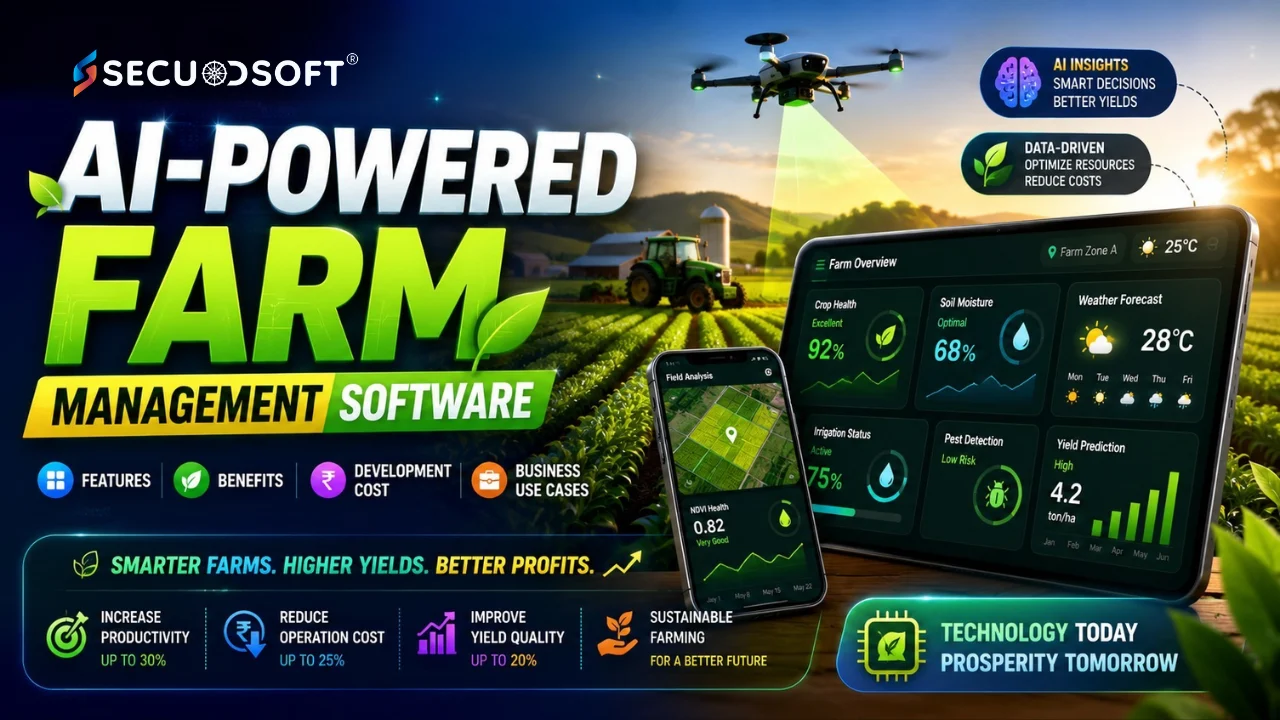
Picture two farmers starting identical seasons with identical land, identical crops, identical weather conditions. Farmer A manages operations traditionally, experience-based decisions, manual record keeping, reactive problem-solving when issues emerge. Farmer B deploys AI-powered farm management software, satellite imagery analyzing crop health weekly, soil sensors triggering precision irrigation automatically, predictive models warning about pest infestations 10 days before visible symptoms appear, yield forecasting guiding marketing decisions three months ahead.
By harvest, Farmer B achieves 35% higher yields, uses 28% less water, spends 40% less on pesticides, and sells at 15% better prices because advance yield forecasting enables forward contract negotiations. Farmer A's season was decent. Farmer B's season was transformational.
This isn't hypothetical. Indian agricultural businesses deploying precision agriculture software consistently document these improvements across diverse crops, geographies, and farm sizes. The technology gap between data-driven and traditional farming creates measurable competitive advantages that compound every season.
India's agricultural sector, contributing ₹19 lakh crore annually to GDP while employing 45% of workforce, stands at a digital transformation inflection point. AI farm management software isn't future technology, it's competitive necessity for agricultural businesses serious about profitability in 2026.
Traditional agriculture operates on accumulated wisdom, invaluable but incomplete. Experienced farmers recognize drought stress symptoms visually but cannot detect subsurface water depletion until visible damage appears. They identify pest pressure through field observation but cannot predict migration patterns from neighbouring farms before infestation arrives. They make planting decisions based on decades of local knowledge but cannot incorporate real-time climate model predictions for the coming season.
Crop losses from preventable disease cost Indian farmers ₹90,000 crore annually. Water overuse in irrigation wastes ₹45,000 crore in input costs while depleting groundwater resources unsustainably. Misaligned harvest timing, arriving at markets when supply peaks depress prices, costs smallholder farmers 15-25% of potential revenue. Inefficient fertilizer application wastes ₹30,000 crore annually while contributing to soil degradation reducing long-term productivity.
Collectively, these preventable losses represent ₹1.65 lakh crore annually in Indian agriculture alone. AI-powered farm management software addresses each loss category through data-driven decision-making that enhances rather than replaces farmer expertise.
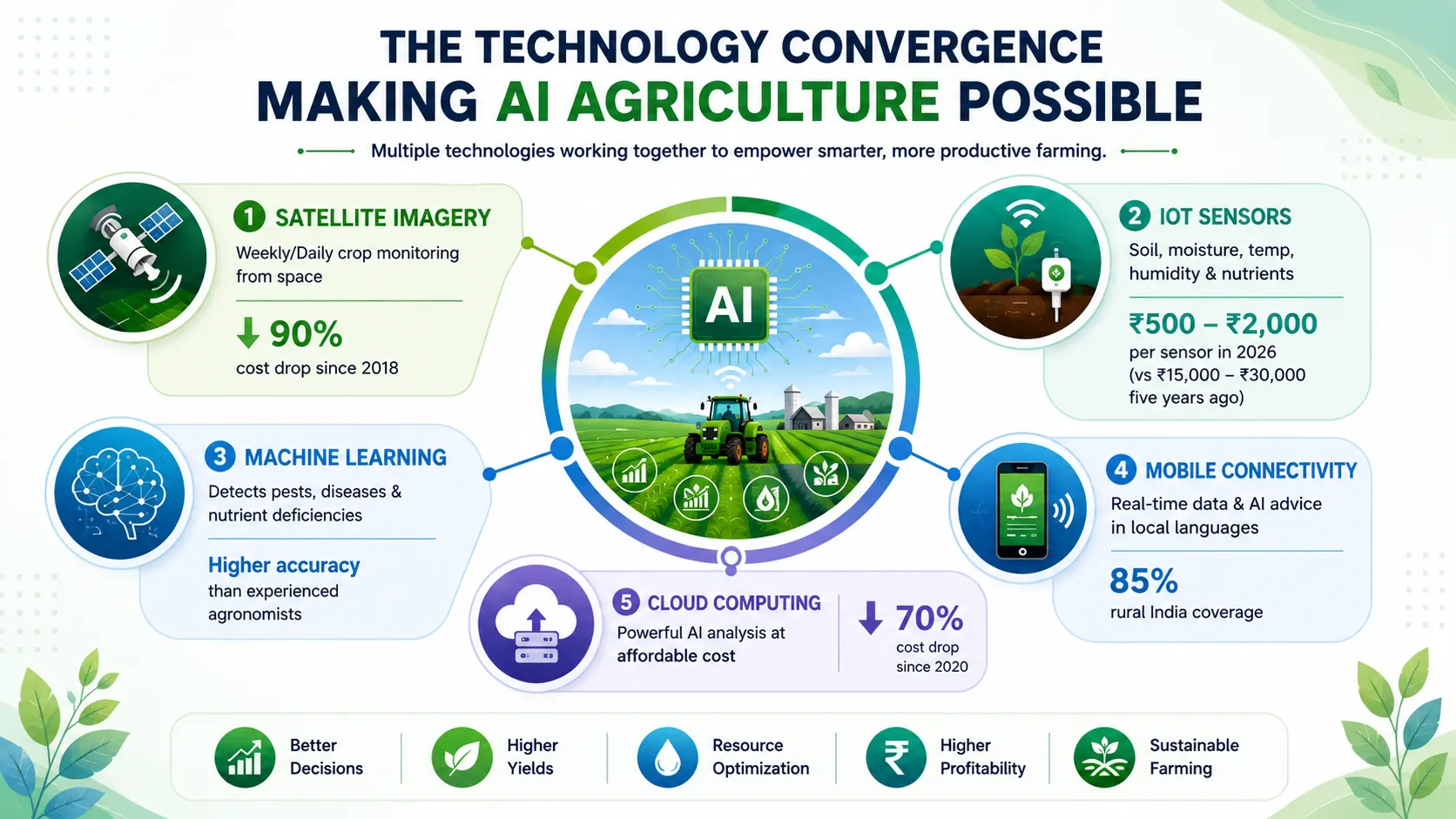
Several technology streams converged simultaneously making smart farming technology practically deployable at scale:
Satellite imagery provides weekly or daily crop monitoring across any farm size at costs decreasing 90% since 2018. What once required expensive aerial photography is now available through constellation satellites providing 3-meter resolution imagery.
IoT sensors for soil moisture, temperature, humidity, and nutrient levels cost ₹500-₹2,000 per sensor in 2026 versus ₹15,000-₹30,000 five years ago. Deployment across medium-sized farms becomes economically viable.
Machine learning models trained on millions of crop data points recognize pest pressure signatures, disease patterns, and nutrient deficiency indicators with accuracy exceeding experienced agronomists in controlled testing.
Mobile connectivity reaching 85% of rural India enables real-time data transmission from field sensors to cloud platforms and back to farmer smartphones with actionable recommendations in local languages.
Cloud computing costs decreased 70% since 2020, making sophisticated AI analysis affordable for individual farms rather than only corporate agricultural operations.
AI-powered farm management software integrates data from multiple sources, satellite imagery, IoT sensors, weather stations, historical records, market data, applies machine learning analysis, and delivers actionable recommendations through interfaces accessible to farmers with varying technical sophistication.
The distinction from traditional farm management software matters enormously. Older systems digitize existing processes, replacing paper records with digital spreadsheets. AI systems transform processes, analyzing data patterns to provide insights humans cannot generate through observation alone.
Businesses planning to implement intelligent agricultural platforms often partner with experienced AI development services providers to build machine learning models, predictive analytics engines, and computer vision solutions tailored to their farming operations.
Weekly satellite imagery processed through computer vision algorithms identifies crop health variations invisible to ground-level observation. Normalized Difference Vegetation Index (NDVI) mapping reveals which field sections are thriving and which show stress, enabling targeted intervention rather than broadcast treatment.
The system analyzes imagery changes week-over-week, identifying declining areas early. A section showing 15% NDVI decline triggers automated alert: "Section C showing moisture stress. Recommend irrigation within 48 hours." Without satellite monitoring, the farmer might notice visual stress symptoms two weeks later after significant yield impact.
Where satellite imagery identifies problem areas, drone flights provide ground-truth verification and detailed assessment. Modern systems schedule drone missions automatically when satellite data indicates areas warranting closer inspection. Drone imagery processed through AI classifies issues specifically, distinguishing between fungal infection and pest damage that might appear visually similar.
Distributed soil sensors monitor moisture levels at multiple depths throughout fields. AI systems analyze sensor data continuously, comparing actual soil moisture against crop-specific optimal ranges for each growth stage. When moisture drops below threshold, irrigation triggers automatically, or alerts reach farmer smartphones for manual approval.
A dedicated mobile app development strategy enables farmers, agronomists, and field staff to monitor crops, receive instant alerts, approve irrigation schedules, and access farm insights from anywhere.
Traditional irrigation schedules based on calendar dates or fixed volumes waste substantial water and energy. AI-driven irrigation responds to actual soil conditions. Studies across Indian cotton, rice, and wheat cultivation document 25-40% water use reduction through sensor-guided irrigation while maintaining or improving yields.
The system integrates weather forecast data into irrigation scheduling. Upcoming rainfall within 48 hours triggers irrigation delay. Forecasted heat waves trigger preemptive irrigation building soil moisture reserves. Irrigation decisions incorporate multiple data streams simultaneously in ways manual scheduling cannot achieve.
Pest and disease outbreaks follow patterns, specific temperature and humidity combinations create favorable conditions for particular pathogens and pests. AI models trained on historical outbreak data generate daily risk scores for each field: "Conditions favorable for early blight development next 7 days. Prophylactic fungicide application recommended."
This prediction capability is transformative. Reactive treatment after visible infection often occurs when 20-30% of yield potential is already lost. Prophylactic treatment based on risk prediction prevents loss entirely.
Farmers photograph suspicious plant symptoms using smartphone cameras. AI analysis identifies the likely pathogen or pest with 87-94% accuracy, recommends specific treatment protocols, calculates economic treatment thresholds (whether pest pressure justifies treatment cost), and identifies nearest sources for recommended inputs.
Wearable sensors on livestock continuously monitor activity levels, feeding behavior, rumination patterns, and body temperature. Deviations from individual animal baselines trigger health alerts. Disease detection typically occurs 48-72 hours before clinical symptoms appear, enabling treatment before condition becomes severe and spreading to other animals.
AI analysis of reproductive cycle data, genetic records, and performance history optimizes breeding decisions. Systems identify optimal breeding timing based on estrus detection accuracy exceeding 95%, recommend genetic pairings maximizing offspring performance, and predict breeding outcomes based on historical data.
AI systems calculate optimal feed formulations based on current commodity prices, nutritional requirements by animal category, and production goals. Dynamic feed optimization adjusts rations as input prices fluctuate, maintaining nutritional targets at minimum cost.
Accurate yield forecasts 90-120 days before harvest enable sophisticated marketing strategies. Farmers knowing expected yield quantities and timing can negotiate forward contracts with buyers, decide optimal storage versus immediate sale strategies, and plan input purchases for the coming season with confidence.
Integration with commodity price feeds and historical price pattern analysis provides market timing guidance. System identifies seasonal price patterns suggesting optimal marketing windows. For perishable produce, harvest scheduling aligned with price peaks can improve price realization 10-20%.
The system tracks all income and expenses automatically, calculates profitability by crop, field section, or production enterprise, and provides benchmarking against regional averages. Financial visibility enables data-driven decisions about crop mix, input investment levels, and infrastructure expansion.
Since every agricultural business has different operational workflows, crop types, and integration requirements, many organizations prefer investing in custom software development services instead of generic farm management platforms to ensure long-term scalability and better ROI.
Designed for individual farms or small agricultural businesses:
Timeline: 12-16 weeks
Best For: Individual farms, small cooperatives, agricultural consultants
Annual Maintenance: ₹1.5L - ₹3L
Comprehensive platform serving multiple farms or large operations:
Timeline: 16-24 weeks
Best For: Large farms, agricultural service providers, agritech startups
Annual Maintenance: ₹3L - ₹7L
Full-scale platform serving large agricultural enterprises or multiple farms:
Timeline: 24-40 weeks
Best For: Agritech companies, large cooperatives, agricultural corporations, government projects
Annual Maintenance: ₹7L - ₹20L
| Component | Small | Mid-Market | Enterprise |
|---|---|---|---|
| Core Platform Development | ₹4L–₹8L | ₹8L–₹16L | ₹16L–₹40L |
| AI/ML Model Development | ₹2L–₹5L | ₹6L–₹15L | ₹15L–₹35L |
| IoT Integration | ₹1L–₹3L | ₹3L–₹8L | ₹8L–₹20L |
| Satellite Data Integration | ₹1L–₹3L | ₹3L–₹8L | ₹8L–₹15L |
| Mobile App Development | ₹1.5L–₹4L | ₹4L–₹8L | ₹8L–₹15L |
| Testing & Deployment | ₹50K–₹2L | ₹2L–₹5L | ₹5L–₹10L |
| Hardware (Sensors) | ₹1L–₹5L | ₹5L–₹20L | ₹20L–₹50L+ |
| Cost Category | Monthly Range | Annual Range |
|---|---|---|
| Cloud Hosting | ₹20K–₹2L | ₹2.4L–₹24L |
| Satellite Imagery | ₹10K–₹1L | ₹1.2L–₹12L |
| Weather Data APIs | ₹5K–₹50K | ₹60K–₹6L |
| Maintenance & Support | ₹15K–₹1.5L | ₹1.8L–₹18L |
| Model Retraining | ₹10K–₹75K | ₹1.2L–₹9L |
AI-guided crop management consistently documents yield improvements across crops:
| Crop | Traditional Yield | AI-Managed Yield | Improvement |
|---|---|---|---|
| Wheat | 4.2 Tons/Hectare | 5.6 Tons/Hectare | +33% |
| Rice | 3.8 Tons/Hectare | 4.9 Tons/Hectare | +29% |
| Cotton | 2.1 Tons/Hectare | 2.8 Tons/Hectare | +33% |
| Tomato | 35 Tons/Hectare | 48 Tons/Hectare | +37% |
| Sugarcane | 72 Tons/Hectare | 95 Tons/Hectare | +32% |
Year 1 ROI: 6% (₹2 lakh net benefit)
Year 2 ROI: 94% (₹32 lakh net benefit, platform paid off)
Year 3 ROI: 185% (₹67 lakh cumulative net benefit)
Platform investments typically recover fully within 12-18 months, with years 2-5 generating compounding returns.
Large agricultural corporations managing thousands of acres across multiple locations leverage enterprise platforms for centralized management. Single dashboards provide visibility across all operations. Agronomists monitor hundreds of farms remotely, intervening where data indicates issues while allowing successful operations to continue without unnecessary intervention.
Fertilizer, pesticide, and seed companies deploy farm management platforms to service dealer networks. Platforms demonstrate product value through data, showing customers exactly how company products performed versus alternatives. Data-driven relationships create customer loyalty far stronger than traditional sales approaches.
State agricultural departments deploy platforms for monitoring crop conditions across districts, providing early warning of food security risks, delivering advisory services to smallholder farmers through mobile interfaces, and tracking agricultural program outcomes with data rather than self-reported surveys.
Banks and agricultural finance companies integrate farm management data into credit assessment. Yield history, soil health trends, and management practice data provide objective risk assessment enabling lending to previously unbankable farmers with strong management practices but limited collateral.
Several high-value startup opportunities exist in Indian agricultural technology:
Building successful AgriTech software requires more than technical expertise—it demands a deep understanding of agricultural operations, AI, IoT, cloud technologies, and data-driven decision-making. Secuodsoft develops intelligent farm management solutions tailored to the unique needs of agribusinesses, cooperatives, startups, and large-scale agricultural enterprises, helping them improve productivity, optimize resources, and make smarter farming decisions through modern technology.
AI-powered farm management software is transforming agriculture from intuition-based farming to data-driven decision-making. By combining artificial intelligence, IoT, satellite imagery, predictive analytics, and automation, modern farm management platforms help agricultural businesses increase crop yields, reduce input costs, optimize resource utilization, and improve long-term sustainability. As climate challenges, labor shortages, and market uncertainties continue to grow, adopting intelligent farming technology is becoming a strategic investment rather than an optional upgrade.
Whether you're an agribusiness, cooperative, agricultural startup, or large-scale farming enterprise, investing in custom AI-powered farm management software can create a significant competitive advantage. Partnering with an experienced AgriTech software development company ensures your solution is built around your unique operational requirements, integrates seamlessly with existing systems, and remains scalable for future growth. The right technology investment today can drive higher productivity, better profitability, and smarter farming outcomes for years to come.
Copyright ©2026 Secuodsoft. All rights reserved.