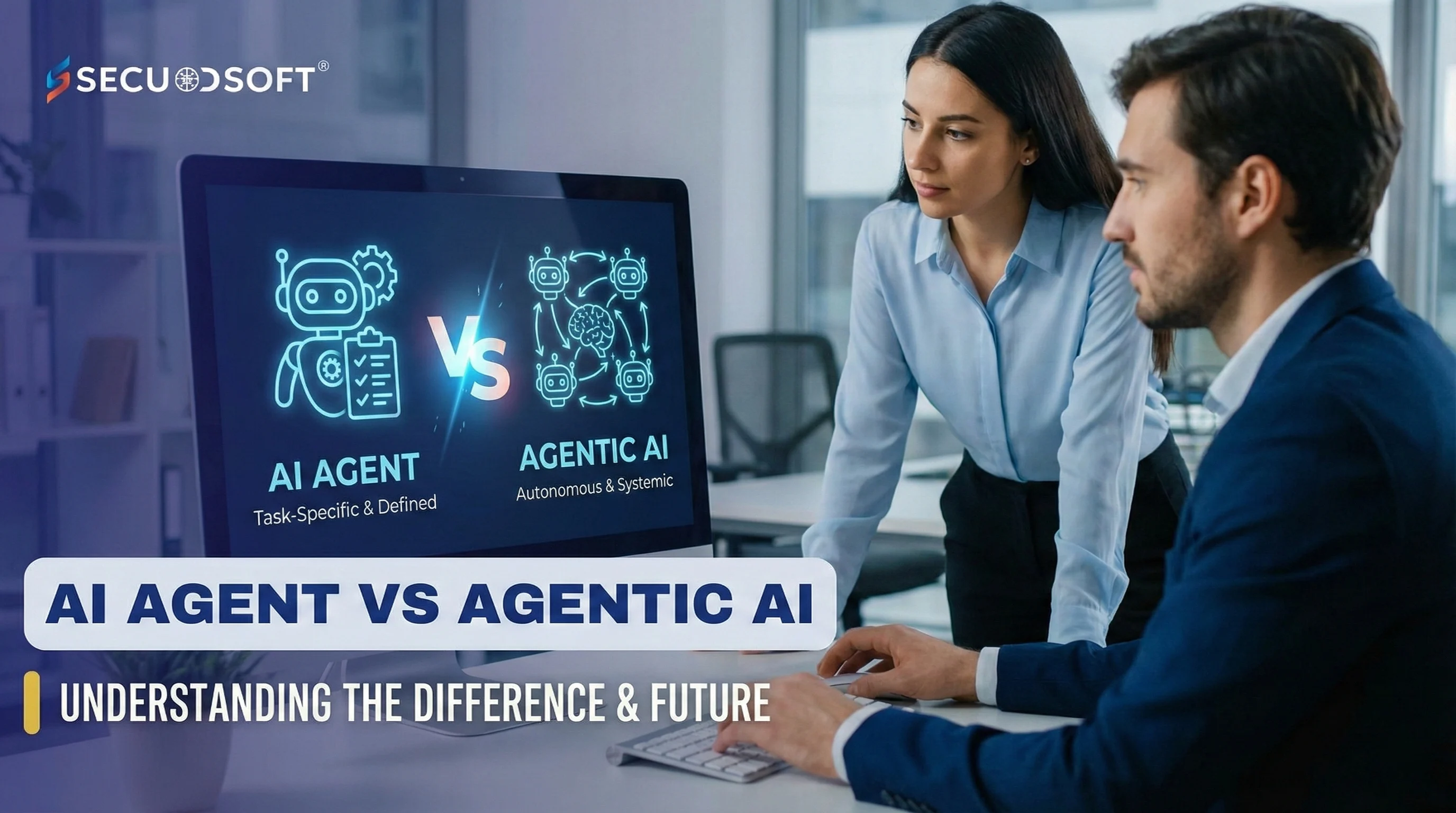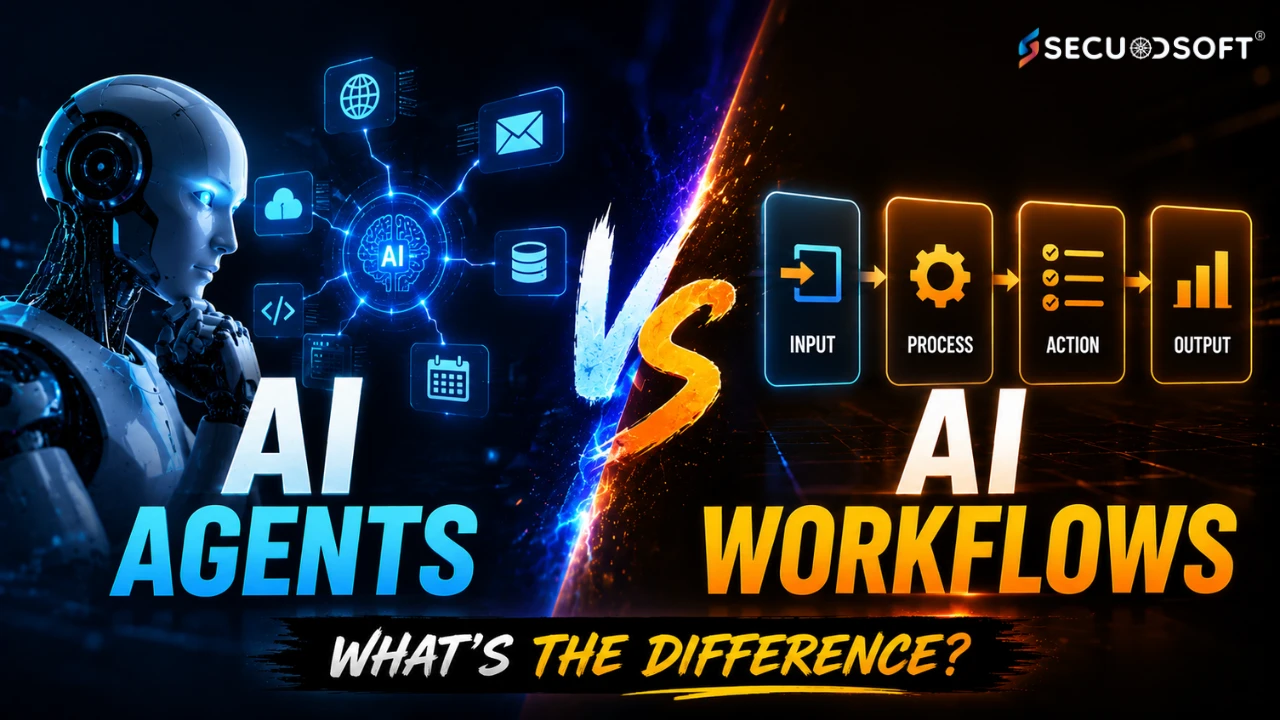
Artificial intelligence has evolved far beyond simple chatbots and rule-based automation. Today, businesses are increasingly adopting AI Agents and AI Workflows to automate operations, improve productivity, and reduce operational costs. However, many organizations mistakenly assume these two technologies are interchangeable.
Choosing the wrong approach can result in expensive implementations, inefficient automation, and disappointing ROI. While AI workflows excel at executing predefined business processes, AI agents are designed to reason, plan, make decisions, and complete tasks with minimal human intervention.
According to industry analysts, enterprise investment in AI automation continues to accelerate as organizations look beyond traditional robotic process automation (RPA) toward more intelligent systems capable of handling dynamic business scenarios. Businesses that implement the right AI automation strategy can significantly reduce manual effort, improve operational efficiency, and create better customer experiences.
This comprehensive guide explains the difference between AI Agents vs AI Workflows, how each technology works, where they deliver the greatest value, and which solution best fits your business objectives in 2026.
Think of an AI workflow as a highly efficient production line.
Every step follows a defined path.
If a specific condition occurs, the workflow performs a predetermined action.
For example:
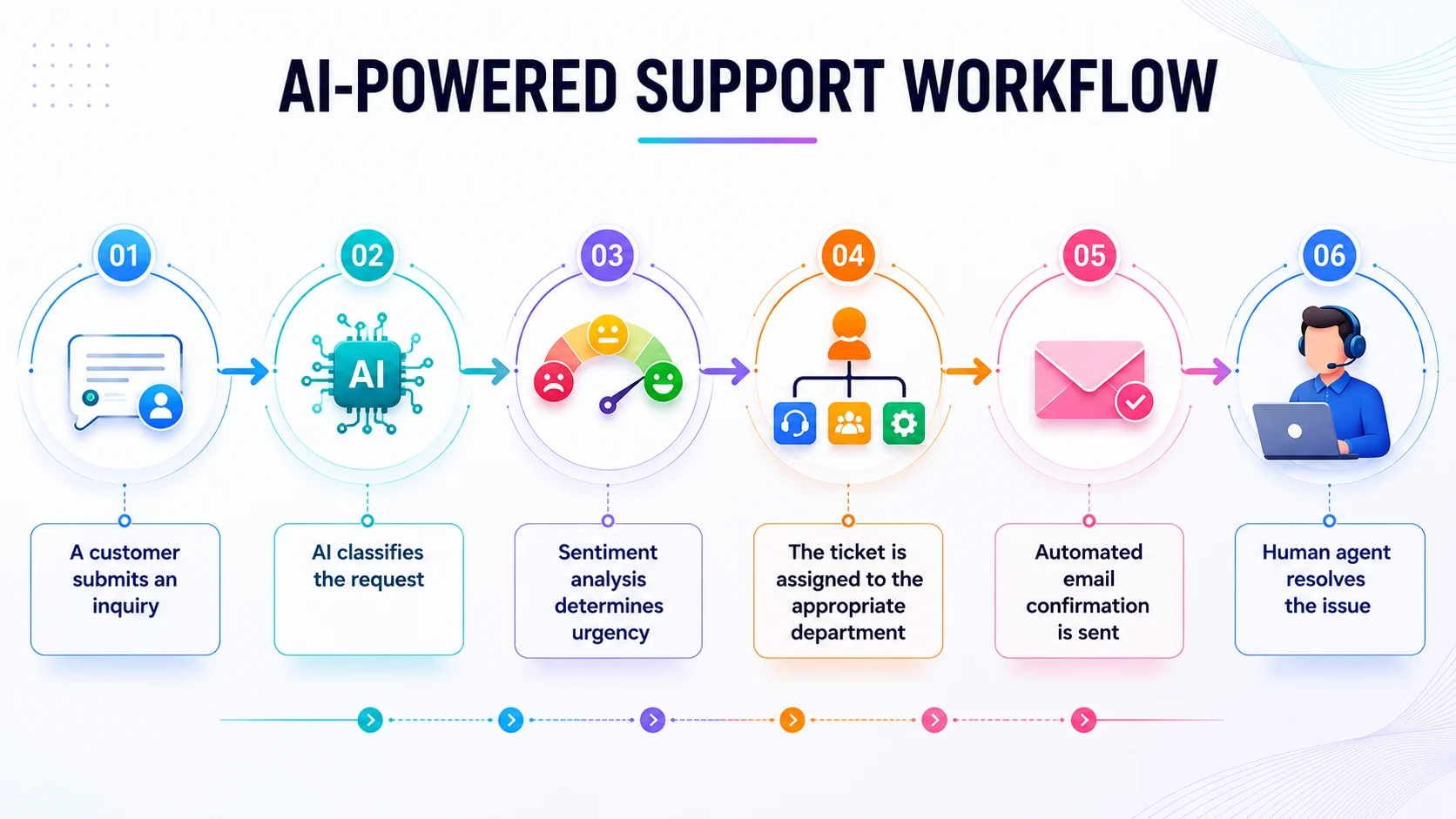
The workflow is intelligent because AI enhances individual steps, but the overall process remains predefined.
Because every action is predefined, AI workflows are highly reliable and suitable for repetitive operational processes.
AI agents represent the next generation of intelligent automation.
Instead of following fixed instructions, AI agents understand objectives, evaluate available information, decide what actions to take, execute those actions using available tools, and continuously adapt until the objective is achieved.
Rather than asking:
"What should I do next?"
An AI agent asks:
"What is the best way to accomplish this goal?"
For example, consider the objective:
"Resolve this customer's billing issue."
Instead of simply displaying billing information, an AI agent can:
All without human intervention.
This level of autonomy is what separates AI agents from traditional workflow automation.
| Feature | AI Workflows | AI Agents |
|---|---|---|
| Decision Making | Rule-based | Autonomous reasoning |
| Goal Orientation | Executes predefined tasks | Achieves objectives |
| Adaptability | Low | High |
| Learning Capability | Limited | Continuous improvement |
| Multi-Step Planning | Fixed sequence | Dynamic planning |
| Tool Usage | Predefined integrations | Selects tools automatically |
| Human Intervention | Frequent | Minimal |
| Best For | Repetitive processes | Complex business operations |
Every AI workflow follows a structured automation pipeline.
A simplified example looks like this:
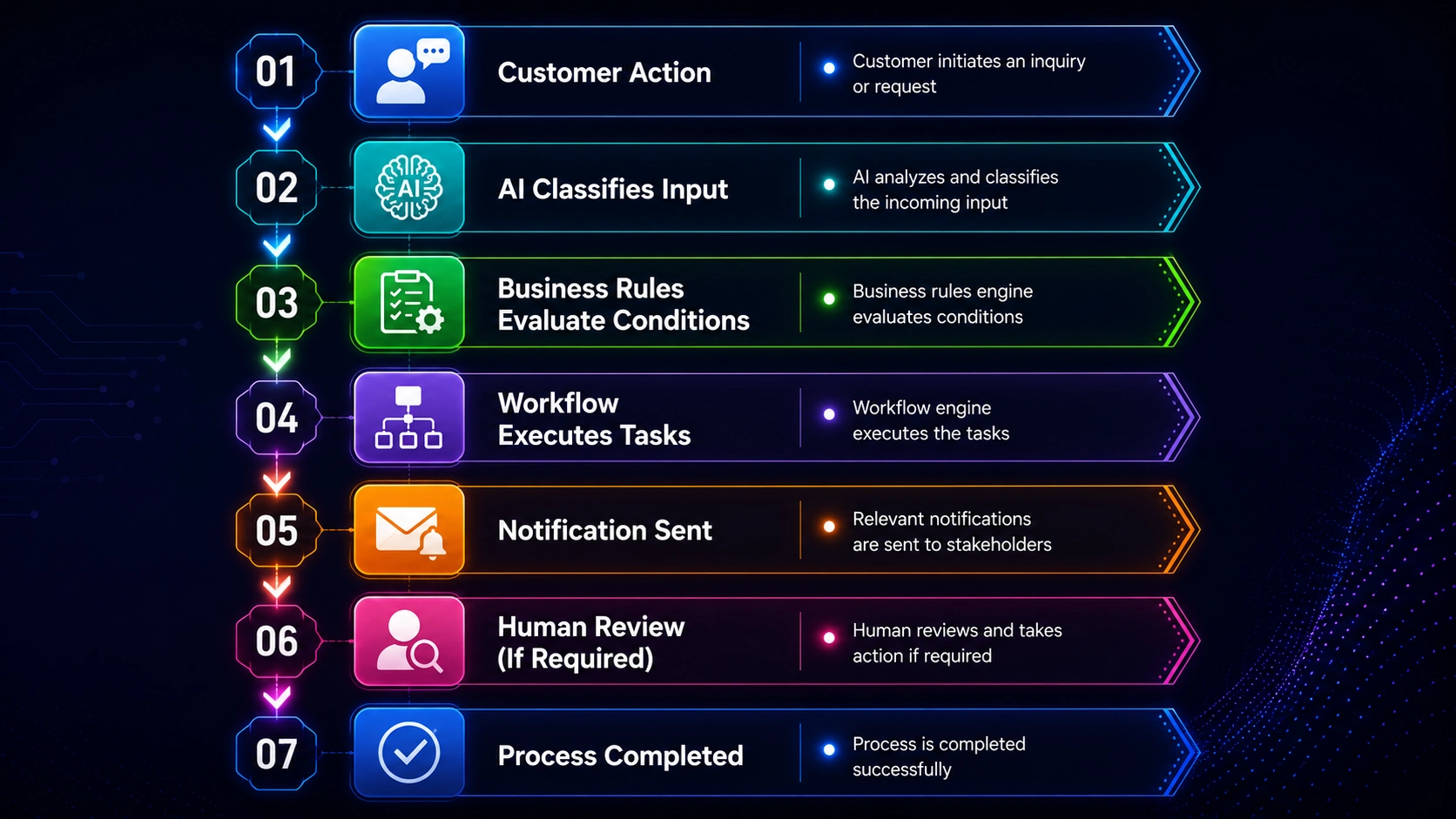
Since every decision is mapped in advance, AI workflows are ideal where consistency and compliance matter more than flexibility.
Examples include:
AI agents follow a completely different architecture.
Instead of executing instructions, they continuously evaluate progress toward a goal.
A simplified AI agent process looks like this:
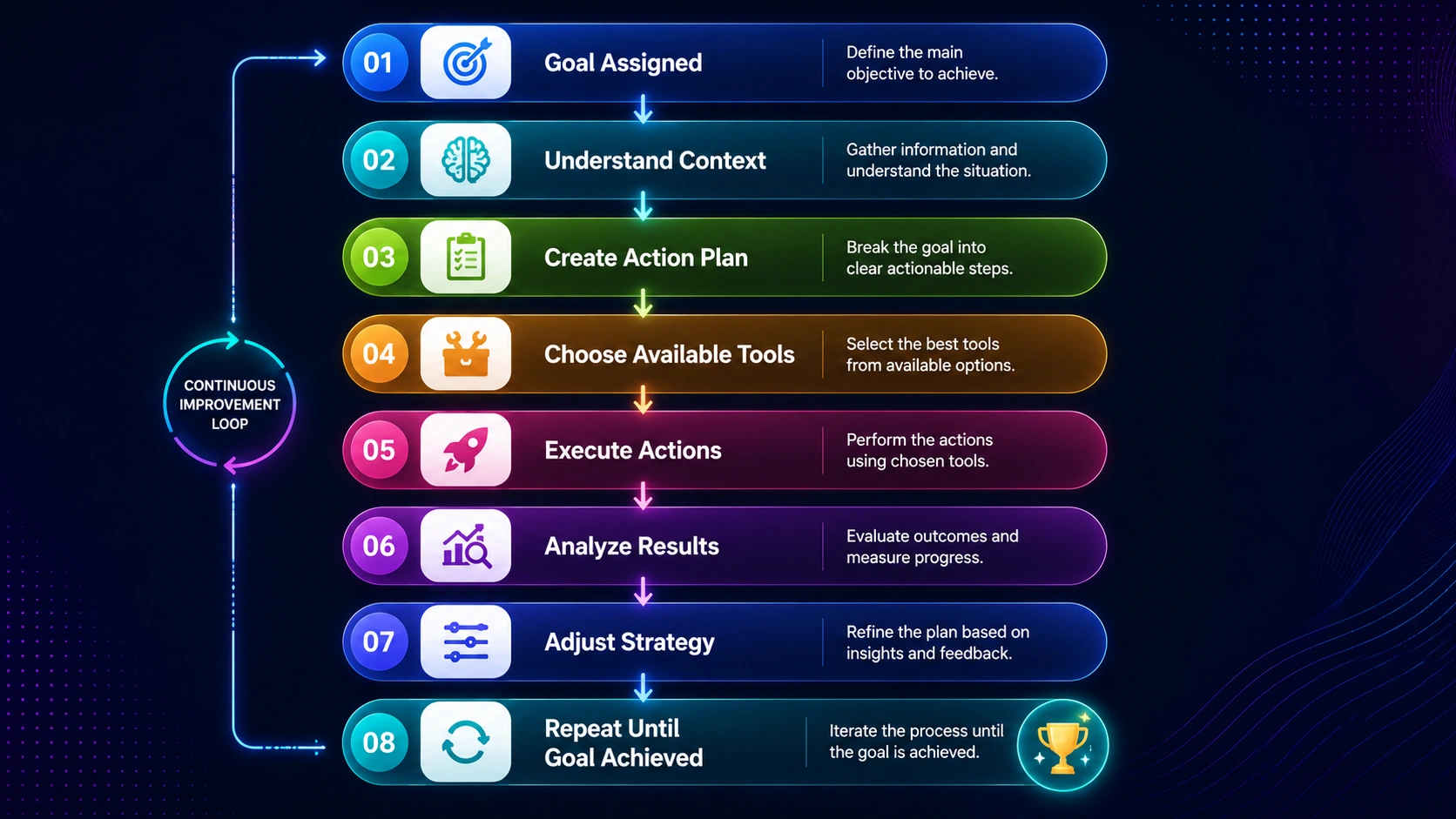
This reasoning loop enables AI agents to solve problems that have no predefined solution.
Rather than waiting for human instructions, the agent independently determines what should happen next.
Although both technologies automate work, their capabilities differ dramatically.
AI workflows make decisions only within predefined business rules.
If an invoice exceeds $5,000, send it to the finance manager.
If customer satisfaction falls below 3 stars, create a support ticket.
That's the limit.
AI agents evaluate multiple variables simultaneously before making intelligent decisions.
For example, instead of merely escalating a dissatisfied customer, an AI agent might analyze purchase history, identify retention opportunities, calculate customer lifetime value, generate a personalized compensation offer, and communicate directly with the customer.
AI workflows perform exceptionally well in structured environments.
However, unexpected situations often require manual intervention.
AI agents excel in dynamic environments where conditions constantly change.
They adapt their strategies based on available information without requiring developers to rewrite automation logic.
This makes AI agents particularly valuable for industries such as healthcare, finance, logistics, cybersecurity, and customer support.
AI workflows answer:
"What should happen next?"
AI agents answer:
"How can I successfully complete this objective?"
That distinction fundamentally changes what businesses can automate.
For instance, if inventory shortages occur, a workflow may simply notify the purchasing department.
An AI agent could instead:
And it does all automatically.
Traditional workflows become increasingly complex as businesses grow.
Every new exception requires additional rules.
Over time, maintenance becomes difficult.
AI agents scale more naturally because they reason through new scenarios instead of relying exclusively on predefined logic.
As organizational complexity increases, AI agents often require fewer manual updates than workflow-based systems.
AI workflows rarely improve unless developers modify them.
AI agents continuously learn from interactions, feedback, historical outcomes, and business data.
Over time, they become better at making decisions, selecting tools, prioritizing tasks, and improving business performance.
Both AI Agents and AI Workflows solve business problems, but they excel in different scenarios. Understanding where each technology performs best helps organizations make smarter investment decisions.
AI workflows are ideal when business processes follow a structured sequence and require consistency rather than autonomous decision-making.
Common examples include:
For example, when a customer submits a support request, an AI workflow can automatically categorize the issue, assign it to the correct department, send an acknowledgment email, and notify the support executive. Every action follows predefined rules, ensuring speed, consistency, and compliance.
AI agents become valuable when work requires reasoning, planning, decision-making, and adaptation.
Examples include:
Instead of simply forwarding customer issues, an AI agent can analyze previous conversations, understand customer sentiment, identify purchasing history, determine urgency, recommend personalized solutions, and even resolve the issue without human intervention.
This significantly reduces response time while improving customer satisfaction.
AI-powered automation is no longer limited to desktop applications. Many businesses are embedding AI agents and intelligent workflows directly into customer-facing mobile applications, enabling personalized recommendations, real-time support, predictive notifications, and automated user experiences across Android and iOS platforms.
The answer depends entirely on the type of business problem you're trying to solve.
Examples include:
Examples include:
Choosing between AI workflows and autonomous AI agents often requires evaluating your existing business processes, data availability, integration requirements, and long-term automation goals. AI development company can help you identify the right implementation strategy, whether you need intelligent workflow automation, custom AI agents, or a hybrid solution tailored to your organization.
One of the biggest factors influencing implementation decisions is development cost and please note that all the figures here are given as Approx value.
| Solution Type | Estimated Cost | Development Timeline |
|---|---|---|
| Basic AI Workflow | $8,000 – $20,000 | 4–8 Weeks |
| Enterprise AI Workflow | $20,000 – $60,000 | 2–4 Months |
| Basic AI Agent | $25,000 – $60,000 | 3–5 Months |
| Enterprise AI Agent | $60,000 – $200,000+ | 5–10 Months |
While AI agents require a larger initial investment, they often automate significantly more work than traditional workflows.
Businesses should evaluate automation opportunities based on long-term ROI rather than development cost alone.
Every organization has unique workflows, legacy systems, and operational requirements. Instead of relying on generic automation tools, many businesses invest in custom software development to build AI-powered solutions that integrate seamlessly with their existing applications, CRM platforms, ERP systems, and internal business processes.
| Business Metric | AI Workflow | AI Agent |
|---|---|---|
| Manual Work Reduction | High | Very High |
| Process Automation | Excellent | Excellent |
| Decision Automation | Limited | Excellent |
| Customer Experience | Good | Outstanding |
| Operational Efficiency | High | Exceptional |
| Scalability | Moderate | High |
| Continuous Improvement | Low | High |
Organizations implementing AI agents often achieve larger long-term gains because intelligent automation extends beyond simple task execution.
Many AI projects fail not because of poor technology but because businesses implement the wrong solution.
Not every process requires autonomous intelligence.
If your workflow simply routes invoices for approval, building an AI agent increases complexity without delivering meaningful value.
A workflow is faster, cheaper, and easier to maintain.
Businesses frequently expect workflows to behave like intelligent assistants.
Unfortunately, workflows cannot reason beyond predefined logic.
Once unexpected situations arise, manual intervention becomes necessary.
Whether implementing AI workflows or AI agents, success depends on clean, structured, and reliable business data.
Poor-quality data results in poor automation outcomes regardless of the technology.
Successful AI implementation starts with business objectives, not tools.
Organizations should first identify repetitive, time-consuming, or decision-heavy processes before selecting an AI solution.
The next generation of enterprise automation is rapidly shifting toward Agentic AI, where multiple AI agents collaborate to complete complex business objectives.
Instead of relying on a single intelligent assistant, businesses will deploy specialized AI agents working together.
For example:
A customer places an order.
One AI agent verifies inventory.
Another processes payment.
A third schedules logistics.
A fourth updates the CRM.
A fifth sends personalized communication.
All these agents collaborate automatically without requiring manual coordination.
This represents a significant evolution beyond today's workflow automation.
Over the next few years, organizations are expected to adopt hybrid automation strategies that combine AI workflows for structured processes and AI agents for intelligent decision-making.
Modern AI implementation isn't just about adopting the latest technology, it's about choosing the right automation strategy for your business goals. At Secuodsoft, we help organizations build intelligent AI workflows and autonomous AI agents that streamline operations, improve decision-making, and accelerate digital transformation. From workflow automation and enterprise AI integration to custom AI agent development, our solutions are designed around measurable business outcomes rather than one-size-fits-all technology.
With expertise in artificial intelligence, enterprise software, cloud applications, and business process automation, our team develops scalable AI solutions that integrate seamlessly with your existing systems. Whether you're looking to automate repetitive workflows or build next-generation AI agents capable of autonomous decision-making, we deliver secure, future-ready solutions that help your business stay competitive in the AI-driven economy.
As businesses continue embracing intelligent automation, understanding the difference between AI Agents vs AI Workflows becomes increasingly important. AI workflows remain the best choice for structured, repetitive processes that require consistency and efficiency, while AI agents unlock a new level of automation by reasoning, planning, and acting autonomously to achieve complex business objectives. Choosing the right approach depends on your operational goals, process complexity, and long-term automation strategy.
Rather than viewing these technologies as competitors, forward-thinking organizations are combining both to create smarter, more scalable automation ecosystems. By implementing AI workflows where structure matters and AI agents where intelligence adds value, businesses can improve productivity, reduce operational costs, enhance customer experiences, and build a strong foundation for future AI innovation.
Copyright ©2026 Secuodsoft. All rights reserved.