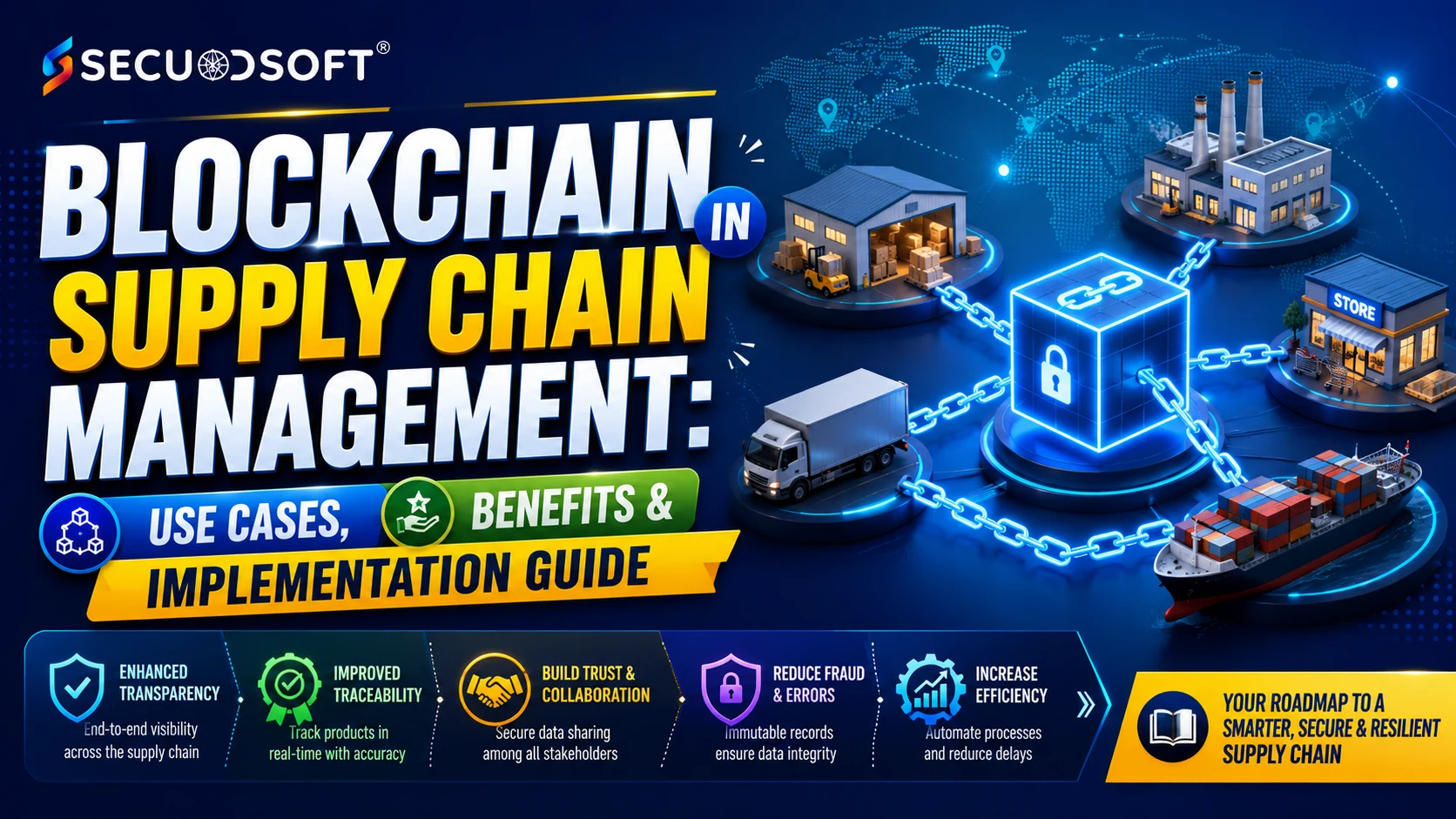
Supply chains have become increasingly complex, involving manufacturers, suppliers, distributors, logistics providers, warehouses, retailers, regulators, and customers across multiple locations. Blockchain in Supply Chain Management provides a way for these participants to share a trusted, tamper-resistant record of transactions, product movements, certifications, and other important events. Instead of relying entirely on disconnected databases, spreadsheets, emails, and paper documents, organizations can use blockchain to create a shared source of information across participating parties. Recent industry and research work highlights traceability, data integrity, transparency, and real-time visibility as major areas where blockchain can improve supply chain operations.
The technology is particularly valuable where businesses need to prove where a product came from, verify that information has not been altered, reduce disputes, or coordinate activities between organizations that do not share the same systems. From pharmaceutical distribution and food traceability to manufacturing, logistics, retail, and international trade, blockchain supply chain solutions are increasingly being explored for practical business applications. However, blockchain is not a universal replacement for ERP, warehouse, or logistics systems. Its value comes from using a shared ledger where multiple parties need trustworthy records and coordinated processes.
Blockchain in supply chain management refers to using distributed ledger technology to record and share supply chain events across authorized participants. Each relevant transaction or event can be recorded on the blockchain, creating a chronological and tamper-resistant history.
For example, a pharmaceutical product can generate multiple digital records as it moves through the supply chain:
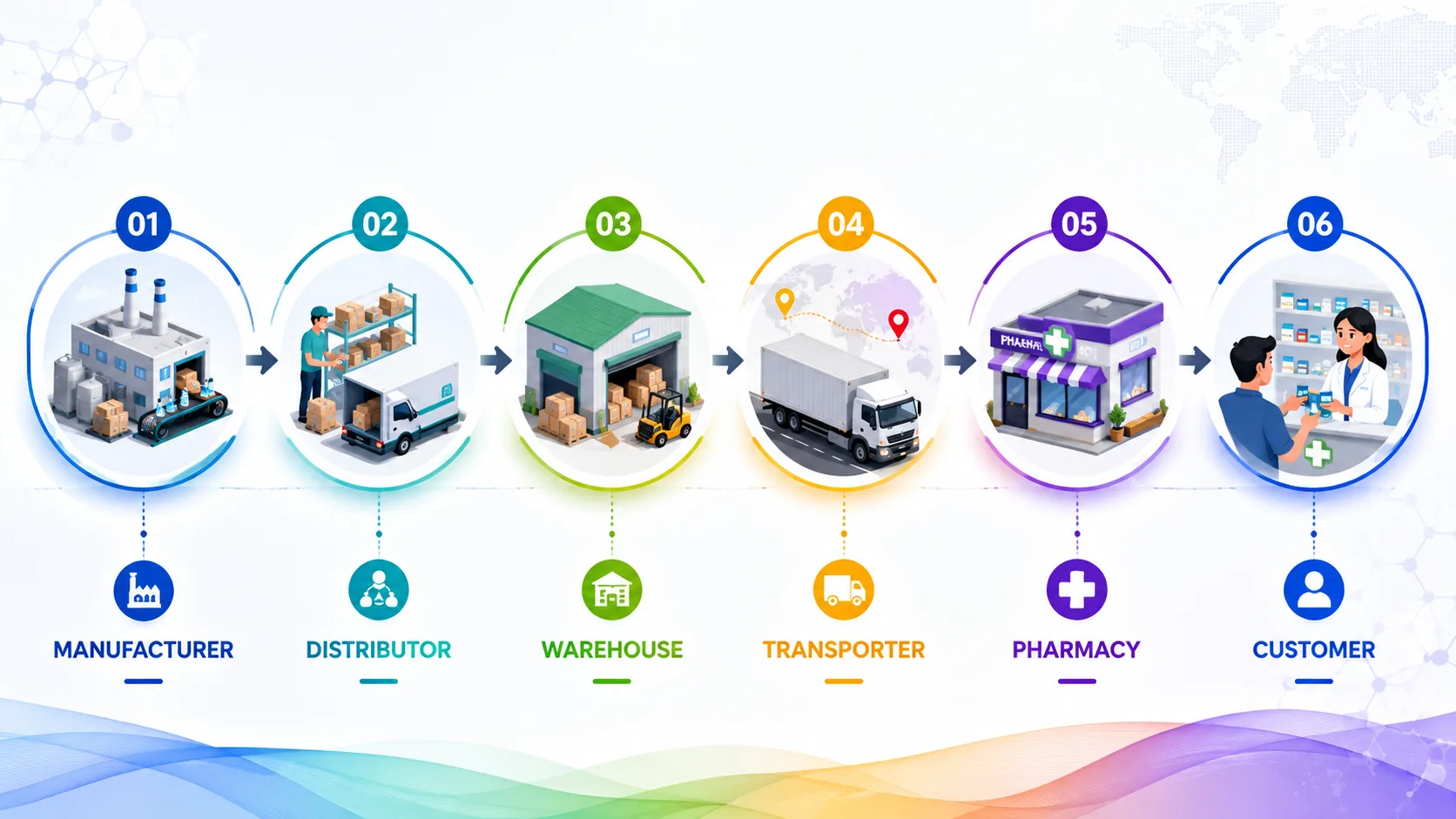
Information such as batch numbers, manufacturing dates, shipment details, certifications, ownership transfers, and delivery events can be linked to the product's digital history.
Blockchain does not automatically guarantee that every piece of information entered is correct. Instead, it provides a stronger mechanism for preserving and sharing information once it has been recorded. This distinction is important when designing a real-world blockchain supply chain system.
A typical blockchain-enabled supply chain can work through the following process:
When combined with IoT sensors, blockchain can also record information such as location, temperature, and environmental conditions. IBM, for example, describes blockchain and IoT as complementary technologies for tracking assets and recording shipment and environmental information.
Traditional supply chains often operate through multiple independent systems. A manufacturer may use one ERP platform, a logistics provider another system, a distributor a spreadsheet, and a retailer a separate inventory platform.
This fragmentation creates several problems:
Blockchain can provide a shared record that participating organizations can access according to predefined permissions. This can reduce the need to repeatedly reconcile information across disconnected systems.
However, successful implementation requires collaboration among participants. Industry guidance also identifies legacy-system integration, participation across the network, and organizational change as important adoption challenges.
Product traceability is one of the strongest use cases for blockchain supply chain technology.
Businesses can record important events throughout a product's lifecycle, helping them determine:
This is particularly valuable in industries where provenance matters, including food, pharmaceuticals, luxury goods, and manufacturing.
If a quality problem occurs, companies can use the recorded history to identify potentially affected batches more efficiently.
Counterfeit goods create financial, legal, and reputational risks.
Blockchain can help establish a verifiable product history by associating physical products with digital identities such as QR codes, RFID tags, serial numbers, or other identifiers.
A customer or authorized business partner can verify whether a product's recorded history corresponds with its expected supply chain journey.
Blockchain does not physically prevent counterfeit goods from entering the market, but it can make verification and provenance tracking more difficult to manipulate.
Large organizations may work with hundreds or thousands of suppliers.
Blockchain can help maintain verifiable records of:
This creates a more transparent supplier ecosystem and can simplify audits.
Blockchain can provide a shared record of shipment events across manufacturers, logistics companies, customs authorities, distributors, and customers.
Instead of every organization maintaining separate records, authorized participants can reference a common transaction history.
When blockchain is combined with IoT devices, sensor data can provide additional visibility into shipment conditions. For example, temperature-sensitive goods can be monitored during transportation, while relevant events can be recorded for later verification.
Smart contracts are programmable rules that can automatically execute predefined actions when specified conditions are met.
For example:
Delivery confirmed → Quality requirements verified → Payment released
Smart contracts can potentially automate:
This can reduce manual intervention and shorten transaction cycles.
Blockchain can improve inventory visibility when multiple organizations need to share information about products moving through a network.
Businesses can record inventory-related events such as:
When integrated with ERP, warehouse management, and IoT systems, blockchain can become part of a broader digital supply chain architecture.
Supply chain finance involves multiple parties, financial transactions, invoices, and payment obligations.
Blockchain can provide a shared record of relevant transactions, potentially reducing reconciliation and documentation requirements.
For example, once delivery information is verified, a financing or payment process could be triggered through predefined rules.
This can improve transparency between buyers, suppliers, and financial institutions.
Food and pharmaceutical supply chains require strict handling conditions.
Blockchain can record information associated with:
IoT sensors can collect environmental information while blockchain provides a tamper-resistant record of relevant events.
This combination can strengthen accountability and make investigations easier when products fail quality requirements.
International trade involves substantial documentation, including invoices, shipping records, certificates, customs information, and compliance documents.
Blockchain can provide a shared digital record that authorized parties can reference.
The objective is not necessarily to eliminate existing systems such as EDI, but to improve coordination and trust across a multi-party environment. IBM notes that blockchain and EDI can complement one another as organizations modernize supply chain data exchange.
When a defective or contaminated product reaches the market, companies need to determine which products and batches are affected.
A blockchain-based traceability system can provide a detailed product history that helps organizations identify relevant supply chain events and participants.
This can support faster investigations and more targeted recalls.
| Benefit | Business Impact |
|---|---|
| Greater transparency | Participants can verify shared supply chain records |
| Better traceability | Products can be tracked across multiple stages |
| Improved data integrity | Recorded transactions become harder to manipulate |
| Faster reconciliation | Shared records reduce duplicate verification |
| Fraud reduction | Stronger provenance and transaction verification |
| Automation | Smart contracts can automate predefined processes |
| Better compliance | Digital records simplify audits and verification |
| Improved collaboration | Multiple organizations can coordinate using shared information |
| Faster dispute resolution | Participants have a common transaction history |
| Better customer trust | Product origin and history can be more easily verified |
The biggest value is often not blockchain alone, but the combination of shared data, standardized processes, automation, and improved visibility.
Blockchain should not automatically replace existing supply chain software.
A traditional ERP or supply chain management platform may remain the primary system for managing internal operations, while blockchain acts as a shared trust and verification layer between organizations.
| Area | Traditional Systems | Blockchain-Based Approach |
|---|---|---|
| Data ownership | Usually organization-specific | Shared among authorized participants |
| Visibility | Often limited between organizations | Greater network-level visibility |
| Records | Can be modified within system permissions | Tamper-resistant transaction history |
| Reconciliation | Often required between systems | Shared ledger can reduce reconciliation |
| Automation | Depends on application | Smart contracts can automate predefined rules |
| Traceability | Depends on system integration | Shared transaction history can improve provenance |
| Integration | ERP/WMS-focused | Can connect ERP, IoT, APIs, and other systems |
The right approach depends on the business problem. If only one organization needs a database, blockchain may add unnecessary complexity. If multiple independent parties need a trusted shared record, blockchain becomes more compelling.
Successful blockchain implementation should begin with the business process, not the technology.
Determine what you actually want to solve.
Examples include:
Avoid implementing blockchain simply because it is a trending technology.
Map everyone who needs to contribute or access information.
This could include:
Blockchain delivers greater value when the participating network and governance model are clearly defined.
Most enterprise supply chain projects require careful consideration of permissioned versus public blockchain architectures.
A permissioned network can provide controlled access, which may be appropriate when businesses need privacy and governance over who can participate.
The architecture should consider:
Blockchain rarely operates in isolation.
It may need to integrate with:
This integration layer is critical because blockchain only becomes useful when reliable operational data can enter and leave the network.
Define the business rules that should be automated.
For example:
If shipment is delivered and quality conditions are verified, release payment.
Smart contracts should be carefully tested because errors in automated business logic can create operational and financial consequences.
Rather than deploying blockchain across the entire supply chain immediately, select one high-value process.
For example:
One product → One supplier network → One logistics route → One blockchain pilot
Measure the results before expanding.
Important KPIs include:
The goal should be measurable business improvement, not blockchain adoption itself.
Blockchain offers significant potential, but organizations should understand its limitations.
Existing ERP and logistics systems may have been built years before blockchain was considered. Connecting these systems requires APIs, middleware, data mapping, and careful testing.
A blockchain network becomes more useful when relevant participants participate. Convincing suppliers, logistics providers, and other partners to adopt new systems can be difficult.
Blockchain protects recorded information from unauthorized alteration, but it does not automatically verify whether the original information was accurate.
If incorrect data enters the system, the blockchain can preserve incorrect data very effectively.
Large supply chains may generate enormous volumes of transactions and sensor data. Architecture must therefore be designed carefully to avoid unnecessary blockchain storage and processing.
Organizations need clear rules covering:
Blockchain implementation requires investment in development, integration, infrastructure, security, governance, and training. It should therefore be justified by a specific business case.
The next phase of blockchain supply chain development is likely to focus less on blockchain as an isolated technology and more on how it works with other digital systems.
Blockchain can increasingly act as a verification layer alongside:
Recent 2026 research is examining blockchain-enabled supply chains alongside real-time optimization and decision-support systems, reflecting a broader movement toward connected and data-driven supply chain operations.
AI can analyze supply chain data and identify patterns, while IoT can capture real-world events such as location and temperature. Blockchain can provide a trusted record of relevant events and transactions.
This combination could create more intelligent supply chains where businesses don't simply track what happened, they can analyze why it happened and automate appropriate responses.
Building a blockchain-based supply chain platform requires more than blockchain development expertise. It requires an understanding of business workflows, enterprise integration, data security, smart contracts, APIs, and the operational realities of multi-party supply networks. Secuodsoft approaches blockchain projects by first identifying the business process that needs improvement and then designing the technology architecture around measurable outcomes such as traceability, transparency, automation, and operational efficiency.
From blockchain-based applications and smart contracts to enterprise integrations and custom software platforms, the development approach can be tailored to the organization's existing technology ecosystem. This helps businesses adopt blockchain where it creates genuine value rather than introducing unnecessary complexity into processes that can already be handled effectively by conventional software.
Blockchain in Supply Chain Management can help organizations create greater transparency, improve product traceability, strengthen data integrity, automate selected processes, and build greater trust between supply chain participants. Its strongest applications include provenance tracking, counterfeit prevention, logistics visibility, supplier verification, smart contracts, cold-chain monitoring, trade documentation, and supply chain finance. However, blockchain is not a replacement for every ERP or supply chain system; its real value emerges when multiple independent parties need a shared and verifiable record.
For businesses considering blockchain adoption in 2026, the best approach is to start with a clearly defined operational problem, evaluate whether blockchain is actually appropriate, integrate it with existing systems, pilot the solution, and measure business outcomes before scaling. When combined strategically with IoT, AI, cloud platforms, and enterprise software, blockchain can become an important component of a more transparent, connected, and resilient digital supply chain.
Copyright ©2026 Secuodsoft. All rights reserved.