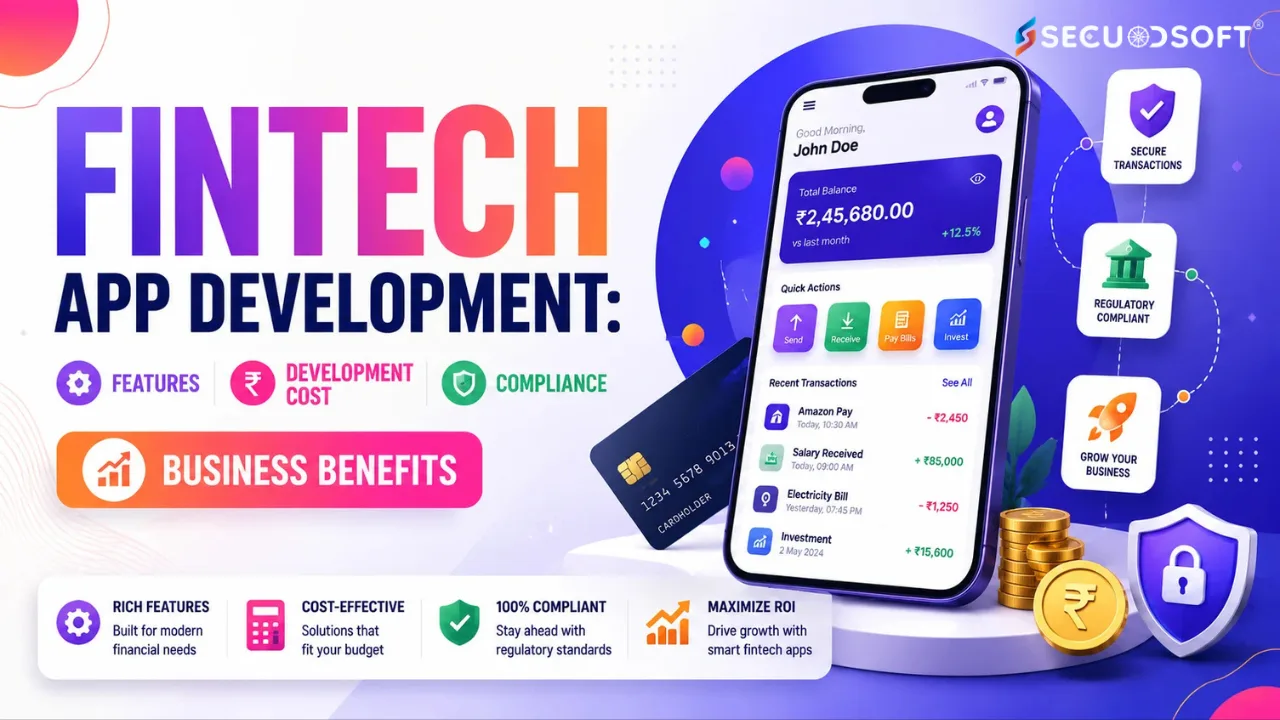
India's digital payments market reached ₹420 lakh crore in transaction value in 2024, with 75% growth projected through 2026. Yet this explosive opportunity masks a critical reality: 87% of FinTech app development projects either fail to achieve profitability or never launch successfully. The culprits aren't technical, they're regulatory. Developers underestimate compliance complexity, overestimate timeline feasibility, and discover mid-development that mandatory security certifications require three-month waiting periods they didn't budget for.
The FinTech space in 2026 isn't for cautious businesses building incrementally. It demands sophisticated understanding of regulatory requirements, security imperatives that cost ₹20-50 lakhs alone, and features that differentiate in a crowded market. Yet businesses that navigate these successfully capture extraordinary market opportunities. A payment app capturing just 0.1% of India's digital payment market represents ₹4.2 lakh crore transaction volume. A lending platform connecting to just 1,000 lenders processes ₹500+ crore monthly. The opportunity scale justifies the complexity.
This comprehensive guide details exactly what FinTech app development entails in 2026, from mandatory compliance requirements through essential features to realistic development costs and proven revenue models that actually generate returns.
FinTech applications collectively control ₹500+ lakh crore in transaction volume, representing 45% of total financial services market. Unlike traditional software markets where 15-25% growth is considered exceptional, FinTech markets grow 40-80% annually. This growth scale attracts venture capital aggressively, ₹12,000+ crore invested in Indian FinTech startups through 2024, with acceleration continuing through 2026.
The competitive intensity notwithstanding, success requires understanding the regulatory foundations first.
While many startups begin with ready-made financial software, growing FinTech businesses often discover that scalability, compliance, and product differentiation require a tailored Custom Software Development Services allows organizations to build platforms that align with unique business models, integrate seamlessly with banking APIs, meet evolving regulatory requirements, and support long-term innovation without the limitations of generic software solutions.
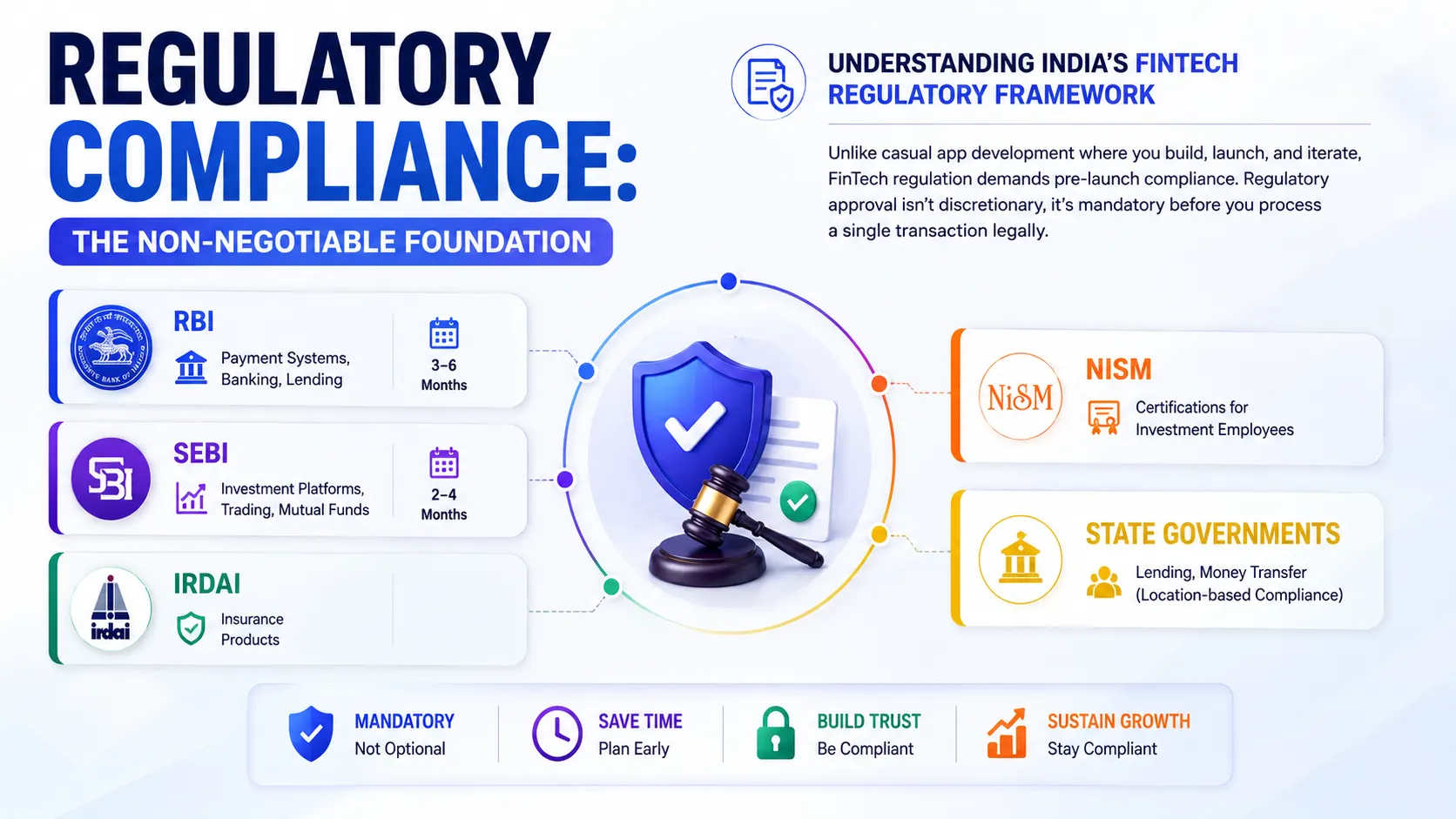
Unlike casual app development where you build, launch, and iterate, FinTech regulation demands pre-launch compliance. Regulatory approval isn't discretionary, it's mandatory before you process single transaction legally.
Every financial transaction requires identity verification. Your app must implement:
Implementation cost: ₹10-30 lakhs depending on verification methods deployed
Development timeline: 4-8 weeks
Regulatory requirement: Non-negotiable for any money movement
Your app must prevent movement of illicit funds:
Implementation cost: ₹15-40 lakhs for sophisticated AML systems
Development timeline: 6-10 weeks
Regulatory requirement: Mandatory, with strict penalties for violations
The Digital Personal Data Protection (DPDP) Act 2023 requires:
Regulatory compliance alone does not guarantee application security. Financial platforms must continuously defend against evolving cyber threats including credential theft, API attacks, ransomware, account takeovers, and payment fraud. Investing in professional Cybersecurity Services helps organizations perform vulnerability assessments, penetration testing, security monitoring, and compliance validation to reduce operational risks while protecting customer trust.
Implementation cost: ₹20-50 lakhs for comprehensive security architecture
Development timeline: 8-12 weeks
Regulatory requirement: Mandatory with compliance audits required annually
| Compliance Area | Requirements | Cost Range |
|---|---|---|
| SSL/TLS Encryption | HTTPS everywhere, TLS 1.3 minimum | ₹2–5 Lakhs |
| API Security | Rate limiting, authentication, input validation | ₹5–15 Lakhs |
| Biometric Authentication | Fingerprint/Face Recognition | ₹10–25 Lakhs |
| Transaction Limits | Velocity checks, amount limits | ₹3–8 Lakhs |
| Fraud Detection | ML-based anomaly detection | ₹15–40 Lakhs |
| Audit Trails | Complete transaction logging | ₹5–10 Lakhs |
| Disaster Recovery | Backup systems, RTO/RPO compliance | ₹10–25 Lakhs |
Total compliance infrastructure: ₹70-178 lakhs (25-35% of total development cost)
Users store money in app-based wallets, transfer between accounts, withdraw to bank accounts. Core functionality requiring:
Development cost: ₹20-40 lakhs
Revenue model: Charge 1-2% on P2P transfers, commission on settlements
Your app processes payments through payment gateways (Razorpay, PayU, Instamojo). Integration requires:
Development cost: ₹15-30 lakhs
Revenue model: Commission on each transaction (0.5-2%)
NEFT, RTGS, IMPS transfer capabilities enabling instant money movement:
Development cost: ₹20-35 lakhs
Revenue model: Small commission per transfer (₹5-50)
For investment-focused apps:
Development cost: ₹40-80 lakhs (requires significant data integration)
Revenue model: Percentage of assets under management (0.25-1%)
For lending-focused apps:
Development cost: ₹35-70 lakhs
Revenue model: Commission on loan origination (1-3%)
Essential for any money movement app:
Artificial intelligence has become one of the biggest competitive advantages in modern FinTech platforms. Beyond fraud detection, AI enables intelligent credit scoring, personalized financial recommendations, transaction categorization, customer support automation, and predictive risk analysis. AI Development Services can significantly improve operational efficiency while delivering smarter and more personalized financial experiences.
Development cost: ₹25-50 lakhs
Revenue model: Reduces fraud losses by 60-80% = indirect revenue protection
Simple money transfer between users with basic features:
Timeline: 16-20 weeks
Team: 4-6 developers, 1 QA, 1 compliance officer
Monthly operational cost: ₹3-8 lakhs (RBI gateway fees, cloud hosting, support)
Annual runway before profitability: ₹50-100 lakhs
Feature-rich platform with investment, lending, or specialized services:
Timeline: 20-28 weeks
Team: 8-12 developers, 2-3 QA, compliance specialist, product manager
Monthly operational cost: ₹8-15 lakhs
Annual runway before profitability: ₹100-200 lakhs
Comprehensive platform handling diverse services at enterprise scale:
Timeline: 28-40 weeks
Team: 15-25 developers, 4-6 QA, dedicated compliance/security, data engineers
Monthly operational cost: ₹15-30 lakhs
Annual runway before profitability: ₹200-400 lakhs
| Component | Basic App | Mid-Market | Enterprise |
|---|---|---|---|
| Development | ₹15–25L | ₹30–60L | ₹60–150L |
| Compliance Setup | ₹5–10L | ₹15–30L | ₹30–50L |
| Security Infrastructure | ₹3–8L | ₹10–20L | ₹20–40L |
| Third-Party Integrations | ₹2–5L | ₹8–15L | ₹15–30L |
| Testing & QA | ₹2–4L | ₹5–10L | ₹10–20L |
| Deployment & Support | ₹1–3L | ₹3–8L | ₹8–15L |
Users pay commission on financial transactions (transfers, payments, trading). Highest-volume revenue model used by Paytm, PhonePe.
Profitability model: 50 lakhs monthly transactions × ₹1.50 average commission = ₹75 lakh monthly revenue
Premium features behind subscription paywalls. Used by investment apps and lending platforms.
Profitability model: 100,000 active users × 2% premium conversion × ₹500 average subscription = ₹1 crore annual revenue
Lend at 15-20% to borrowers, pay 5-8% to lenders. Capture 7-15% spread.
Profitability model: ₹100 crore loan portfolio × 10% average spread = ₹10 crore annual profit
Investment platforms charge 0.25-1% annually on assets managed.
Profitability model: ₹1,000 crore AUM × 0.5% fee = ₹5 crore annual revenue
Premium merchants or investment products pay for featured placement.
Profitability model: 20-50 premium partners × ₹1-10 lakh monthly sponsorship = ₹2-5 crore annual revenue
| Metric | Typical Range |
|---|---|
| Development Investment | ₹25L–₹100L |
| First-Year Revenue | ₹50L–₹300L |
| Break-Even Timeline | 18–36 Months |
| User Acquisition Cost | ₹50–₹300 per User |
| Lifetime Value (User) | ₹500–₹5,000 |
| Month-on-Month Growth | 8–15% (Sustainable) |
| 5-Year Revenue Potential | ₹10–₹500 Crore |
Success factors: Strong product-market fit, viral/referral-driven user acquisition, disciplined unit economics, focused feature scope in early stages.
At Secuodsoft, we help startups, financial institutions, NBFCs, payment companies, and enterprises build secure, scalable, and feature-rich FinTech applications. Our development approach combines modern technologies, AI capabilities, cloud infrastructure, and enterprise-grade cybersecurity to deliver digital financial solutions that meet evolving customer expectations and regulatory requirements.
From mobile banking and digital wallets to lending platforms, investment applications, insurance solutions, and payment systems, we build FinTech products that are designed for performance, security, and future scalability.
FinTech app development is no longer limited to banks and large financial institutions. From digital wallets and lending platforms to investment apps, insurance solutions, and embedded finance products, businesses across industries are leveraging financial technology to deliver faster, more secure, and highly personalized customer experiences. The success of any FinTech application depends on balancing innovation with security, regulatory compliance, scalability, and exceptional user experience from the very beginning.
Whether you're building a new financial product or modernizing an existing platform, partnering with an experienced FinTech app development company can significantly reduce development risks while accelerating time to market. By choosing the right technology stack, prioritizing compliance, and focusing on long-term scalability, businesses can create secure, future-ready FinTech applications that drive customer trust, operational efficiency, and sustainable growth in an increasingly competitive digital financial ecosystem.
Copyright ©2026 Secuodsoft. All rights reserved.